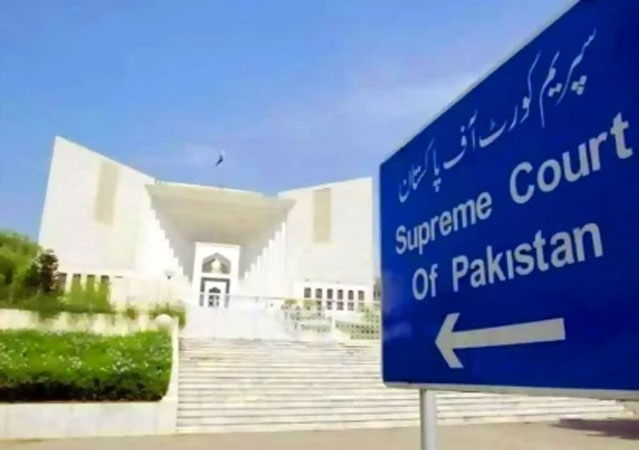
 Supreme Court judge Athar Minallah, in his dissenting opinion, has stated that individuals of law enforcement agencies involved in extra-judicial killings, enforced disappearances and custodial torture deserve the severest punishment under the law.
“Enforced disappearances, extra-judicial killings, custodial torture and murders, and excessive use of force are the most intolerable crimes in a democratic society and the worst forms of violations of the Constitution and the fundamental rights guaranteed therein.
“There can be no tolerance for such acts and conduct by law enforcement agencies and their members, and such cases warrant the imposition of the severest punishment when guilt is proved,” Justice Minallah wrote in his note, upholding the death sentence of a Frontier Corps (FC) Balochistan soldier.
However, the majority judges converted his death sentence to life imprisonment.
According to the case record, a young university student, Mohammad Hayat, was deprived of his life in a gruesome, brutal and shocking manner while he was in the custody of armed members of a paramilitary force. It was a case of extra-judicial custodial killing of an innocent citizen, committed in Turbat district of Balochistan.
Justice Minallah observed that in a society where grievances relating to enforced disappearances, excessive use of force, abuse of power, extra-judicial killings and violations of fundamental rights by law enforcement agencies are widespread, granting impunity for crimes committed against citizens becomes the most aggravated form of transgression of law.
“The gravity intensifies when a citizen falls victim to aggression by a law enforcement agency or its officers. Any such act or conduct is intolerable in a society governed under the Constitution. The rule of law is eroded when the law enforcers take the law into their own hands and arrogate to themselves the role of judge and executioner. This is exactly what happened in this case,” he noted.
Responding to the objection regarding the FC member’s trial in a civilian court, Justice Minallah said it was neither in the public interest nor in the interest of national security to refer such trials to military courts where the rights of citizens are involved.
“The scheme of the Constitution unambiguously contemplates shielding the armed forces from being exposed to controversies involving civilians. The Constitution restricts the role and functions of the armed forces under Article 245 to the defence of Pakistan against external aggression and, subject to law, to act in aid of civil power when called upon to do so,” he said.
He emphasized that public trust in paramilitary forces, especially when commanded by serving army officers, was crucial for the discharge of their constitutional duties.
“In this case, a young university student was a victim of extrajudicial custodial killing by a member of a paramilitary force commanded by serving officers of the Pakistan Army,” he noted.
He further stated that the appellant and FC Balochistan were governed by a special statute – the Frontier Corps Ordinance, 1959 – and that the Sessions Court had full jurisdiction to conduct the trial.
“In the facts and circumstances of this case, trial before a military court would have been against the public interest, illegal and unconstitutional,” he added.
On the question of sentencing, Justice Minallah wrote that deterrent punishment is not only necessary to reflect the gravity of the crime but also to make the offender an example for others as a preventive measure for the protection of society.
“In heinous crimes committed with premeditation and brutality, no leniency ought to be shown. A sentence of death creates deterrence in society so that no one dares to commit murder.
“When guilt is proven beyond any shadow of doubt, taking a lenient view jeopardizes peace and opens the door to lawlessness. Courts must not hesitate to award maximum punishment where warranted.”
He noted that sentencing discretion must be exercised judiciously and that life imprisonment instead of death requires strong reasons recorded by the court. “Punishment must commensurate with the gravity of the crime,” he stressed.
Justice Minallah also highlighted the statutory role of the FC. A reading of the Ordinance of 1959 shows that the Frontier Corps, Balochistan was established primarily to protect and administer Pakistan’s external frontiers.
“The purpose of its existence is to protect citizens against external aggression, enemies, hostile entities and collaborators. Command and control rest exclusively with the federal government, which appoints senior officers, including the Inspector General, who are seconded from the Pakistan Army.
“The FC is a disciplined paramilitary law enforcement force whose duty is to protect citizens. Its officers and members are armed solely to defend the people and the state,” he noted.
He said that as a uniformed disciplined force, FC personnel are expected to maintain exemplary conduct, professionalism and integrity while dealing with civilians.
“They enjoy a position of authority and trust, and therefore owe a fiduciary duty to the people. Breach of this duty has grave consequences for society and the FC itself.
“The appellant, as a trained member of the FC, was expected to protect the victim, not kill him. The firearm issued to him was meant exclusively for defence, not for unlawful use against citizens,” he concluded.