• Skip to primary navigation
  • Skip to main content
  • Skip to primary sidebar
  • Skip to footer
Trending:
  • Kashmir
  • Elections
Tuesday, June 9, 2026

Daily Times

Your right to know

  • HOME
  • Latest
  • Iran-Israel war
  • Gilgit Baltistan Election
  • Pakistan
    • Balochistan
    • Gilgit Baltistan
    • Khyber Pakhtunkhwa
    • Punjab
    • Sindh
  • World
  • Editorials & Opinions
    • Editorials
    • Op-Eds
    • Commentary / Insight
    • Perspectives
    • Cartoons
    • Letters to the Editor
    • Featured
    • Blogs
      • Pakistan
      • World
      • Lifestyle
      • Culture
      • Sports
  • Business
  • Sports
  • E-PAPER
    • Lahore
    • Islamabad
    • Karachi

South Korean scientists create artificial muscle 4,000 times stronger than its weight

Published on: November 4, 2025 4:51 PM

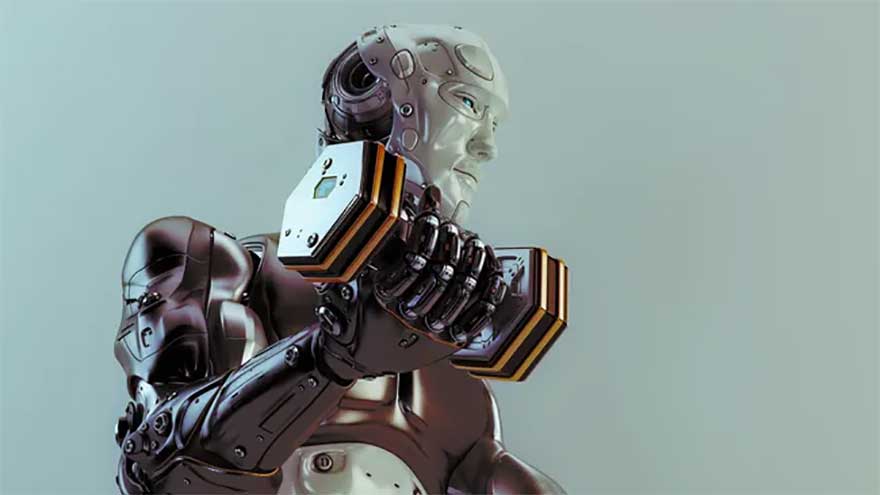
Humanoid robots could lift 4,000 times their own weight
In a stunning scientific breakthrough, researchers in South Korea have created an artificial muscle that can lift around 4,000 times its own weight, marking a revolutionary step toward the development of more lifelike humanoid robots and wearable technologies.

The research team at the Ulsan National Institute of Science and Technology (UNIST), led by Professor Hoon Eui Jeong, published their findings in the journal Advanced Functional Materials on September 7. Their innovation lies in overcoming a long-standing limitation in robotics — creating muscles that are both strong and flexible.

Read More: Things to know about an AI safety summit in Seoul

Traditional artificial muscles are typically either stretchable but weak or strong but rigid. However, Jeong’s team engineered a “high-performance magnetic composite actuator” — a polymer-based material that can adjust its stiffness depending on the task. This allows the artificial muscle to become rigid when lifting heavy loads and soft when contracting or moving.

Weighing just 1.13 grams (0.04 ounces), the muscle can lift up to 5 kilograms (11 pounds) — roughly 4,400 times its own weight. It also exhibits 86.4% strain, more than double that of human muscle, and achieves a work density of 1,150 kJ/m³, which is 30 times greater than human tissue.

Read More: Scientists build climate ‘time machine’ in Amazon to study future earth

According to the researchers, this dual cross-linking structure — combining chemical and physical bonding networks — provides the material with exceptional durability and adaptability. The incorporation of magnetic microparticles (NdFeB) further enables external control, allowing for precise manipulation through magnetic fields.

Professor Jeong said the development could pave the way for “more versatile soft robots, wearable devices, and intuitive human–machine interfaces.” Scientists believe this innovation could revolutionize industries ranging from medical rehabilitation and exoskeletons to next-generation robotics and space technology.

Filed Under: Technology Tagged With: Artificial Intelligence, Humanoid robots, Innovation, Latest, robotics, South Korea, technology, UNIST

Submit a Comment


Primary Sidebar


Latest News

Afghanistan blast tragedy claims seven lives

Election results halted in five GB constituencies

NATO boosts defence of Finland, Sweden

Powerful quake kills 35 in Philippines

Israeli military widens Gaza control area

Pakistan

Election results halted in five GB constituencies

Pakistan vows self-defence against Afghanistan-based militants

Pakistan eyes INSTC, Gwadar link with Russia

Karachi heatwave warning as temperature may reach 43°C

CDF Munir vows expanded Lebanon defence ties

More Posts from this Category

Business

IT ministry secures Rs22bn development budget without cuts

PM Shehbaz pushes faster Discos privatisation

McDonald’s tests Archy AI to transform drive-thru experience

Apple brings custom EQ controls to latest AirPods

PSX rebounds sharply after volatile session

More Posts from this Category

World

Afghanistan blast tragedy claims seven lives

NATO boosts defence of Finland, Sweden

Powerful quake kills 35 in Philippines

More Posts from this Category


Footer

Home
Lead Stories
Latest News
Editor’s Picks

Culture
Life & Style
Featured
Videos

Editorials
OP-EDS
Commentary
Advertise

Cartoons
Letters
Blogs
Privacy Policy

Contact
Company’s Financials
Investor Information
Terms & Conditions

Facebook
Twitter
Instagram
Youtube

© 2026 Daily Times. All rights reserved.

We use cookies to ensure that we give you the best experience on our website. If you continue to use this site we will assume that you are happy with it.