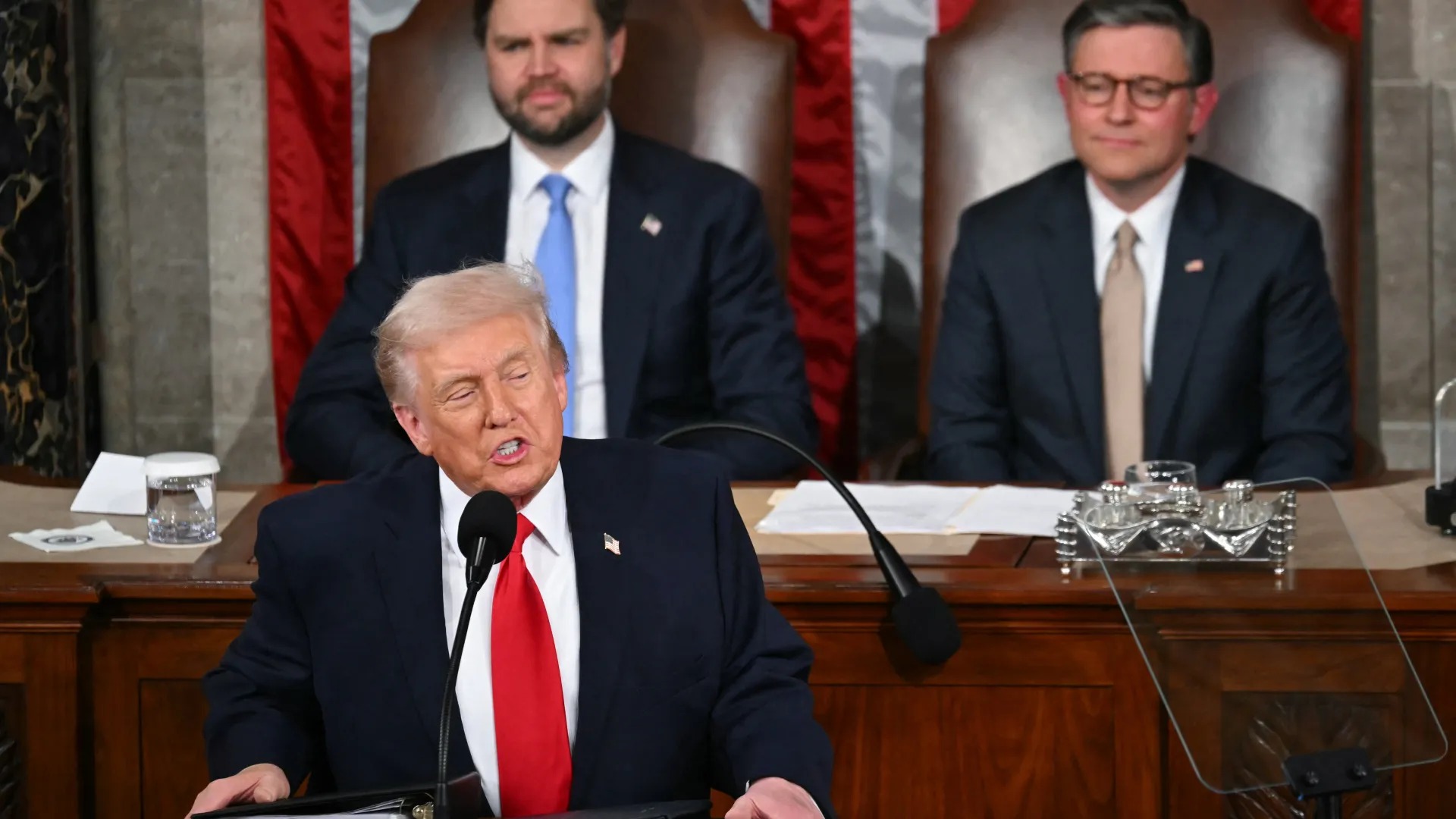
US President Donald Trump’s claim that Iran is on the verge of developing missiles capable of striking the United States appears unsupported by official intelligence reports. Sources familiar with the assessments say his statement exaggerates the threat. Unclassified 2025 US Defense Intelligence Agency reports indicate Iran could take until 2035 to develop a militarily viable intercontinental ballistic missile from its existing space-launch vehicles. The discrepancy raises questions about the accuracy of public statements regarding imminent military action.
During his recent State of the Union address, Trump cited Iran’s missile and nuclear programmes, along with its support for militant groups, as justification for possible US strikes. He asserted that Tehran’s missiles would soon reach American soil, but sources indicate there is no evidence of an operational ICBM currently under development. Officials note that even with potential assistance from China or North Korea, Iran would need several years to produce a fully functional intercontinental ballistic missile. Analysts emphasize the technical complexity of converting space-launch vehicles into operational ICBMs.
Read more : US government accused of major ‘cover-up’ over Trump sex abuse …
Iranian officials have rejected claims of expanding missile capabilities, with Foreign Minister Abbas Araghchi stating the country maintains missiles with a maximum range below 2,000 kilometers for defensive purposes only. He stressed that Iran does not intend to develop a global threat, asserting that its missile programme is purely for deterrence. Observers note that Iran possesses the largest ballistic missile force in the Middle East, capable of striking Israel, US bases in the region, and parts of Europe. Nevertheless, its technology remains far from operational ICBM status.
Experts also highlight the challenges Iran would face in developing re-entry vehicles capable of carrying nuclear warheads safely through the atmosphere. While the country has launched satellites using space-launch vehicles, converting these to deliver nuclear payloads requires substantial technical advances. David Albright, a former UN nuclear inspector, noted that Israeli airstrikes in 2024 and 2025 damaged key missile production facilities, further slowing progress. This has reinforced the assessment that Iran remains years away from producing an operational long-range nuclear missile.
Read more : Trump lays out case for possible attack on Iran in State of the Union …
Meanwhile, US Secretary of State Marco Rubio described Iran’s capabilities in more measured terms, stating the country is on a pathway toward developing weapons that could potentially reach the US. This contrasts with Trump’s urgent warnings of immediate threat. The ongoing negotiations between the US and Iran over Tehran’s nuclear programme continue amid heightened tensions. Intelligence and international monitoring, including assessments from the International Atomic Energy Agency, indicate Iran’s nuclear weapons programme was shuttered in 2003, although uranium enrichment continues under civilian pretenses.
The situation underscores the gap between political rhetoric and intelligence assessments, as officials stress Iran’s current capabilities do not support claims of an imminent ICBM threat. While Trump’s warnings heighten public concern, analysts urge caution and careful evaluation of technical realities. Ongoing surveillance and verification remain essential to monitor Iran’s long-term missile and nuclear developments. Regional security depends on balancing diplomacy, accurate intelligence, and measured responses to perceived threats.