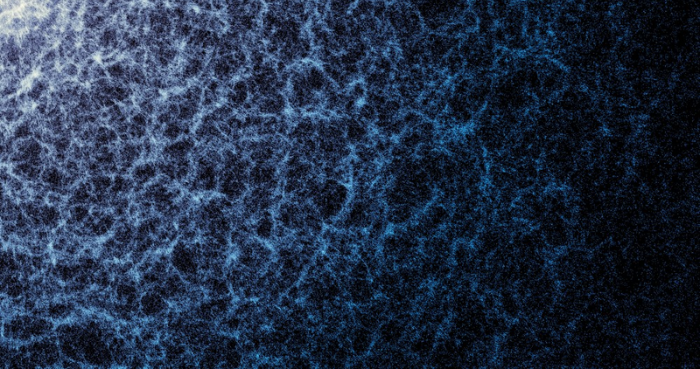
WASHINGTON: The Dark Energy Spectroscopic Instrument (DESI) has produced the largest high-resolution 3D map of the universe to date, offering scientists an unprecedented dataset to study the structure and expansion of the cosmos.
Read More: 5,000 Locally Assembled Units by Nishat Group and Omoda & Jaecoo
Over a five-year observation period, DESI recorded data from more than 47 million galaxies and quasars, along with 20 million stars. The massive survey provides one of the most detailed views of the universe ever assembled, enabling researchers to trace cosmic evolution across vast distances and time.
This image shows a small portion of DESI’s year-five map in which the large-scale structure of the Universe, created by gravity, is visible. Each dot represents a galaxy.
The denser areas indicate regions where galaxies and galaxy clusters have clumped together to form the…
— Curiosity (@CuriosityonX) April 16, 2026
Installed on the Nicholas U. Mayall 4-m Telescope at Kitt Peak National Observatory in Arizona, the instrument began collecting data in 2021. It uses 5,000 robotically controlled optical fibers connected to advanced spectrographs, allowing it to capture light from thousands of celestial objects simultaneously.
Scientists use this spectroscopic data to measure redshift, which shows how fast galaxies are moving away from Earth. By comparing galaxy clustering patterns from different cosmic epochs, researchers aim to better understand the role of dark energy in the universe’s expansion.
A 2024 study based on early DESI data suggested that the expansion rate of the universe may not be constant, raising questions about the standard cosmological model. The newly expanded dataset will allow scientists to further investigate whether the so-called “cosmological constant” could be changing over time.
Michael Levi, director of DESI at Lawrence Berkeley National Laboratory, described the project as “incredibly exciting” and “spectacularly successful,” noting that the instrument performed beyond expectations.
Read More: Positive momentum helps PSX gain nearly 1,400 points
DESI is expected to continue observations until 2028, with plans to extend its cosmic map by an additional 20 percent, covering regions of the sky that are more difficult to observe.
The findings are expected to play a major role in advancing understanding of dark energy and the fundamental forces shaping the universe.