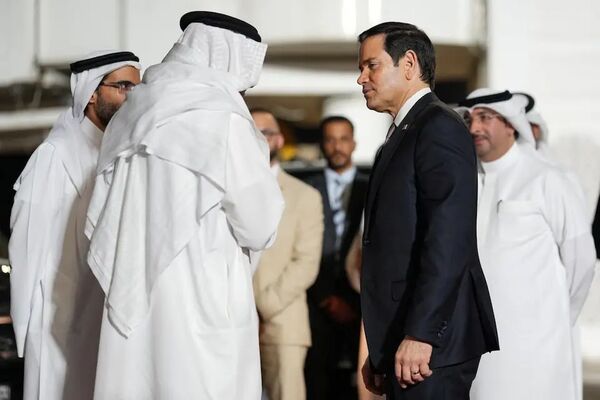
US Secretary of State Marco Rubio arrived in Bahrain on Thursday to seek support for the Trump administration’s preliminary agreement with Iran. The visit marks the final stop of his Gulf tour aimed at reassuring regional allies about the proposed deal. The outcome is significant for Middle East security, regional power dynamics, and global energy markets.
Rubio is scheduled to meet Bahraini officials in Manama and hold discussions with the Gulf Cooperation Council, which includes Saudi Arabia, the United Arab Emirates, Qatar, Kuwait, Oman, and Bahrain. The visit comes amid concerns among Gulf states that excessive concessions to Tehran could strengthen Iran’s regional influence and alter the region’s security balance.
During earlier visits to the UAE and Kuwait, Rubio sought to assure leaders that Washington would not pursue policies that undermine the security of its long-standing partners. He stressed that the proposed agreement was not overly favorable to Iran despite concerns raised by regional governments affected by the recent conflict.
Questions over the framework agreement remain after conflicting statements from Washington and Tehran. US President Donald Trump claimed Iran had agreed to unlimited nuclear inspections, while Iranian officials denied making such commitments. Differences also remain over financial incentives, the Strait of Hormuz, and broader regional security arrangements.
All six GCC countries provided varying levels of logistical support to the United States during the conflict and remain central to Washington’s security strategy in the Middle East. However, some Gulf governments are reportedly concerned that improved US-Iran relations could shift regional power balances. Rubio has also clarified that he is not seeking financial contributions for any proposed reconstruction fund during the current visit.