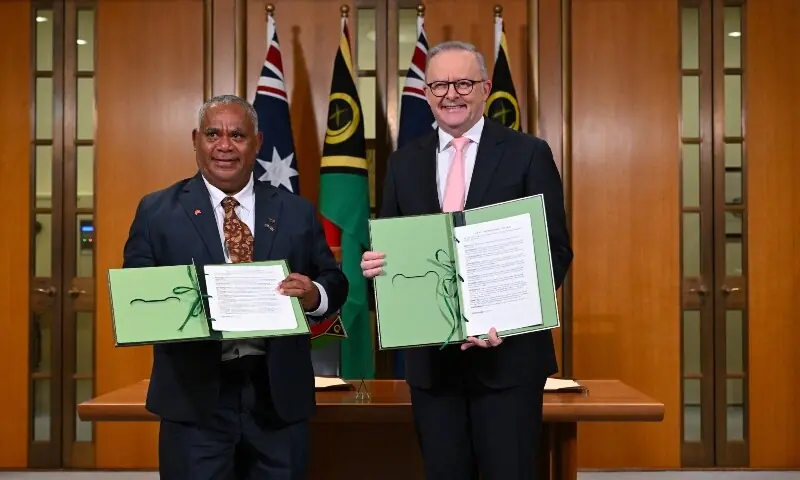
Australia and Vanuatu have signed a wide-ranging economic and security agreement that prohibits the establishment of any foreign military base in the Pacific island nation, marking a significant step in regional security cooperation.
The agreement, known as the Nakamal Agreement, was signed in Canberra by Australian Prime Minister Anthony Albanese and Vanuatu Prime Minister Jotham Napat. Under the deal, Australia will provide Vanuatu with financial support worth A$345 million to strengthen infrastructure, security and development projects.
Speaking after the signing ceremony, Albanese said the agreement provides certainty that no foreign military base will be established in Vanuatu while respecting the country’s sovereignty. Napat described the pact as a balanced arrangement that safeguards both nations’ collective and individual security.
The agreement states that Vanuatu will not allow its territory to be used for any foreign military base or military infrastructure. It also commits the Pacific nation to preventing the militarisation of critical infrastructure.
Australia will assist Vanuatu in developing ports, aviation, energy and digital infrastructure, while both countries will work together on policing, maritime security, cybersecurity, intelligence cooperation and law enforcement training. The agreement also recognises Australia as Vanuatu’s primary policing partner.
The pact comes amid increasing strategic competition in the Pacific, where Australia and its allies have expressed concern over China’s growing security and economic influence. Beijing has previously funded infrastructure projects in Vanuatu, including the expansion of the wharf at Luganville, prompting speculation about potential military use. China and Vanuatu have consistently said the facility was intended for civilian purposes.
Despite the new agreement, Vanuatu said it will continue to maintain economic relations with China and is separately negotiating another economic cooperation agreement with Beijing. Under the pact, Vanuatu will consult Australia when engaging third countries on infrastructure projects.
Analysts say the agreement strengthens Australia’s role in the Pacific but is unlikely to end strategic competition in the region, as Vanuatu continues to pursue a foreign policy based on maintaining relationships with multiple international partners.