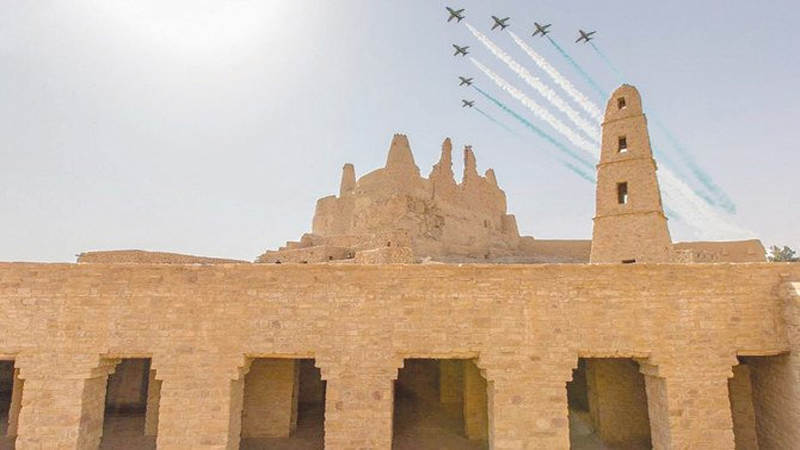
 Al-Jouf in Saudi Arabia, known as the land of olives, is an area deep-rooted in history and biodiversity. Due to its moderate climate and fertile land, it has become known as “The Kingdom’s food basket.” Al-Jouf is an area steeped in civilizational, cultural and archaeological heritage and historical diversity. Signs of stability in the region in the prehistory era can be found at the most ancient archaeological site, Al-Shouwehtiya, which dates back as far 1.3 million to 1 million years BC, during the Old Stone Age.
Al-Rajajil, meanwhile, is a collection of about 50 groups of man-made stone columns near the ancient oasis town of Sakakah, which date back to the Copper Age, about 4000 BC.
A visit to ancient castles and relics that date back to ancient times provide a memorable and unique experience, while you savor the hospitality, nature and history of the region.
Al-Jouf is characterized by its location near the entrance to Wadi Sirhan entry and the northern border, which meant it was an important location for the commercial traffic that thrived in the pre-Islamic era. The area is mentioned in documents from the Assyrian period; there are detailed texts dating back to the eighth and seventh centuries BC that provide a picture of political relations between the region and other parts of the ancient world.
Each city and province in Al-Jouf has a distinct character, and abundant archaeological, civilizational and heritage sites.
The most prominent archaeological sites in Al-Jouf, include Zaabal Castle, Sisra Well and Rajajil in Sakaka, which is also home to Mouwaysin Castle and petroglyphs, Marid Castle, Umar bin Al-Khattab Mosque and Al-Dar’i Quarter in Dummat Al-Jandal, Ka’af Castle and Al-Saeedi Mountain in Al-Qurayyat.
The Nafud Desert extends to Iraq in one direction and Jordan in the other, where it meets the Syrian desert. It contains fossils of extinct animals and dry lake sediments, presenting an incredible opportunity for desert explorers and adventurers.
It is not all sand, however; there is also a huge green area containing more than 18 million trees, including 15 million olive trees that produce 20,000 tons of olives each year, a million date palms that produce 40,000 tons of dates, and a million fruit trees that produce 17,000 tons of fruit. An abundant variety of vegetables are also cultivated.
Al-Jouf also includes has what is said to be one of the largest artificial lakes in the Middle East, and the only lake in the Arabian Peninsula: Dummat Al-Jandal, a 500,000 square meter body of water that collects excess water from agricultural irrigation. The water, which is clean but salty, reaches a depth of 15 meters and is surrounded by a park for locals and visitors. Flanked by mountains, it is located near Umar bin Al-Khattab Mosque and Marid Castle. Geologists have confirmed it is one of the richest areas in water in the world.
In addition to being an incredible reminder of the Kingdom’s past, Al-Jouf is also at the heart of the country’s future, in terms of energy production. A solar-power project in Sakaka includes seven photoelectric solar sites with a capacity of 1.52 gigawatts, an investment estimated to be worth SR6 billion ($1.51billion), while Dummat Al-Jandal Wind Energy project has a 400 gigawatts capacity. Together they are helping Al-Jouf earn its title as the nation’s “capital of renewable energy.” courtesy arab news