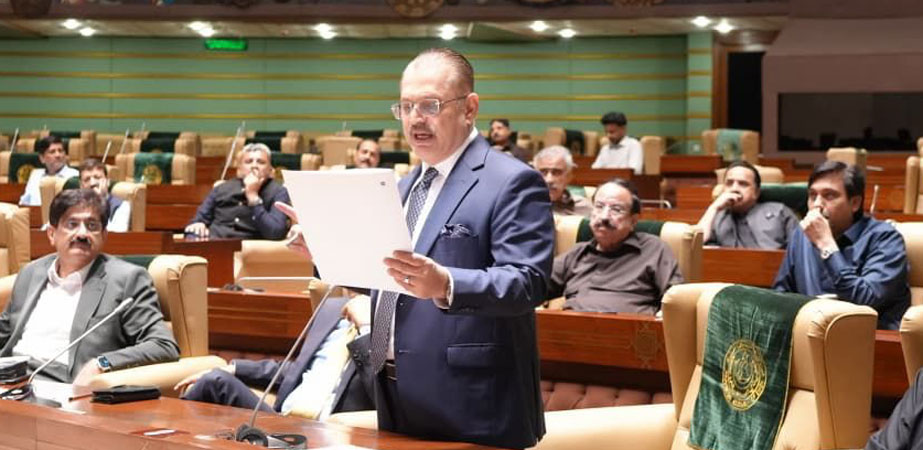
 Sindh Senior Minister and Provincial Minister for Information, Transport and Mass Transit, Sharjeel Inam Memon, said that the country is currently facing extraordinary circumstances, and all provinces are fulfilling their national responsibilities despite limited resources. He said that, for the strength of the federation and the stability of the country, all provinces have sacrificed the pace of their own development and have consistently placed national interest above all else. He added that Pakistan’s stability and progress have been prioritized over provincial development because development can always be pursued later, but strengthening the country remains the foremost priority.
Addressing the Sindh Assembly session, Senior Minister Sharjeel Inam Memon said that the Sindh government has adopted Artificial Intelligence (AI) for media monitoring in line with modern requirements. Through this system, content published and broadcast in newspapers, television, and social media is analyzed. He said that Sindh was the first province in the country to establish a Journalists Protection Wing to safeguard journalists, while the Sindh Information Commission was also established for the first time to promote access to information and transparent governance.
He said that press freedom in Pakistan is most vibrant in Sindh, but unfortunately, the Sindh government has become the biggest target of that freedom. He expressed regret that certain circles spread fabricated stories and unverified information, whereas the fundamental principle of journalism is to verify facts before presenting news to the public. He said that criticism is the right of every citizen and every journalist; however, it is equally their responsibility not to publish or broadcast any news without proper research and verification.
Senior Minister Sharjeel Inam Memon said that some individuals irresponsibly create narratives about the distribution of ministries and the appointment of a Chief Minister according to their own wishes, whereas the reality is entirely different. Citing an example, he said that a journalist in Punjab faced difficulties the very next day over a single tweet, whereas freedom of expression has always been protected in Sindh.
He said that the Sindh government has formulated a comprehensive policy for the promotion of the film and drama industry, under which a dedicated budget has also been allocated. He said that the Sindh government’s first feature film, Mir Ilyari, was produced at a cost of approximately Rs 55 million. However, some quarters spread baseless claims that it cost only Rs 20 million. He added that the film was showcased at various international platforms, and later a private television network acquired its broadcasting rights, which clearly demonstrates the success of the project.
Sharjeel Inam Memon said that the Sindh government is also producing several documentaries to showcase the true, positive, and culturally rich image of Sindh to the world. He further said that Pakistan Peoples Party Chairman Bilawal Bhutto Zardari introduced a modern digital platform, “iWork for Sindh,” which has so far received more than 4.8 million visits, while over 113,000 young people have registered on the platform. He added that the platform also offers an Artificial Intelligence-based “Auto CV” feature, enabling candidates to prepare their professional profiles with ease.
Highlighting the performance of the Transport Department, Sharjeel Inam Memon said that the Sindh government is simultaneously implementing several major projects to provide modern, safe, and quality public transport facilities. He said that rapid progress is being made on the Yellow Line BRT project, a section of the Taj Haider Bridge has been completed, and construction of the depot is also underway. He further stated that during the execution of the project, a Project Director had made an advance payment to the contractor in violation of rules and regulations. The Sindh government took action against the irregularity itself, setting a practical example of accountability.
He said that the Red Line BRT project has been subjected to unfair criticism, although executing such mega infrastructure projects in densely populated urban areas is far more challenging than carrying out construction in remote or undeveloped regions. He explained that relocating gas, water, electricity, sewerage, and other utility services in urban areas presents significant challenges, making occasional project delays unavoidable. He added that when the concerned contractor failed to maintain the required pace of work, the Sindh government terminated the contract and entrusted the project to the Frontier Works Organization (FWO) to ensure its timely completion.
Senior Minister Sharjeel Inam Memon said that the Karachi BRT project is not merely a transport initiative but an investment in the future of Karachi and its people. He said that the Orange Line BRT was completed by the Sindh government using its own resources, while the Green Line BRT was originally a federal government project that was later handed over to the Sindh government. He said that when the Sindh government assumed responsibility for the Green Line, its daily ridership stood at around 53,000 passengers, which increased to 78,000 within just three months. Similarly, the daily ridership of the Orange Line BRT has risen from 1,800 to 8,500 passengers.
He said that the People’s Bus Service is currently operating successfully in Karachi, Hyderabad, Mirpurkhas, Sukkur, Larkana, Shikarpur, Khairpur, and Tando Allahyar, where approximately 125,000 citizens benefit from the service every day. He said that the Sindh government continues to provide subsidies for this project to ensure affordable and quality public transport for the people.
Sharjeel Inam Memon said that Pakistan’s first electric (EV) buses were also introduced by the Sindh government, while the Pink Scooty Scheme was launched to empower women. He said that some people criticize the project by claiming that it is limited to only 1,000 scooties, but the fact is that when the initiative was launched, only around 150 women held motorcycle driving licences, whereas today more than 25,000 women have obtained motorcycle licences. He added that those who once objected to women riding scooters are now encouraging their daughters to join the project, which reflects a positive change in social attitudes.
He said that the government’s goal is to enable 100,000 women to obtain driving licences, and if government resources prove insufficient, the private sector will also be engaged to support the initiative. He clarified that the Pink Scooty Scheme is exclusively for women; therefore, the relevant authorities have been directed to take legal action if any man is found using a Pink Scooty.
He further announced that the Sindh government is set to launch the Sindh Electric Taxi Project during the current fiscal year, while the public will soon receive the good news of a dedicated “Pink Taxi” service for women.
Senior Minister Sharjeel Inam Memon also highlighted the performance of the Sindh Revenue Board (SRB), stating that the institution has achieved remarkable success in revenue collection. He said that while the growth rate of the Federal Board of Revenue (FBR) was around 10 percent, the Sindh Revenue Board recorded a growth rate of 24 percent, which is an extraordinary achievement.
He said that while the Federal Board of Revenue collects taxes at 18 percent, Punjab at 16 percent, and the Sindh government at only 15 percent, Sindh’s revenues continue to grow steadily despite the lower tax rate. He further said that the FBR has approximately 23,000 employees, whereas the Sindh Revenue Board has successfully achieved its revenue targets with only 368 officers and staff. He said that, the SRB’s performance despite its limited workforce demonstrates that effective strategies and a transparent system can deliver outstanding results.
In the third part of his address, Senior Minister Sharjeel Inam Memon highlighted the Sindh government’s achievements in development planning, law and order, education, infrastructure, and the energy sector. He said that over the past several years, the government has completed the construction and rehabilitation of 3,114 kilometres of roads across the province.
He said that journalists from different provinces were invited to visit development projects in Sindh, and after witnessing the ground realities, they appreciated the government’s efforts. He added that the condition of highways managed by the federal government is evident to everyone, whereas roads maintained by the Sindh government are comparatively in better condition.
Sharjeel Inam Memon said that the recruitment of 97,000 teachers in the Education Department was carried out with complete transparency and strictly on merit. He said that despite such a large-scale recruitment process, not a single individual has come forward to allege that any candidate was appointed through political influence or recommendation. According to him, this is clear evidence of the Sindh government’s transparent recruitment system, and such performance deserves appreciation rather than criticism.
He said that some elements have attempted to create a negative impression of Karachi and Sindh, whereas the reality is quite the opposite. He said that, from Karachi to Kashmir, the Sindh Police has achieved significant success in maintaining law and order. He added that there is currently no major issue of kidnapping for ransom in Sindh, and law enforcement agencies are working effectively to safeguard the lives and property of the people.
Senior Minister Sharjeel Inam Memon said that the Sindh government’s Public-Private Partnership (PPP) model has received appreciation not only at the provincial and national levels but also from the federal government. He said that the Prime Minister himself praised the model and directed Federal Minister for Planning Ahsan Iqbal to benefit from the Sindh government’s experience. He expressed regret that while the Sindh government’s projects are appreciated across the country, some opposition parties within the province refuse to acknowledge these achievements solely because of political differences.
Sharjeel Inam Memon, while describing the Thar Coal Project as a landmark in Pakistan’s energy history, said that the project was the dream of Shaheed Mohtarma Benazir Bhutto. However, work on the project came to a halt after the fall of her government. He said that following the formation of the Pakistan Peoples Party government in 2008, work on the project resumed under the special patronage of President Asif Ali Zardari, as a result of which Thar coal is now generating 3,960 MW of electricity.
He said that the Sindh government invested approximately one billion US dollars in the project, but its benefits are not limited to Sindh alone. Rather, the entire country is benefiting, as the electricity generated from Thar is being supplied to the national grid. According to him, there can be no greater service to Pakistan than Sindh contributing to the country’s energy needs through its own resources.
He further said that diagnostic and other medical facilities have been established in almost every district of Sindh, enabling people to receive better healthcare services. He added that today the federal government is also keen to benefit from the Sindh government’s experience in various sectors and is seeking its assistance in several areas.
Sharjeel Inam Memon, while referring to the housing project for flood-affected families, said that the largest housing project in the world’s history is currently underway in Sindh, under which 2.1 million houses are being constructed. He said that the total population of Sindh is approximately 56.96 million, and assuming an average household size of six people, the project will provide housing to more than 12.6 million people, covering nearly 22 percent of the province’s population.
He said that the transparency and quality of this mega project have been audited by the World Bank, the Pakistan Army, and various international donor organizations, all of which have declared the project transparent and successful. He added that, on the instructions of Pakistan Peoples Party Chairman Bilawal Bhutto Zardari, ownership of all these houses is being transferred to women in order to promote their economic and social empowerment.
In his address, Sindh Senior Minister Sharjeel Inam Memon also spoke in detail about local government services, healthcare, education, industry, investment, and the positive image of the province. He said that although lengthy speeches were delivered in the House on the budget and other issues, no one raised the issue of garbage, which, according to him, reflects the significant improvement in cleanliness wherever the Sindh Solid Waste Management institutions are operational. He added that the modern Rescue 1122 ambulance service is also providing timely and quality emergency medical assistance to the public.
Highlighting the Sindh government’s achievements in the health sector, Sharjeel Inam Memon said that a total of 4,740,941 patients have so far received treatment at the National Institute of Cardiovascular Diseases (NICVD). He said that these include 4,184,950 patients from Sindh, 386,000 from Balochistan, 42,637 from Khyber Pakhtunkhwa, 119,088 from Punjab, 3,782 from Azad Jammu and Kashmir, and 3,516 from Gilgit-Baltistan. He said that these figures clearly demonstrate that Sindh’s government hospitals are serving not only the people of Sindh but patients from across Pakistan.
He said that patients in Sindh government hospitals are not treated on the basis of their identity cards or provincial affiliation; rather, every Pakistani is provided healthcare without discrimination. Recalling the past, he said that there was a time when students from Gulf countries, particularly Dubai, came to Karachi for higher education, while universities in Jamshoro still maintain international hostels for foreign students, reflecting Sindh’s longstanding educational traditions.
Senior Minister Sharjeel Inam Memon said that Karachi’s economic challenges began because of the flawed policies of the past. He said that Sindh was once Pakistan’s industrial hub, where major industries were established, but later many industries were shifted elsewhere as a result of deliberate policies. He added that repeated strikes, industrial instability, and deteriorating conditions prevented workers from reaching factories, forcing many industries either to shut down or relocate.
Sharjeel Inam Memon said that instead of remaining trapped in the bitterness of the past, there is a need to focus on building the future. He said that all members of the House are elected representatives of the people, and it is their collective responsibility to further strengthen the dignity and supremacy of the Sindh Assembly. Addressing the opposition members, he said that they are not only representatives of their respective political parties but also the “brand ambassadors” and “marketing managers” of the province. Therefore, it is the shared responsibility of all members to project the positive image of Sindh and Karachi.
He said that some political parties portray only a negative image of Karachi through their daily press conferences, which undermines investor confidence. He questioned how investors could be expected to invest in Karachi if they are constantly told that the city is defined only by its problems. He added that there was a time when foreign nationals freely visited the streets of Karachi, but persistent negative publicity later damaged the city’s image and reputation.
Senior Minister Sharjeel Inam Memon said that everyone has the right to criticize the Sindh government. However, criticism that tarnishes the image of the entire city and province ultimately harms the interests of its own people and voters. He said that if we are truly sincere about Karachi and Sindh, we should avoid negative publicity and instead highlight the province’s development, investment opportunities, and positive achievements.
He said that when it rains in any other city, it is treated as a routine news event, but whenever it rains in Karachi, continuous negative coverage is broadcast for hours, creating a misleading impression of the city before the world. He added that if people genuinely claim to love Karachi, they should contribute to its progress and development rather than damage its reputation.
Sharjeel Inam Memon said that while some members of the House criticized family politics, no one acknowledged the fact that a woman from a marginalized community, Krishna Kumari, is serving in the Senate of Pakistan, which, according to him, is a practical manifestation of the Pakistan Peoples Party’s commitment to equal representation.
He said that shisha culture continues in five-star hotels in Islamabad, whereas it has been banned in Sindh. He further stated that the federal government owes Sindh approximately Rs 200 billion in infrastructure cess. He called upon the opposition, whose parties are part of the federal government, to also raise their voices for the legitimate financial rights of Sindh.
Sharjeel Inam Memon said that all political forces should rise above their differences and work together for the development, prosperity, and welfare of the people of Sindh. He announced that the doors of all Sindh government departments are open to the opposition and that any constructive suggestions made in the public interest would be welcomed. He urged opposition parties to play a positive and constructive role by working with the government for the province’s development, investment, and prosperity, instead of attempting to tarnish the image of Karachi and Sindh through routine political statements, rallies, and daily negative press conferences.