BELEM, Brazil – With the pace of climate change intensifying, scientists warn that extreme weather events and environmental disruptions are taking a mounting toll worldwide. Recent findings reveal that global temperatures, sea levels, and ecosystem instability are increasing faster than ever before.
A major study published in June updated the Intergovernmental Panel on Climate Change (IPCC) baseline data, revealing that the planet is now warming at 0.27°C per decade—nearly 50% faster than in the 1990s and 2000s.
Read More: Information: A Lifeline Amidst the Climate Crisis
Sea levels have also accelerated, rising at 4.5 millimeters per year over the past decade, compared to an average of 1.85 mm since 1900. Scientists now predict the world will surpass the 1.5°C warming threshold by 2030, bringing irreversible climate impacts. The planet has already warmed by 1.3–1.4°C above pre-industrial levels, according to the World Meteorological Organization (WMO).
Researchers warn that the first major “climate tipping point” may have already been reached as warm-water corals experience near-total die-offs from successive marine heatwaves.
Further studies caution that the Amazon rainforest could begin transforming into a savannah ecosystem if deforestation continues alongside global temperature rise. Meanwhile, meltwater from Greenland’s ice sheet could accelerate the collapse of the Atlantic Meridional Overturning Circulation (AMOC)—a critical ocean current that regulates Europe’s climate.
Read More: Mitigating the Global Climate Crisis
In Antarctica, scientists are alarmed by rapidly declining sea ice, which exposes darker ocean surfaces that absorb more heat, intensifying global warming and disrupting the growth of phytoplankton—organisms essential for absorbing CO₂.
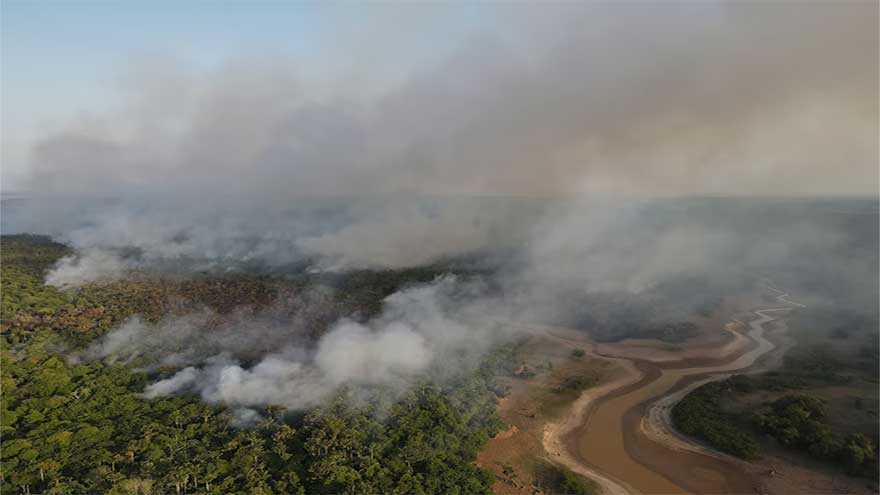
The 2025 State of Wildfires Report found that from March 2024 to February 2025, roughly 3.7 million square kilometers of land—an area the size of India and Norway combined—was burned. Although this is slightly below the 20-year average, the fires released more carbon dioxide due to the destruction of carbon-dense forests.
Heatwaves are emerging as the most lethal climate impact. UN health and weather agencies estimate that half the global population is now struggling with heat stress, while worker productivity declines by 2–3% per degree above 20°C.
Read More: Pakistan may lose 20% of GDP by 2050 due to climate crisis
A Lancet study estimated over $1 trillion in economic losses in 2024 due to heat-induced productivity drops. In Europe, researchers at Imperial College London calculated 24,400 deaths from heat exposure this summer, while another study found 62,700 heat-related deaths across 32 countries during last year’s record-breaking heatwave.
Concerns are growing over political interference in climate science. The Trump administration’s 2026 budget proposal seeks drastic cuts to NASA’s Earth Science Division and NOAA’s climate programs, prompting fears of weakened global climate monitoring.
In contrast, China, Japan, the UK, and the European Union are expanding public science funding, with the EU recently launching real-time, open-access weather monitoring systems to enhance transparency and collaboration.
Read More: Understanding Climate Change
From rising seas and melting ice to record heat and political challenges, 2025 underscores the urgency of coordinated global action. Scientists warn that the window to prevent catastrophic climate outcomes is closing rapidly.