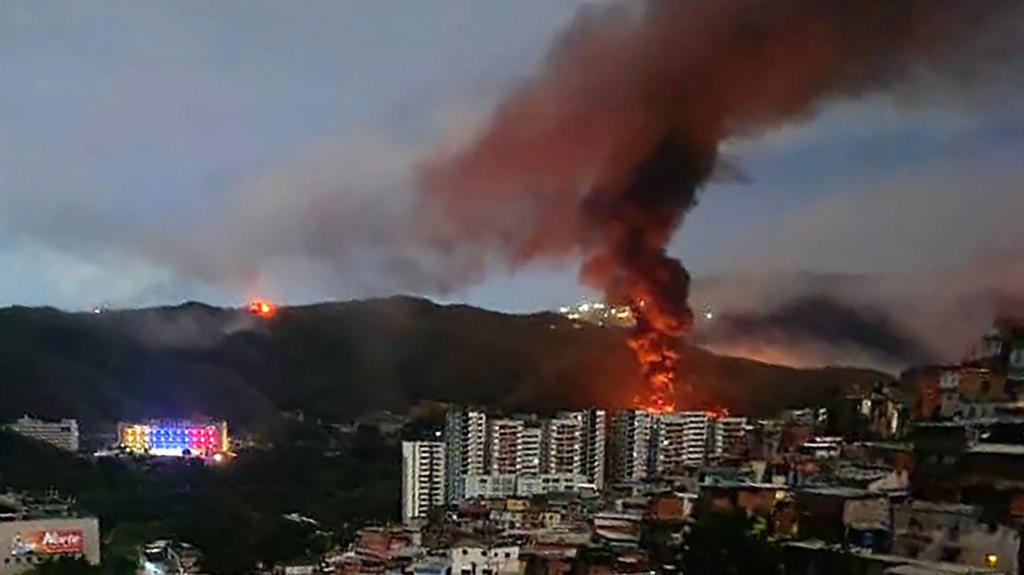
An explosive claim by U.S. President Donald Trump has sent tremors from the Caribbean Sea all the way to Washington, D.C. According to Trump, the United States launched large-scale military strikes on Venezuela, leading to the arrest of President Nicolás Maduro and his wife. Whether fully confirmed or not, the announcement alone has ignited panic, speculation, and fear across Latin America and beyond.
Across the Caribbean’s restless waters, a familiar yet dangerous confrontation has resurfaced. Oil-rich Venezuela and the world’s most powerful military force, the United States, now appear to be standing face to face once again—this time closer to open war than ever before. In the closing days of December 2025 and the opening weeks of January 2026, reports emerged of bombings in Caracas and other major Venezuelan cities. Explosions echoed through urban neighborhoods, fighter jets roared across the skies, and a climate of fear settled deep into the hearts of ordinary citizens.
Venezuela immediately declared that the attacks were carried out by the United States. The accusation carried enormous weight. America, long recognized as a global superpower, was now being openly accused of initiating direct military action under the leadership of Donald Trump. What made the situation unprecedented was Trump’s own public acknowledgment—his administration officially admitted for the first time that ground targets inside Venezuela had been struck.
This was not merely another covert operation, proxy conflict, or diplomatic pressure campaign. It was a bold, open, and aggressive move that rattled not just Caracas, but the entire Latin American region.
How Did It Begin? A Conflict Decades in the Making
To understand how the situation escalated to this point, one must look beyond the events of recent months. The roots of the U.S.–Venezuela conflict stretch back decades. Relations between Washington and Caracas have long been tense, shaped by ideology, oil, and power politics. However, by 2025, the confrontation had reached a dangerous tipping point.
The United States accused Venezuela of deep involvement in international drug trafficking networks, claiming it had become a central transit hub for narcotics entering North America. Trump repeatedly labeled Venezuela a “narco-state,” accusing President Nicolás Maduro of leading or protecting criminal syndicates responsible for flooding U.S. streets with illegal drugs.
Washington claimed that these networks posed not only a criminal threat but a national security risk. As a result, Trump promised decisive action. His strategy included escalating military pressure, deploying naval and air forces in the Caribbean, tightening sanctions on Venezuela’s oil industry, and enforcing an economic blockade designed to suffocate the Maduro government.
American policymakers openly argued that these measures were necessary not only to combat drug trafficking but also to secure U.S. interests in Venezuela’s vast oil reserves—the largest proven oil reserves in the world.
The Caribbean Turns into a Battlefield
Near the Venezuelan coast in the Caribbean Sea, the U.S. began intercepting oil tankers and cargo ships. Several vessels were seized or blocked under sanctions, while others were forced to turn back. Venezuela condemned these actions as outright piracy and a violation of international maritime law.
By March, the campaign escalated further. It was no longer limited to sanctions and seizures. The United States announced that it had targeted Venezuelan-linked vessels allegedly carrying drugs. According to U.S. claims, over a hundred people were killed during these operations. However, the lack of independent verification and credible evidence cast serious doubt on Washington’s narrative.
Soon after, U.S. naval and air forces reportedly struck multiple targets inside Venezuela. These included military installations, industrial sites, and strategic facilities. American media framed the operation as a “counter-narcotics mission,” but in Caracas, it was seen as nothing less than a declaration of war.
Caracas Under Fire
The sound of explosions shattered the night in Caracas. Low-flying aircraft, sudden power outages, and deserted streets transformed the capital into a city under siege. Fear spread rapidly as residents struggled to understand what was happening and what would come next.
The Venezuelan government stated that U.S. forces had attacked both military and civilian infrastructure in Caracas and in the states of Miranda, La Guaira, and Aragua. Officials declared the strikes a clear violation of international law and national sovereignty.
President Maduro responded swiftly. A national state of emergency was imposed. Citizens were called upon to remain vigilant and prepare for resistance. The government framed the situation as a foreign invasion and vowed to defend the nation at all costs.
Meanwhile, the U.S. Embassy issued urgent security warnings, restricted airspace access, and advised American citizens to exercise extreme caution. Each announcement further escalated tensions.
Washington’s Justification: Narco-Terrorism and Power Politics
The U.S. government justified its actions by pointing to powerful criminal groups operating in Venezuela, particularly the Tren de Aragua gang, which Washington designated as a “narco-terrorist organization.” U.S. officials claimed these groups were responsible for shipping drugs to North America and Europe.
Under this justification, the U.S. Treasury imposed severe sanctions on Venezuelan oil companies and froze the assets of numerous tankers. Trump openly stated that the pressure campaign aimed to force political change in Caracas and ensure greater American control over energy resources.
Critics, however, argued that the war on drugs was merely a pretext. They pointed out that Venezuela’s oil wealth had always been at the center of Washington’s strategic calculations.
Maduro Strikes Back
The Maduro government rejected all U.S. allegations, branding them fabricated excuses for imperial aggression. Military units and civilian militias were mobilized across the country. The leadership insisted that Venezuela was prepared to defend its sovereignty against any external threat.
Maduro accused the United States of attempting to seize Venezuela’s natural resources and overthrow its government by force. He called on international organizations to intervene and warn Washington against further escalation.
Global analysts began voicing serious concerns. If tensions continued to rise, they warned, the conflict could easily transform from limited strikes into a full-scale war—one that would engulf the region and destabilize the entire hemisphere.
A Long History of Oil and Intervention
Venezuela’s strategic importance lies largely in its oil. Since the 1960s, it had been a major supplier to the United States. That relationship began to fracture after Hugo Chávez came to power in 1998. Chávez curtailed foreign investment and strengthened state control over energy resources, directly challenging U.S. interests.
Under Nicolás Maduro, Washington intensified sanctions and economic pressure. What began as financial warfare gradually evolved into military intimidation, with naval deployments and targeted operations becoming increasingly frequent.
How Close Is War?
Today, the question on everyone’s mind is chillingly simple: how close is all-out war?
The United States has deployed warships, destroyers, fighter jets—including F-35s—and thousands of troops across the Caribbean. Venezuela, in response, has detained American citizens and raised its military readiness to the highest level.
Trust between the two nations has completely collapsed. A single miscalculation could ignite a conflict far larger than either side anticipates.
The Forgotten Victims: Ordinary Venezuelans
Amid the geopolitical chess game, it is the Venezuelan people who suffer the most. Years of economic collapse, power shortages, unemployment, and shortages of basic necessities had already pushed society to the brink. Now, bombings and the constant threat of war have made daily survival even more uncertain.
Families fear for their children’s future. Streets empty at night. Anxiety hangs over the nation like a dark cloud.
And one haunting question echoes across Venezuela:
Will this war ever end—or has it only just begun?