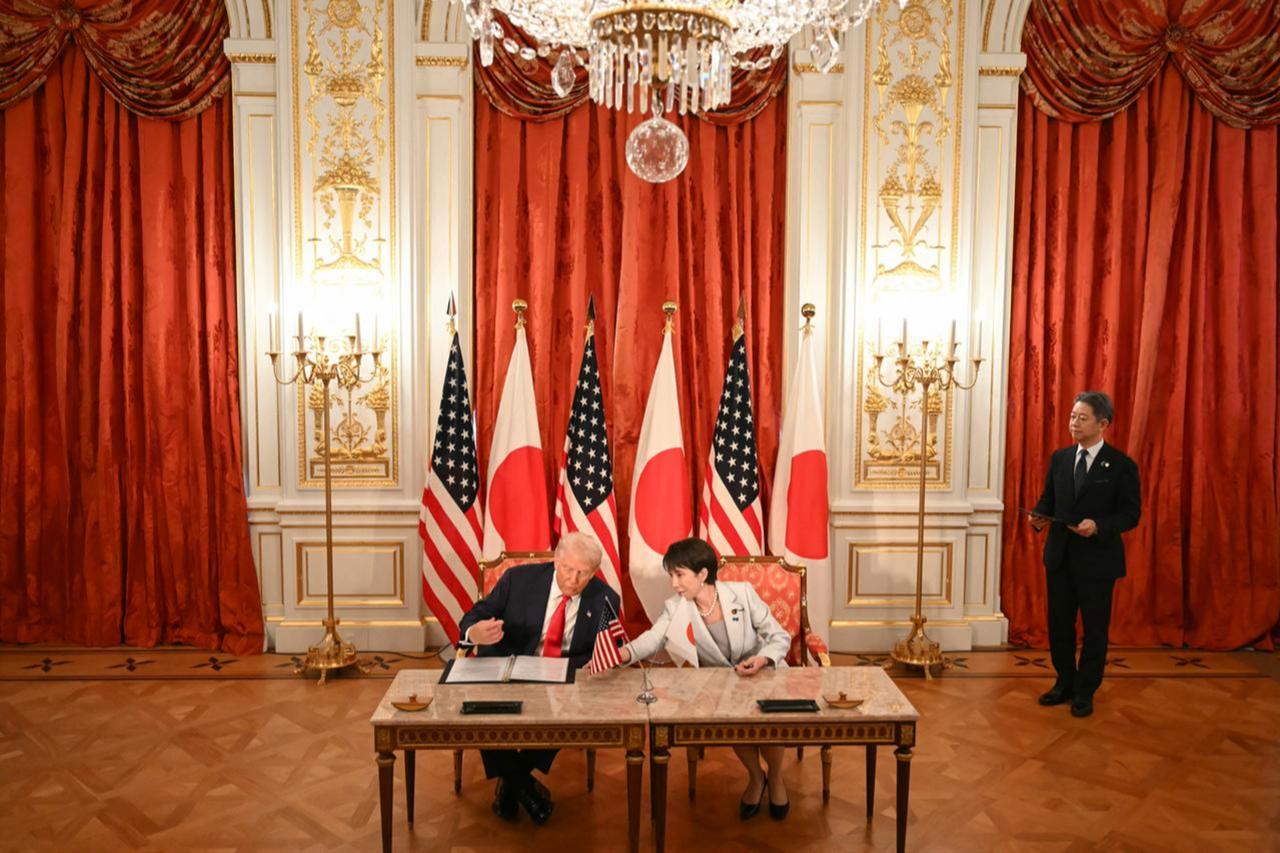
The United States on Tuesday announced the first tranche of investments by Japan under a $550 billion trade deal struck in 2025 during President Donald Trump’s administration. Tokyo has committed $36 billion toward three major infrastructure projects in the US, marking the initial step in fulfilling its large-scale pledge in exchange for reduced US trade tariffs.
Read More: Trump seals $550bn trade deal with Japan, cuts auto tariffs
The investment package includes a natural gas facility in Ohio, a deep-water oil export facility in the Gulf of Mexico, and a synthetic diamond manufacturing plant. US Trade Secretary Howard Lutnick called the projects a “massive America First trade win,” highlighting the strategic and economic benefits for the country.
U.S.–Japan trade deal just went official 🚨
President Donald Trump announced a new agreement between the United States and Japan
And the numbers are big.
Key highlights 👇
• $550B in Japanese investment into the U.S
• Funding for an LNG facility in Texas
• Funding for a… pic.twitter.com/NnFas6WoVa
— Draxen (@Draxen_Web3) February 18, 2026
The Ohio natural gas facility will generate 9.2 gigawatts of electricity, enough to power approximately 7.4 million homes or the equivalent of nine nuclear reactors. It is designed to supply AI data centres and other energy-intensive operations. The Gulf of Mexico oil project is projected to generate $20–30 billion annually in crude exports, reinforcing America’s role as a global energy supplier. The synthetic diamond plant aims to reduce US dependence on imports, particularly from China.
Japanese Prime Minister Sanae Takaichi emphasized that the projects “strengthen the Japan–US alliance” and will help build resilient supply chains in critical sectors such as energy, AI, and data centres. She noted that the initiative promotes mutual benefit, economic growth, and strategic security.
The full $550 billion commitment, to be deployed through 2029, includes a combination of capital, bonds, loans, and public guarantees via the Japan Bank for International Cooperation. Analysts have cautioned that Japanese firms may face challenges due to unclear administrative procedures and concerns over US labor availability.
Read More: Japan lower house passes US trade deal but auto tariffs still in limbo
The announcement comes ahead of Takaichi’s planned White House visit on March 19, and signals Japan’s effort to deliver on its trade promises while strengthening strategic and industrial cooperation with the United States.