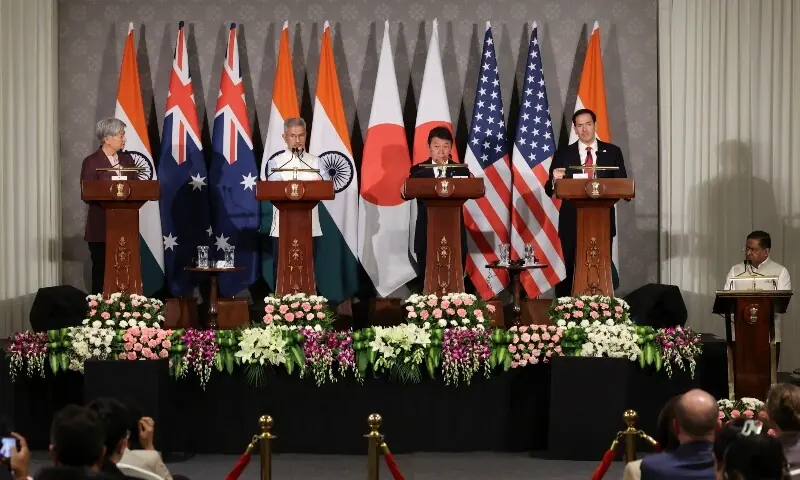
NEW DELHI: Foreign ministers of Australia, India, Japan and the United States—collectively known as the Quad have agreed to jointly develop a port in Fiji and signed new agreements focused on critical minerals and energy security, marking a renewed push to strengthen cooperation in the Indo-Pacific.
The meeting was attended by Australia’s Penny Wong, India’s Subrahmanyam Jaishankar, Japan’s Toshimitsu Motegi and US Secretary of State Marco Rubio in New Delhi.
Read More: Kolinisau tasked with taking Fiji to sevens gold at 2028 Olympics
Officials announced that the group’s first joint infrastructure project will focus on building a port in Fiji, aimed at addressing infrastructure gaps in Pacific island nations and improving regional connectivity.
Addressing the press alongside FM @SenatorWong of Australia, FM Toshimitsu Motegi of Japan and @SecRubio of USA after Quad Foreign Ministers’ Meeting.
🇮🇳 🇦🇺 🇯🇵 🇺🇸 https://t.co/cL7nb50X2u
— Dr. S. Jaishankar (@DrSJaishankar) May 26, 2026
US Secretary of State Marco Rubio said the initiative represents a “practical demonstration” of the Quad’s ability to deliver high-quality infrastructure and strengthen cooperation in the Indo-Pacific region.
In addition to the port project, the Quad partners signed agreements on an Indo-Pacific Energy Security initiative and a critical minerals framework. The agreement seeks to coordinate investment and policy tools to strengthen supply chains for essential minerals used in industries such as defence, aerospace, semiconductors and renewable energy.
The initiative is also seen as strategically important amid global concerns over supply disruptions, particularly after China restricted exports of certain critical minerals following diplomatic tensions.
Officials said the framework will also focus on mining, processing and recycling of key resources to reduce dependency on single-source suppliers.
The Quad, which has faced questions over its long-term direction due to limited leader-level summits in recent years, has now signalled renewed activity through ministerial-level cooperation.
Analysts say the latest agreements may help restore momentum to the grouping as it continues to emphasise a “free and open Indo-Pacific” and strengthen maritime security coordination among member states.
Read More: China engages in Australia’s largest maritime drill for first time
China has previously criticised the Quad as a strategic bloc aimed at containing its influence, while member countries maintain that the grouping is focused on regional stability, development and secure supply chains.
The latest developments come amid broader geopolitical shifts and growing competition for influence across the Indo-Pacific region.