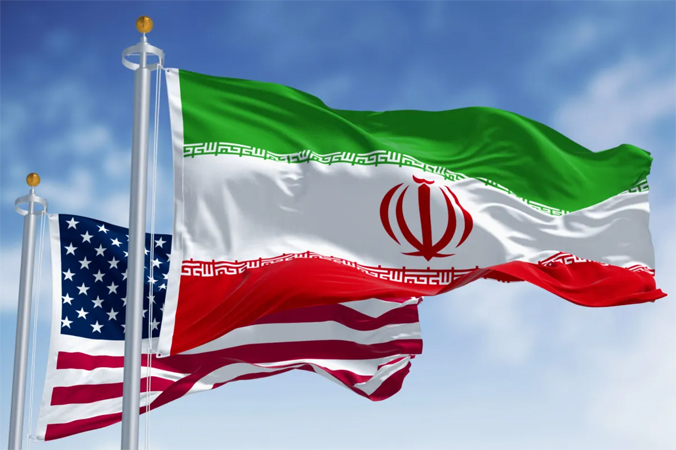
 Iranian Foreign Minister Abbas Araghchi said on Sunday that talks and message exchanges with the United States were ongoing, but stressed that no assessment of negotiations could be made until a clear outcome was reached.
“We should not give importance to speculation and we cannot judge the talks until we get to a clear result,” Araghchi added.
Iran’s parliament speaker and top negotiator, Mohammad Bagher Ghalibaf, said on Sunday that Tehran will not accept any deal with Washington unless it ensures “the rights of the Iranian people are secured.”
“There is no trust in the ?enemy’s words and ?promises. Our only criterion is to achieve tangible results ?before we fulfil our ?commitments in ?return,” the state broadcaster IRIB quoted Ghalibaf as saying during a virtual session of the parliament after he took an oath as the parliament’s re-elected speaker.
A senior Islamic Revolutionary Guard Corps (IRGC) commander said Iran’s enemies had made a strategic miscalculation in assessing the country’s capabilities and resolve, arguing that Tehran had emerged in a stronger position while the United States faces decline and failure.
Speaking to IRNA News Agency, IRGC Deputy for Political Affairs Yadollah Javani said the enemies had wrongly assumed they could achieve a quick victory by imposing war on Iran.
He said their strategic objectives included destroying Iran’s nuclear capabilities, eliminating its missile defence capacity, and ultimately overthrowing the Islamic Republic.
Javani added that those goals have failed, resulting in a shift in regional equations in Iran’s favour.
He further said the United States must choose between accepting the rights and conditions of the Iranian people or continuing the war.
US President Donald Trump said he had secured guarantees from Iran that it would not develop nuclear weapons, as reports emerged he had sent a tougher peace proposal back to Tehran.
Any tweaks to the proposal could prolong even further an agreement to formally end the Middle East war and open the Strait of Hormuz maritime route after weeks of efforts to secure a deal despite fractious rhetoric and the occasional flare-up of armed conflict.
The New York Times and Axios media outlets reported on Saturday that Trump had sent back a new framework to be considered by Iran with “tougher” terms, though it was not immediately clear what that entailed.
Trump has said his priorities for any deal include stopping Iran from any nuclear weapon development and re-opening the blockaded Strait of Hormuz.
“The one guarantee that I have to have is that there will be no nuclear weapons. They’ve agreed to that, and it was very interesting,” he told his daughter-in-law Lara Trump in an interview broadcast on her Fox News program on Saturday night.
But Tehran has previously cast doubt on Trump’s assertions and the parties appeared far apart on their key priorities.
Iran has said it requires the release of $12 billion in frozen assets before it moved to substantive talks on issues such as its nuclear program and called earlier Trump comments that its enriched uranium — a precursor for nuclear weapons — would be destroyed “baseless”, according to Iranian media.
Tehran has also insisted that Lebanon must be included in any end to the war despite ongoing fighting, with Beirut accusing Israel of a “scorched-earth policy” as its forces advanced and carried out further airstrikes it says target Iran-backed group Hezbollah.
After Trump and US officials earlier said they were on the brink of striking a deal, he struck a less urgent tone and hinted at renewed military action in the Fox interview.
“I’m in no hurry,” he said. “Slowly but surely we’re getting, I think, what we want and if we don’t get what we want, we’re going to end in a different way”.