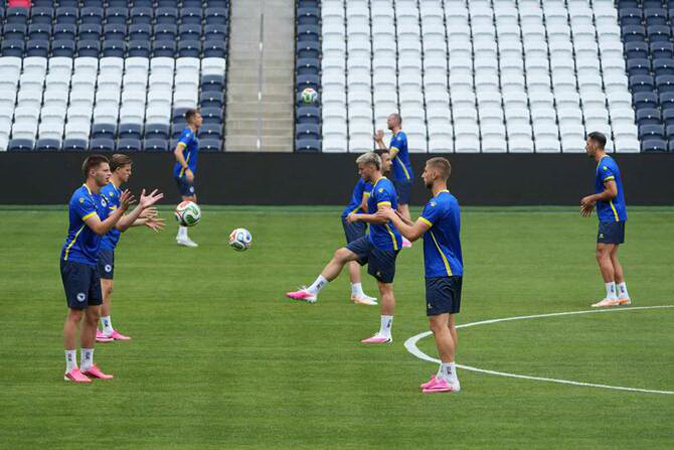
 Bosnia’s World Cup team is led by 40-year-old captain Edin Džeko and 18-year-old winger Kerim Alajbegovic
An estimated 60,000-70,000 Bosnians live in St. Louis, many arriving in the early 1990s during the Bosnian War
Far from its European homeland, Bosnia and Herzegovina has zealous fans in the American Midwest as it prepares for its second World Cup.
An estimated 60,000-70,000 Bosnians live in St. Louis, with many arriving in the early 1990s during the Bosnian War and the breakup of Yugoslavia.
Bosnia faces Panama on Saturday in an international friendly at St. Louis’ Energizer Park and plays World Cup group matches in Toronto (vs. Canada), Los Angeles ( vs. Switzerland) and Seattle (vs. Qatar).
“We should be able to create an atmosphere like a home match,” said Elvir Kafedžic, a Bosnia-born St. Louisan and an assistant coach for the city’s MLS team, St. Louis City SC.
He was only 9 1-2 when he fled Bosnia in 1992 with his mother and brothers to escape the war.
“Unfortunately, I remember a lot of it,” said Kafedžic, whose story mirrors many who rebuilt in St. Louis after meandering across Europe.
“We kind of tumbled through some different countries like Montenegro, the Czech Republic, Sweden and wound up in Germany,” Kafedžic explained.
That ended when Germany stopped granting temporary protection to Bosnians in the late 1990s.
“We didn’t have anywhere to go back to in Bosnia. And we already had some relatives living in St. Louis. So in 1999 we made the move with my mom and two older brothers.”
Bosnia defeated Italy: Bosnia qualified for the World Cup two months ago, defeating four-time World Cup champion Italy 4-1 on penalties after a 1-1 draw. The deciding penalty was converted by Esmir Bajraktarevic, a Bosnian-American from Appleton, Wisconsin. “That day you could see cars flying Bosnian flags in the streets,” Kafedžic said of the St. Louis scene. “All the restaurants, all the coffee shops were packed wall-to-wall with strangers hugging each other. For me, this goes beyond soccer. This shows who we are, the pride, where we come from and how deeply we’re connected to our roots.”
Bosnia’s World Cup team is led by 40-year-old captain Edin Džeko and 18-year-old winger Kerim Alajbegovic. Džeko has scored at least 50 goals playing in the English Premier League, Italy’s Serie A, and the German Bundesliga.
Bosnia’s only other World Cup appearance was at Brazil in 2014, where it was narrowly eliminated in the group stage. The team’s first World Cup goal was scored by Vedad Ibiševic in a 2-1 loss to Argentina.
Ibiševic played high school soccer in St. Louis, starred at Saint Louis University and followed up with a successful professional career, primarily in the Bundesliga. “Little Bosnia” in St. Louis St. Louis surfaced as a destination for Bosnian refugees because it offered jobs, reasonable housing prices and had a small community in place.
“We all came looking for a better life because everything was taken away from us at home,” Kafedžic said. “You can’t put in words how thankful we are.”
A swath of the city’s South Side is known as “Little Bosnia,” anchored by rows of tidy red-brick houses, bars, cafes and bakeries and a replica wood fountain that mimics one in the capital Sarajevo, known as the Sebilj. “It represents Sarajevo in the heart,” said Jasmina Silic, working across the street from the monument at the Skala Bar on Gravois Avenue, the fulcrum of the community.