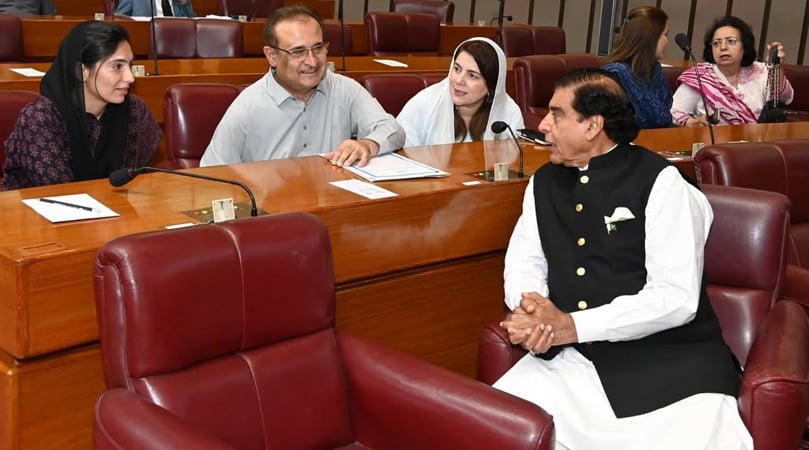
 The debate on federal budget 2026-27 continued in National Assembly on Monday and the lawmakers presented various perspectives on taxation, economic planning, sectoral development, and regional diplomacy.
Participating in the budget debate, Member National Assembly (MNA) Latif Khosa said that the budget imposed a significant taxation burden on the public and there was a need to strengthen revenue collection mechanisms, particularly within the Federal Board of Revenue (FBR), to ensure that targets would met more effectively.
He stressed that budgetary planning should better reflect public aspirations and be more closely aligned with citizens’ expectations.
Mir Ghulam Ali Talpur, MNA from Pakistan Peoples Party Parliamentarians (PPPP) highlighted the importance of dialogue and diplomacy in resolving disputes, noting that recent ceasefire understandings present an opportunity for constructive negotiations over the coming period. He emphasised that sustainable solutions could only be achieved through continued engagement among all stakeholders.
On economic policy, Talpur also called for stronger support to the agriculture sector, including tax and duty relief on agricultural machinery and inputs, and improved access to financing for farmers.
He underscored the importance of boosting exports and strengthening rural productivity through targeted interventions.
Noor Alam Khan, MNA from Jamiat Ulema-e-Islam (Fazl) welcomed recent diplomatic engagements and appreciated Pakistan’s leadership role in promoting peace and regional stability.
He also stressed upon the importance of unity among national institutions in countering security challenges and preventing escalation in the region.
He called for more realistic fiscal projections, better resource distribution among provinces, and greater focus on completing ongoing infrastructure, energy, and water projects, particularly in underserved regions.
Hafeez-ud-Din, from Muttahida Qaumi Movement – Pakistan emphasised upon the need for structural reforms in taxation and energy sectors, advocating a shift towards a more production- and income-based tax system.
He also highlighted the importance of addressing inefficiencies in state-owned enterprises and improving coordination between financial institutions to strengthen economic planning.
He further noted that high energy costs, circular debt, and policy inconsistencies continued to pose challenges to industrial growth, urging comprehensive reforms to ensure stability and investor confidence.
MNA Shahram Khan criticised the government’s economic performance over the past five budgets, arguing that inflation, unemployment, and rising utility costs have affected public welfare.
He called for stronger implementation of policies to translate economic claims into tangible relief for citizens.
Sardar Nabil Ahmed Gabol MNA from PPPP, appreciated the functioning of the House and praised parliamentary leadership for maintaining decorum.
He highlighted development initiatives in Lyari, particularly in sports and infrastructure, and underscored the importance of peace, reconciliation, and inclusive national development.
Referring to recent diplomatic achievement, he acknowledged the country’s leadership efforts in facilitating peace-related initiatives and improving international engagement. The lawmaker also stressed upon the need to resolve internal political tensions and promote national unity.
He added that welfare initiatives such as the Benazir Income Support Programme (BISP) remained a key support for vulnerable families, and also acknowledged government efforts on social welfare schemes and said such programmes help sustain millions of households across the country.
Gabol also drew attention towards fiscal pressures, noting that debt servicing and inflation continue to limit development spending, and urged policymakers to prioritise relief for ordinary citizens through improved financial management.
Jamiat Ulema-e-Islam-Fazl (JUI-F) leader Maulana Abdul Ghafoor Haideri raised serious concerns over continued neglect of Balochistan in national development planning and budget allocations.
He asked what concrete steps had been taken for youth employment, public welfare and the development of backward areas, saying, “time constraints prevented him from elaborating further but the issues were “fundamental and long-standing.”
Referring to Balochistan, he said the province had long remained deprived of its due share in development, adding that it constituted a significant portion of the country and could not be ignored in national policy making.
The JUI-F leader questioned the budgetary allocation for development projects in Balochistan, claiming that no significant schemes had been included for his constituency and that even larger development initiatives were missing across Balochistan.
Pakistan Muslim League (Nawaz) lawmaker Anjam Aqeel Khan said Pakistan’s diplomatic standing has improved significantly, with the country now maintaining stronger engagement with major global powers.
He praised the prime minister and the Foreign Office for more effective diplomatic outreach, crediting the political leadership for restoring international recognition of Pakistan.
On the federal budget, he said it was prepared under difficult regional and security circumstances. While acknowledging limited public relief, he said priority had been given to national security and economic stability.