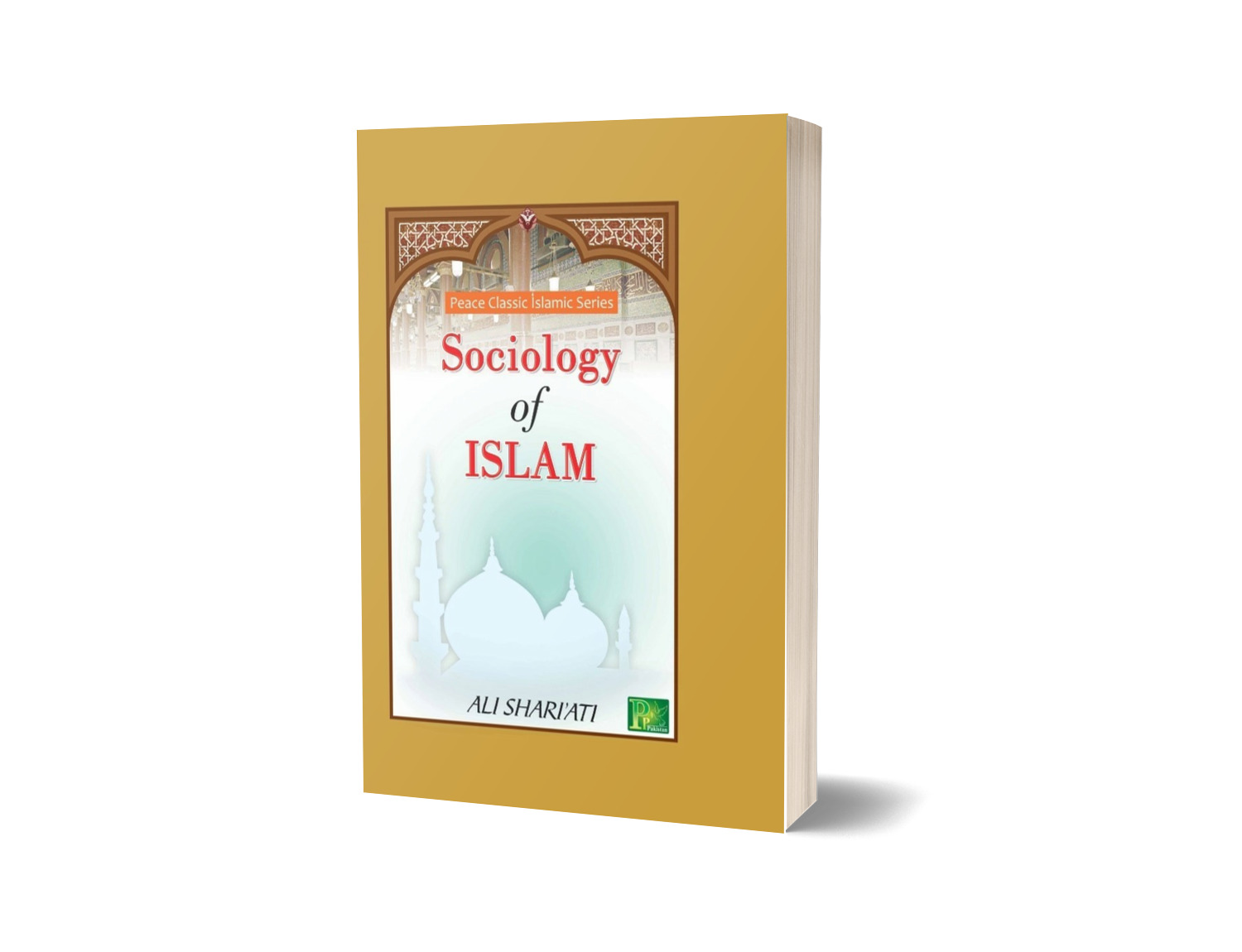
To challenge history or to reinterpret it both are intellectual things. Most scholars take pride in questioning the historical fallacies connected with their culture or religion. Sometimes they get the required success but most of the time face severe backlash from society, especially when they dare to challenge the religious history and decades-long beliefs and customs passed on from one generation to another. But Dr. Ali Shariati, a name less-known in Pakistan, didn’t really believe in rejecting the myths associated with Islamic history. Unlike Sir Syed Ahmad Khan and Gulam Ahmed Pervez who objected to the established Islamic doctrines, Ali Shariati focused on the possible revolutionary interpretation of those long-standing religious tenets.
This book ‘On the Sociology of Islam’ is one such book in which Dr. Ali Shariati has reinterpreted and revolutionized the basic concepts of Islam. No other Islamic scholar has ever interpreted the Islamic beliefs as Sharaiti did. Although this book doesn’t revolve around a single theme, it consists of eight lectures that Ali Shariati gave at Husseinieh-e-Ershad, a religious and cultural institution in Iran. In these lectures, Dr. Ali Shariati studied Islam from a sociological perspective and how the concept of man in Islam is different from the west. It’s important to discuss each chapter individually because all lectures revolve around a number of topics including Islamic philosophy and Quranic stories.
In the first chapter entitled ‘Approaches to the understanding of Islam’, Ali Shariati, being a sociologist, presents four different schools of thought in sociology that share different opinions regarding the ‘basic factor’ that contributes to social change. The first school of thought that Ali Shariati mentions are those who believe that everything happens out of chance. Like if a country invades another country, it’s mere accidental. The state could stop that act. According to this school of thought, there is no pre-planning, cause and effect. Everything happening in the world is coincidental. The second school of thought believes that there are some determining factors that contribute to social change. According to this school of thought, these determining factors play the same role as the natural laws in the natural domain. Of course, in this group, we can count Hegel who presented his theory of dialectics and maintained that only with two contradictory things we can reach the final truth. Karl Marx too extended this argument in his historical materialism. The third group includes those people who believe in hero worship. According to this school of thought, it’s the heroes who change societies. Without heroes, history is nothing. The fourth group believes that it’s the elite group that plays a major role in societal change. In their opinion, this elite group is joined by a leader then society moves toward a greater change.

Interestingly, Ali Shariati challenges all these schools of thought and says that neither does society work accidentally nor does it depends on some determining factors. It has also nothing to do with heroes or a group of elite. He maintains that societal change is solely dependent on the people. Although all other factors can also play their role, it’s ultimately the people who bring change to their societies. He further uses verses from the Holy Quran in which God has clearly asked his prophets that their purpose is to just convey God’s message to the people and the rest is depending on them.
In the second lecture entitled ‘Man and Islam,’ Dr. Ali Shariati explains the concept of man from the Islamic perspective and compares it with the post-renaissance man of the west. Shariati looks back at the time of the creation of man. How God made man his representative on the earth and bestowed him with knowledge and that knowledge became the cause of his superiority over the angels. But Ali Shariati laments that capitalism and materialism have made men like machines. It has taken them their dignity and honor. In the lecture, he further says that man is a bi-dimensional being as he was raised with mud, the lowest thing, and then God put his own spirit in him, the highest thing so that he could travel from this lowest point to the highest point by using his will power.
In the third lecture named ‘The world-view of Tauhid,’ Ali Shariati challenges the traditional definition of Tauhid (Monotheism) as we see Tauhid as a mere belief that God is one. But Ali Shariati says that Tauhid is not just a testimony that God is one. Rather, Tauhid provides the ‘intellectual foundation for all affairs of society.’ He says that Tauhid opposes all kinds of oppressive regimes and bears no disharmony in society. A system based on the exploitation of a man over the other is the system of shirk. By that means, there is no concept of feudalism and capitalism in Islam.
As Ali Shariati revisited Islamic history through a Marxist perspective, in the fourth lecture, he talks about the dialectics of nature, especially the contradiction between God and Iblis; spirit and clay. Simultaneously, in the fifth lecture, Dr. Ali Shariati discusses the dialectics of Sociology and maintains that Sociology is also founded on dialectics. He explains different political systems including serfdom, feudalism, bourgeois, etc., and proves how these political systems create a contradiction in society.
The most important chapter in the book is the sixth lecture as Dr. Ali Shariati presents his philosophy of history in this lecture. He revisits the history of Cain and Abel, the two sons of Adam, and maintains that the Islamic society is divided into two poles: the pole of Cain and the Pole of Abel. In order to understand these two poles, we first need to understand the history of Cain and Abel briefly. As we all know, at the beginning of the world, the marriages of brothers and sisters were allowed. Prophet Adam had two sons Cain and Abel and they had a sister named Aclima. Cain was a farmer and a landlord. On the other hand, Abel was a shepherd. Both the sons wished to marry their sister. Prophet Adam asked them to present a gift to God, the one who present the best would be allowed to marry their sister. Cain being a landlord was greedy and treacherous by nature that’s why he presented a worthless seed to God. While on the other hand, Abel presented the best shepherd to God. God accepted the gift of Abel because of his humble sacrifice. When Cain was forced to marry her less beautiful sister, Satan led him astray and he killed Abel in revenge. Dr. Ali Shariati reinterprets this story and maintains that a system based on private ownership is the system of Cain. As he says, “What makes Cain evil is an anti-human social system, a class society, a regime of private ownership that cultivates slavery and mastery and turns men into wolves, foxes, and sheep.” He further says a system that serves all humans collectively is the system of Abel.
The second last lecture deals with the ideal society – the Umma. According to Ali Shariati, the word ‘umma’ is used by the Holy Quran for the followers of Prophet Muhammad and it is different from other words including society, nation, race, people, tribe, and clan. He says that “The umma is, therefore, a society in which a number of individuals, possessing a common faith and goal, come together in harmony with the intention of advancing and moving toward their common goal.” Following this, in the last lecture, Dr. Ali Shariati highlights the qualities of the ideal man after explaining the ideal society. This whole lecture is full of eloquent lines as he goes on to mention the qualities the ideal man possesses.
These lectures are still relevant for the Islamic societies that are struggling against the system of oppression and imperialism. These lectures on the one hand can help the students of Islam in understanding its true teachings and on the other hand, they can instigate the spirit of revolution in our youth. Moreover, Dr. Ali Shariati’s inimitable Islamic critique of western philosophy is something that must come under debate among our public intellectuals.
The writer is a political and investigative journalist. He can be reached at @mirhadiabbas.