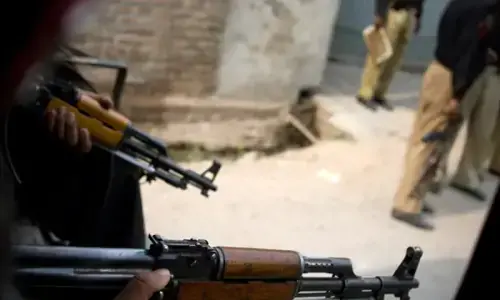
Gilgit woke to the echo of gunfire — a sound that shattered its fragile calm and exposed once again the simmering tension that lurks beneath the mountains’ serenity. On a morning that began like any other, violence returned to a region that has long carried the burden of sectarian fault lines and political neglect.
Judge Malik Inayatur Rehman of the Gilgit-Baltistan Chief Court was lucky to survive a targeted ambush near Khari City Hospital. His vehicle was riddled with bullets — twelve in all — yet miraculously, he and his security staff escaped with their lives. The attack was as symbolic as it was violent: a strike not just on an individual, but on the authority of law and the confidence of the state.
The same day, chaos erupted once more when Maulana Qazi Nisar Ahmed, a controversial cleric associated with the proscribed Ahl-e-Sunnat Wal Jamaat (ASWJ), came under armed assault near the Central Police Office. The incident left five injured, including police guards and his driver. The attackers fled, aided by accomplices, after a brief gun battle with the guards.
Two attacks, hours apart — both aimed at figures of power and influence — sent a chilling reminder that Gilgit-Baltistan’s peace rests on a knife’s edge.
Read More: Pakistan, US Move Ahead with Rare Earth Deal amid PTI’s ‘Secret Pact’ Outcry
The Fractured Calm
For years, the state has touted “peace and stability” in Gilgit-Baltistan as a success story, a symbol of harmony amidst Pakistan’s turbulent landscape. Yet, beneath the rhetoric, the region’s history remains layered with sectarian tension, political marginalisation, and administrative fragility. Sunday’s attacks ripped through that illusion, bringing forth the question: who benefits when Gilgit burns?
Security officials were quick to respond, cordoning off entire neighbourhoods, tightening the web of surveillance, and promising arrests “with iron hands.” Chief Minister Haji Gulbar Khan condemned the attacks, directing a city-wide security overhaul. Governor Syed Mehdi Shah, ministers, and opposition leaders echoed similar sentiments — all condemning, all assuring, all promising.
But the pattern is painfully familiar. Condemnations pile up like snow on the Karakoram peaks, while the causes of unrest — sectarian divides, unemployment, lack of political representation — remain buried beneath official statements.
Protests in the Mountains
The people of Gilgit did not remain silent. Within hours, protests flared across the region — from Skardu to Astore, from Ghizer to Ghanche. Roads were blocked, markets shuttered, the Karakoram Highway paralysed. For a region so dependent on trade routes, this was both a symbolic and economic blockade. The message from the protesters was clear: peace cannot survive on press releases and promises.
Religious leaders from all sects condemned the attacks, calling them part of a “conspiracy to sabotage regional peace.” The phrase, though familiar, resonated deeply — because Gilgit has often found itself caught between local grievances and external manipulations.
A Pattern Too Familiar
Gilgit-Baltistan is no stranger to violence dressed in mystery. In a landscape where sectarian loyalties, political ambitions, and shadow networks intersect, every gunshot carries multiple meanings. Sunday’s events bear the marks of both personal vendetta and calculated destabilisation.
Federal Minister for Kashmir Affairs and Gilgit-Baltistan, Engineer Amir Muqam, called it “an attack on the peace and stability of the entire region.” His words, though sincere, echoed a national frustration — how many times must the same lessons be relearned before real reform follows?
The Unanswered Questions
Who ordered these attacks? Why now — when political realignments and administrative negotiations for Gilgit-Baltistan’s constitutional status are underway? And what does it mean when both a judge and a religious leader are attacked within hours?
Such questions linger in the thin mountain air, unanswered and unsettling.
Peace in Gilgit-Baltistan has always been conditional — maintained through temporary calm rather than structural justice. Until the region’s people feel genuinely represented and protected, the silence between gunshots will remain merely an interlude, not peace itself.