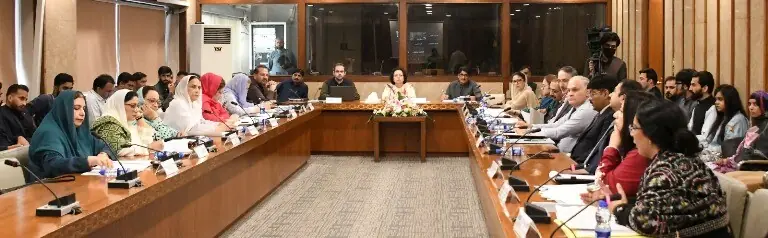
ISLAMABAD / GILGIT: A parliamentary committee on Wednesday expressed serious concern over Pakistan’s outdated Euro-II vehicle emission standards, terming them a glaring example of the country’s environmental oversight failures.
During a meeting of the National Assembly’s Standing Committee on Climate Change and Environmental Coordination, lawmakers were told that Pakistan’s National Environmental Quality Standards (NEQS) still align with Euro-II levels — a benchmark most nations abandoned years ago in favour of Euro-V and Euro-VI standards. “There is no mechanism in place to check emissions or enforce compliance,” said committee chairperson MNA Munaza Hassan, calling the situation a fundamental failure of environmental governance.
Read More: Climate change and global governance
Officials from the Ministry of Climate Change and Islamabad Capital Territory administration briefed the panel, admitting that the Pakistan Environment Protection Agency (Pak-EPA) lacks both funding and technical capacity to monitor air quality effectively. Islamabad Deputy Commissioner Irfan Nawaz Memon revealed that Pak-EPA had to borrow testing units from Punjab’s EPA, while the Capital Development Authority (CDA) funded the purchase of five more devices.
The committee directed the ministry to submit a comprehensive, time-bound air-quality improvement plan within four weeks and urged the government to prioritise climate issues in its foreign engagements. Experts at the meeting said targeted actions could cut air pollution by up to 30%, proposing steps such as staggered school timings, retrofitting old vehicles, and adopting Euro-V-compliant fuels. “We should at least try to make Islamabad a model city,” Ms Hassan concluded.
Meanwhile, in Skardu, the Senate Standing Committee on Kashmir Affairs, Gilgit-Baltistan (GB) and SAFRON urged the federal government to enhance climate resilience efforts in GB — one of the country’s most climate-vulnerable regions.
Read More: NASA Supercomputer Predicts Earth Will Become Uninhabitable in Future
Committee chair Senator Asad Qasim said GB faced unprecedented climate disasters this year, including glacier melt, cloudbursts, and glacial lake outburst floods (GLOFs). The panel called for forest protection, clean energy projects, and community awareness campaigns to mitigate risks. Officials briefed senators on ongoing projects, noting that 1.1 million cubic feet of illegal timber had been seized and that clean energy schemes were being completed under the prime minister’s special directives.
Separately, the Senate committee also reviewed the UNDP-funded GLOF-II project in Skardu. Project head Muteeb Ali informed that of 292 early-warning stations established in GB and KP, 218 are fully operational, while others face technical issues. The panel urged coordination among local authorities, the Meteorological Department, and UNDP to strengthen disaster preparedness.