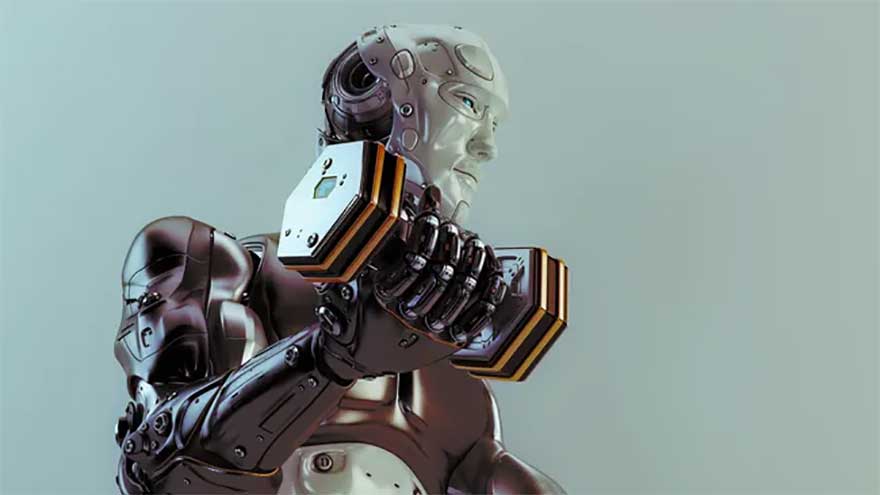
In a stunning scientific breakthrough, researchers in South Korea have created an artificial muscle that can lift around 4,000 times its own weight, marking a revolutionary step toward the development of more lifelike humanoid robots and wearable technologies.
The research team at the Ulsan National Institute of Science and Technology (UNIST), led by Professor Hoon Eui Jeong, published their findings in the journal Advanced Functional Materials on September 7. Their innovation lies in overcoming a long-standing limitation in robotics — creating muscles that are both strong and flexible.
Read More: Things to know about an AI safety summit in Seoul
Traditional artificial muscles are typically either stretchable but weak or strong but rigid. However, Jeong’s team engineered a “high-performance magnetic composite actuator” — a polymer-based material that can adjust its stiffness depending on the task. This allows the artificial muscle to become rigid when lifting heavy loads and soft when contracting or moving.
Weighing just 1.13 grams (0.04 ounces), the muscle can lift up to 5 kilograms (11 pounds) — roughly 4,400 times its own weight. It also exhibits 86.4% strain, more than double that of human muscle, and achieves a work density of 1,150 kJ/m³, which is 30 times greater than human tissue.
Read More: Scientists build climate ‘time machine’ in Amazon to study future earth
According to the researchers, this dual cross-linking structure — combining chemical and physical bonding networks — provides the material with exceptional durability and adaptability. The incorporation of magnetic microparticles (NdFeB) further enables external control, allowing for precise manipulation through magnetic fields.
Professor Jeong said the development could pave the way for “more versatile soft robots, wearable devices, and intuitive human–machine interfaces.” Scientists believe this innovation could revolutionize industries ranging from medical rehabilitation and exoskeletons to next-generation robotics and space technology.