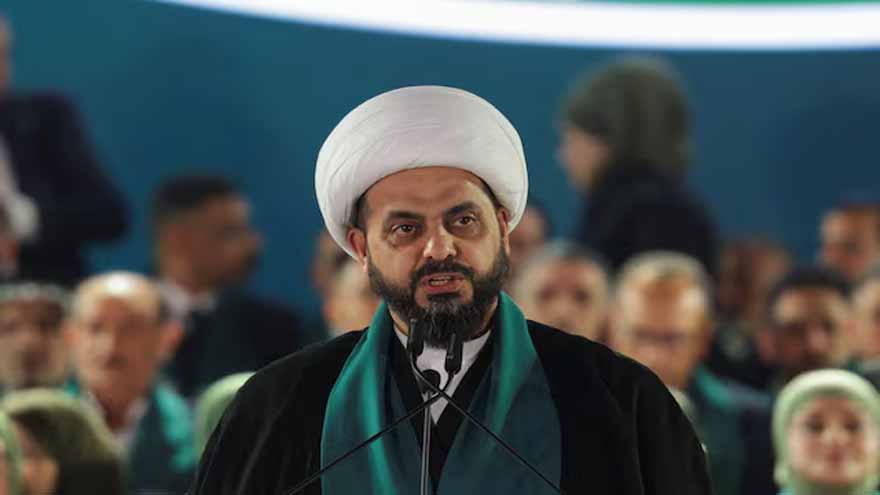
BAGHDAD — Qais Al-Khazali, the Iran-aligned militia leader designated a global terrorist by the United States, is attempting to soften his image and expand his influence in Iraqi politics ahead of parliamentary elections. Khazali’s Asa’ib Ahl al-Haq movement aims to transform from an armed militia into a political force, seeking to secure a stronger role in Shi’ite leadership and government formation.
Despite past controversies, Khazali has emphasized his commitment to politics, pledging in 2012 that his group would lay down its weapons and participate in the political process. Critics, however, remain skeptical, noting the group’s violent past, including attacks on US and British forces and alleged involvement in civilian killings during demonstrations.
Read More: Iraq’s al-Sadr supporters told to withdraw from parliament
Khazali rose to prominence after the 2003 US-led invasion of Iraq, initially as part of Moqtada al-Sadr’s Mehdi Army before forming his own militia in 2006. Asa’ib Ahl al-Haq has fought US forces, Islamic State militants, and participated in Syria’s civil war. Khazali’s political ambitions are part of a broader trend of former militia figures seeking legitimacy through electoral politics.
Many Iraqis remain disillusioned with the country’s political elites, including pro-Iranian militias, as repeated elections have produced little change in governance. Asa’ib Ahl al-Haq won five parliamentary seats in 2021 and hopes to maintain or slightly increase that level of support in the current vote. Success would consolidate Khazali’s role and strengthen Iran-aligned factions in Iraq, while poor performance could hinder his political ambitions.
Read More: US troops cross into Iraq as part of withdrawal from Syria
Khazali, born in 1974 in Baghdad’s Sadr City, has denied involvement in past sectarian killings and maintains that he is not wanted by the Iraqi government. Meanwhile, the US continues to impose sanctions on him and his group for past human rights abuses, underscoring the tension between his political aspirations and controversial history.