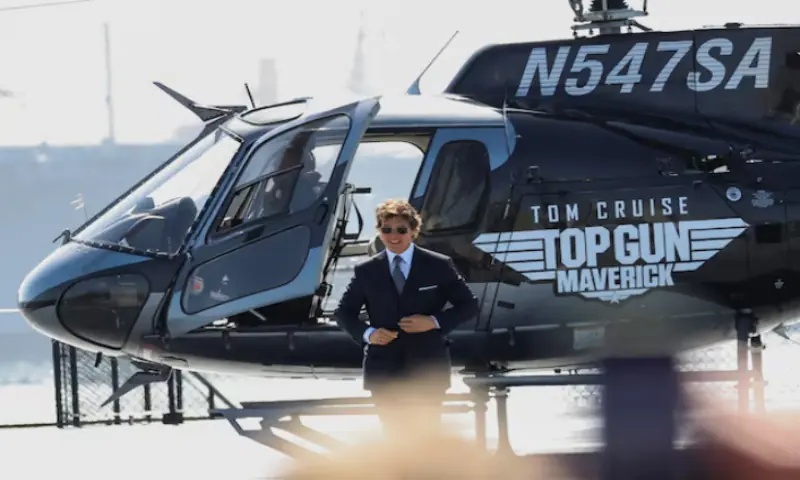
A US federal appeals court has ruled that the blockbuster film Top Gun: Maverick does not violate copyright laws, delivering a major legal victory to Paramount Pictures. The decision brings an end to claims that the 2022 sequel unlawfully borrowed from an article that inspired the original Top Gun film.
The ruling was issued on Friday by the 9th US Circuit Court of Appeals in Pasadena, California. The court found that Maverick was not substantially similar to a 1983 article by journalist Ehud Yonay about the US Navy’s elite fighter pilot training program.
Read More: ‘Top Gun: Maverick‘ lawsuit rejected by judge
Yonay’s article had been licensed to Paramount for the 1986 film Top Gun, in which he was credited. However, after the license was terminated in 2020, his heirs sought a share of the sequel’s profits, arguing that Maverick relied on the same creative foundation.
The plaintiffs, Yonay’s widow Shosh and son Yuval, claimed that both films shared similar characters, dialogue, plotlines, and themes centered on competitive fighter pilots. They argued that these similarities entitled them to compensation from the sequel’s massive success.
The appeals court rejected these arguments, stating that Maverick contained major new elements not present in the original work. These included a fresh storyline, new mission objectives, and Maverick’s role as a veteran pilot training a new generation.
Circuit Judge Eric Miller said the similarities cited by the plaintiffs were too general to qualify for copyright protection. He noted that ideas such as military competition and elite training are not exclusive and cannot be owned.
Read More: Tom Cruise unveils ‘Top Gun‘ sequel with mid-air stunt
The court also ruled that Paramount was not required to credit Yonay in Maverick, as the original agreement did not cover sequels. This upheld a lower court’s dismissal of the case in April 2024.
Top Gun: Maverick grossed more than $1.5 billion globally, becoming Tom Cruise’s highest-grossing film to date. Despite the ruling, Paramount still faces a separate lawsuit from a screenwriter claiming unpaid contributions.