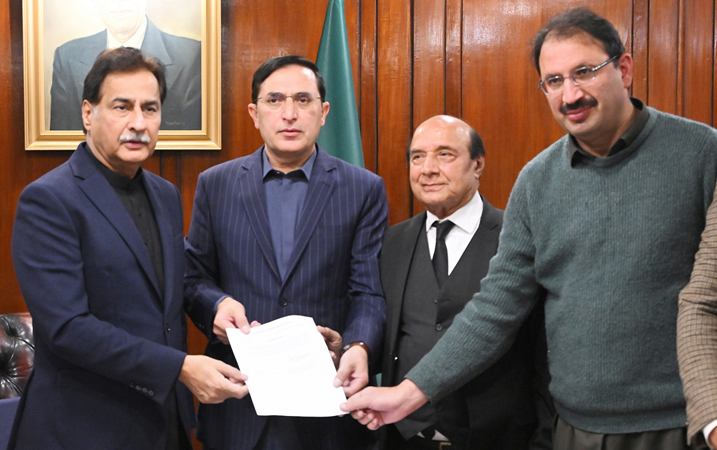
 The National Assembly Secretariat on Friday issued a notification declaring Mahmood Khan Achakzai, MNA, as the Leader of the Opposition in the National Assembly.
According to the notification, issued under Rule 39 of the Rules of Procedure and Conduct of Business in the National Assembly, 2007, the decision was approved by the Speaker of the National Assembly and has taken effect from Jan 16, 2026.
Achakzai, a senior parliamentarian and head of his party, will now assume the constitutional role of the opposition leader in the lower house of parliament.
The position carries key responsibilities, including consultation in important state appointments and playing a central role in parliamentary oversight.
The office of the Leader of the Opposition had remained under discussion in recent weeks amid evolving parliamentary alignments.
Separately, Prime Minister’s Adviser on Political Affairs Rana Sanaullah on Friday urged Pakistan Tehreek-e-Insaf (PTI) to return to parliamentary committees, stressing dialogue and cooperation to ease political tensions.
“PTI should come back and sit in the standing committees and play its full role in parliament,” he said while speaking during the media.
Stressing the importance of cooperation and building trust, Sanaullah said that PTI leaders also believed that solutions lay through parliament and dialogue.
The senior Pakistan Muslim League-Nawaz (PML-N) leader urged the PTI to cooperate with the government on certain matters and “improve its conduct” to help build political trust.
He said the government had taken better and positive steps, adding that similar gestures from PTI would help create an environment of confidence-building.
Sanaullah said that the National Assembly speaker notified Tehreek Tahafuz Ayeen-e-Pakistan (TTAP) chief Mahmood Khan Achakzai as the opposition leader in the NA after taking the views of opposition members.
Achakzai had been nominated for the top parliamentary post by PTI founder Imran Khan following the disqualification of his predecessor Omar Ayub after being sentenced to 10 years’ imprisonment in a May 9 case.
Meanwhile, Sanaullah said that Prime Minister Shehbaz Sharif and PML-N president Nawaz Sharif held positive views about Achakzai, stressing the TTAP chief stood by the party during difficult times.
However, he said that he was unaware of any contact between Achakzai and Nawaz.
The senior PML-N leader stated that the process to appoint Senator Allama Raja Nasir Abbas as the opposition leader in the upper house would begin once the Senate chairman returns to office, likely next week.
Referring to political engagement, Sanaullah said there were contacts with PTI leaders, who also believed in parliament and dialogue. “Whenever politicians have held talks, it has created ease and a way forward.”
However, he said PTI leaders have consistently stated that their party founder was not in favour of negotiations, though they hoped to persuade him if granted a meeting at Adiala jail. He also said PTI’s preparations suggested it would not call off its February 8 protest call, urging the party to return to parliament and play a positive role after the protest’s outcome.
Govt, opposition urged to hold talks
Former federal ministers Shah Mehmood Qureshi and Asad Umar on Friday urged both the government and the opposition to open dialogue in pursuit of political and economic stability, calling for a renewed “Charter of Democracy” to steer the country out of escalating uncertainty.
The two PTI leaders were presented before the Anti-Terrorism Court (ATC) in Lahore after their legal teams filed an application for their attendance in cases linked to the May 9 unrest.
The presiding judge extended their interim bail until February 13. Inside the courtroom, Qureshi and Umar held a brief discussion on the country’s fast-changing political landscape.
Speaking informally to journalists before hearing, Qureshi emphasised that political engagement between the government and opposition was essential for national stability. PTI’s detained leader said Pakistan had responded robustly during the recent flare-up with India but warned that New Delhi “was not likely to back off” and could “act again”.