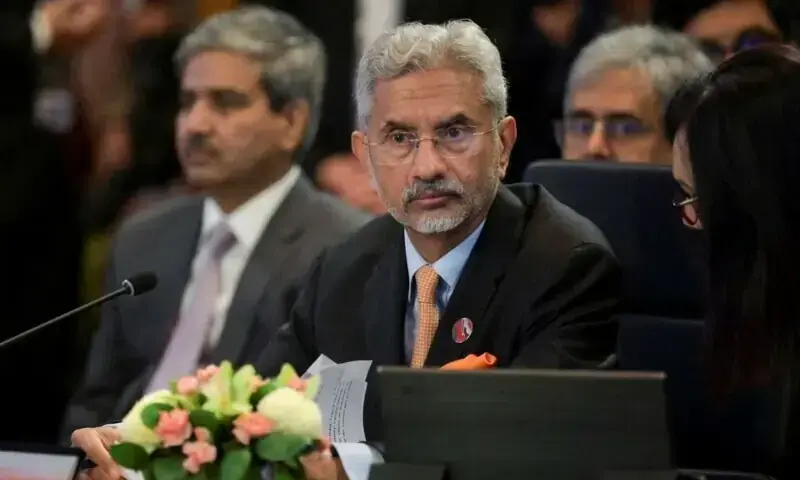
Politicians, bureaucrats, and journalists in Pakistan and India took to social media on Thursday to condemn India’s Foreign Minister Subrahmanyam Jaishankar for describing Pakistan as a “dalal nation” amid the US-Iran peace talks.
Thinks of himself a hi fi dalal, remarks reflect personal frustration. https://t.co/2Rr5hZG6Da
— Khawaja M. Asif (@KhawajaMAsif) March 26, 2026
Reducing diplomacy to name-calling may serve domestic politics—but it does little for peace. It reflects a sick mindset and ill behooves the External Affairs Minister of India to use such language against a country striving to bring peace in our region. https://t.co/KNyebWS4gs
— Jalil Abbas Jilani (@JalilJilani) March 25, 2026
Read More: Pakistan slams India at UN over water dispute claims
Jaishankar’s remarks, reported by India Today on Wednesday, came in response to opposition criticism in India over Pakistan’s mediating role between Washington and Tehran during the ongoing Middle East conflict. He asserted that India “cannot act as a ‘dalal nation’ in global geopolitics.”
What kind of a language is this to begin with? And the number of issues with this reported statement 😐 https://t.co/I9I1s13afe
— Smita Sharma (@Smita_Sharma) March 25, 2026
It seems the Modi’s Dalal, Babu Jaishankar and his cabal have lost all their marbles after May War last year. He seems to be infected with a self destructive virus besides a diplomatic dementia losing everything he had learnt in the diplomatic school. Fact is that he is a Dalal…
— Murtaza Solangi (@murtazasolangi) March 26, 2026
In Pakistan, the response was swift and sharp. Defence Minister Khawaja Asif said Jaishankar “thought of himself as a hi-fi dalal,” attributing the comment to personal frustration. President’s spokesperson Murtaza Solangi called it evidence of “diplomatic dementia,” adding, “Fact is that he is a Dalal of Modi who is a Dalal of Netanyahu.” Former Foreign Minister Jalil Abbas Jilani said the language reflected a “sick mindset” and served domestic politics rather than peace.
Foreign Affairs minister, supposed to be a high end diplomat, resorting to such bizarre language is evident of just one thing : India is frustrated and isolated. https://t.co/H5VR5oPMq0
— Gharidah Farooqi (T.I.) (@GFarooqi) March 25, 2026
You speak such language when grapes are sour and defeat is unforgettable, you lose the space day by day while going down like your jets. https://t.co/RLtpVQUEmV
— Asma Shirazi (@asmashirazi) March 25, 2026
Other Pakistani figures joined the criticism. Former Sindh governor Mohammad Zubair called it unprecedented, while Engr. Khurram Dastgir Khan labelled the comment “reprehensible.” Prime Minister Shehbaz Sharif’s coordinator, Rana Ihsaan Afzal Khan, pushed back, highlighting India’s previous attempts to mediate conflicts like Russia-Ukraine, calling the criticism “sour grapes.” Journalists Asma Shirazi and Gharidah Farooqi echoed the sentiment, calling the remarks “bizarre” and pointing to India’s growing isolation.
What an eloquent foreign minister India has wah 👏 😂now we know who’s behind global isolation and multiple failed fake narratives against Pakistan. Lost miserably https://t.co/yvxAGb8btF
— Ayesha ManzoorWattoo (@ayeshamwattoo) March 25, 2026
What an eloquent foreign minister India has wah 👏 😂now we know who’s behind global isolation and multiple failed fake narratives against Pakistan. Lost miserably https://t.co/yvxAGb8btF
— Ayesha ManzoorWattoo (@ayeshamwattoo) March 25, 2026
Even in India, reactions were mixed. Journalist Smita Sharma questioned the appropriateness of the language, while Pawan Khera of the All India Congress Committee pointed to India’s prior attempts to broker peace in Russia-Ukraine as evidence of selective criticism.
Was India a “Broker Country” when Modi was desperate to mediate between Russia & Ukraine? Selective brokering or selective memory ? https://t.co/sQrY5hS0WR
— Pawan Khera 🇮🇳 (@Pawankhera) March 25, 2026
Read More: Pakistan, India exchange sharp words at UNSC over Afghanistan
The remarks and ensuing backlash underscore heightened tensions between the two neighbours, with Pakistan defending its diplomatic role and critics on both sides questioning the decorum of high-level diplomacy.