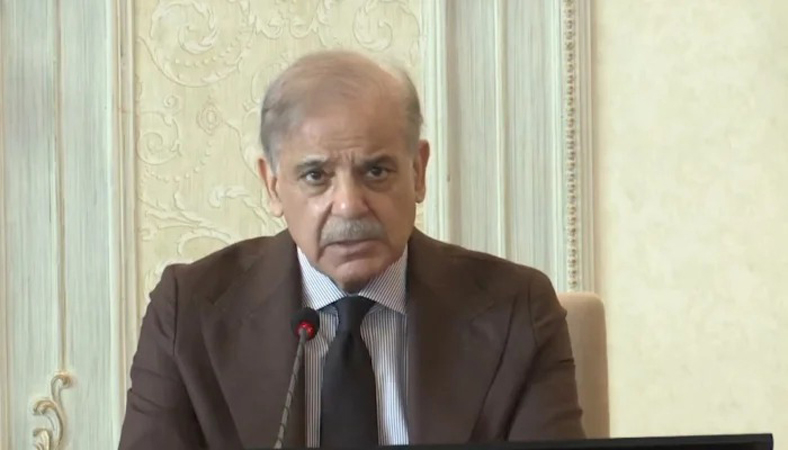
 Prime Minister Shehbaz Sharif on Wednesday said that Pakistan was still continuing its efforts to maintain peace in the region, highlighting the country’s proactive diplomatic role in easing tensions and promoting stability.
Addressing the cabinet, the prime minister highlighted that marathon talks between Iran and the US held in Islamabad on April 11 lasted for 21 hours and marked a significant diplomatic breakthrough. He said Pakistan made sincere and coordinated efforts for the success of the negotiations, with contributions from Field Marshal Syed Asim Munir, Deputy Prime Minister/Foreign Minister Ishaq Dar, and other senior officials.
As a result of these efforts, he noted, the ceasefire between Iran and the United States was extended and continues to hold. Interior Minister Mohsin Naqvi also played an important role in the process, he added.
The prime minister informed the cabinet that Iranian Foreign Minister Abbas Araghchi visited Pakistan with his delegation and held multiple rounds of talks, including a two-hour session with him. He said Araghchi assured that Iran would respond positively after consultations with its leadership.
PM Shehbaz further informed the cabinet that Pakistan had repaid $3.5 billion in due loans and maintained its foreign exchange reserves, with support from Saudi Arabia. He specifically acknowledged the role of Crown Prince Mohammed bin Salman in helping Pakistan sustain its reserve levels.
Meanwhile, two government sources familiar with the matter told Anadolu on Wednesday that Pakistan is working silently to break the ongoing deadlock between the United States and Iran, focusing on finding a new formula for a long-awaited agreement on the Strait of Hormuz and Tehran’s nuclear programme, two government sources familiar with the matter told Anadolu on Wednesday.
“Both sides are actively engaged in back-channel diplomacy, conveying formulae and counter-formulae through Pakistan to reach an agreement,” a source said, adding that the current negotiations were focused on the nearly closed Strait of Hormuz and the nuclear issue.
The sources, however, did not provide details on the formulae from either side, saying that Pakistan’s focus was on finding a “middle way” on the two simmering issues.
Washington and Tehran are currently deadlocked over a fresh Iranian peace proposal conveyed by Pakistan, following two visits to Islamabad last week by Abbas Araghchi, Iran’s foreign minister.
The proposal offered to end the war and reopen the Strait of Hormuz in exchange for the US lifting its blockade of Iranian ports.
“Nothing [in the formulae] is definitive as exchanges are ongoing,” said the source.
“Hopefully, the two sides will reach common ground soon,” the source added, saying that FM Ishaq Dar and Chief of Defence Forces and Chief of the Army Staff Field Marshal Asim Munir were “personally engaged” in the ongoing backdoor diplomacy to break the stalemate.
Tehran has also suggested that talks on its nuclear programme should be postponed for the next round of discussions, an offer President Donald Trump “has not so far shown an interest in accepting”, according to sources.
Brent oil prices have surged to more than $119 a barrel, their highest level since early 2022, raising the economic toll from the war in the Middle East, according to AFP.
Brent oil futures were up 7.6 per cent at $119.69, its highest level since the early days of the Ukraine war in 2022.
Moreover, Deputy Prime Minister/Foreign Minister (DPM/FM), Senator Mohammad Ishaq Dar on Wednesday spoke with UK Foreign Secretary Yvette Cooper, where the two leaders discussed the evolving regional situation.
Foreign Secretary Cooper reiterated UK’s appreciation for Pakistan’s sustained efforts for peace and stability in the region, as well as its continued engagement in this regard, a DPM’s Office news release said.
The DPM/FM reaffirmed Pakistan’s commitment to promoting dialogue, diplomacy, and constructive engagement between the parties. Both agreed to remain in close contact.