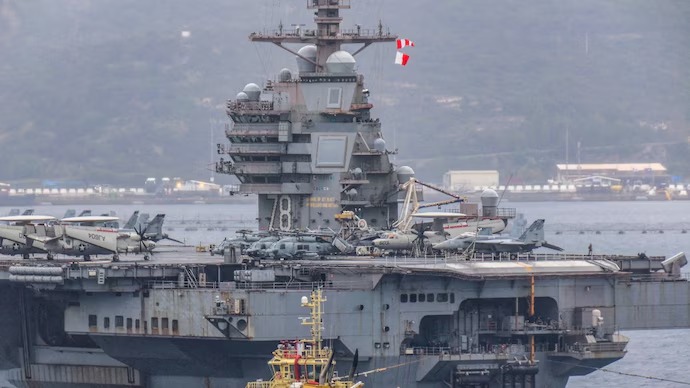
The USS Gerald R. Ford is set to return to the United States after completing a record-breaking deployment of more than 300 days at sea, spanning multiple high-tension regions. The world’s largest aircraft carrier will head back to its home port in Virginia by mid-May, marking the end of a mission that covered the Mediterranean, Caribbean, and Middle East. Its departure comes at a sensitive time, as regional tensions remain fragile and military dynamics continue to evolve.
The carrier’s withdrawal will reduce American naval presence in the Middle East, where the United States had deployed three aircraft carriers simultaneously, a level not seen since the early 2000s. The USS George H.W. Bush and USS Abraham Lincoln will remain in the region, maintaining operational coverage. However, the Ford’s exit signals a notable shift in military posture, especially as a delicate ceasefire with Iran continues alongside ongoing maritime restrictions.
Read more : UAE and Sweden discuss Middle East tensions
During its deployment, the Ford set a modern record for the longest post-Vietnam War mission by a US aircraft carrier, surpassing previous benchmarks held by other vessels. It spent more than 300 consecutive days deployed, exceeding the 294-day record of the USS Abraham Lincoln in 2020. Although it did not surpass Cold War-era records, the mission still stands out as one of the longest and most complex in recent naval history, reflecting evolving operational demands on modern fleets.
However, the extended deployment has raised concerns about the wellbeing of the nearly 4,500 sailors on board, as well as the strain on the ship’s systems and equipment. Reports of operational challenges, including a fire in a laundry area that required repairs, have highlighted the physical and logistical pressures faced during such prolonged missions. These incidents have also sparked discussions about maintenance needs and readiness after extended deployments in demanding conditions.
Read more : Middle East war devastates Pakistan’s economic gains –
The Ford’s journey covered several strategic theaters, beginning in the Mediterranean before shifting to the Caribbean and later moving toward the Middle East as tensions escalated. It also passed through the Suez Canal, reflecting its role in rapid redeployment across regions. This wide-ranging mission underscores the flexibility and reach of modern naval forces, which are increasingly required to respond quickly to evolving geopolitical challenges across different parts of the world.
As the carrier prepares to return home, defense officials have acknowledged that operational demands played a key role in extending its deployment beyond initial plans. The mission reflects a balance between immediate military requirements and long-term readiness considerations. With the Ford heading back, attention will now shift to maintenance, crew recovery, and future planning, while the remaining carriers continue to support US operations in the region.