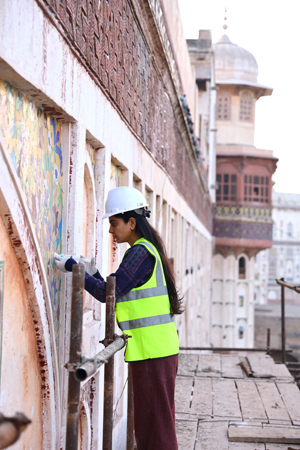
 A magnificent structure that represents the pinnacle of the Mughal Empire’s craftsmanship, the Lahore Fort’s Picture Wall is significant for many reasons. UNESCO recently described it as “one of the world’s largest and most extraordinary Mughal murals” and its conservation as “one of the most ambitious heritage conservation endeavors in Pakistan’s history.”
The nearly decade-long conservation of the Picture Wall was supported by multiple local and international donors. Funding was provided by the Government of Punjab, through the Walled City of Lahore Authority (WCLA), as well as by Aga Khan Trust for Culture (AKTC). International support came from the United States Ambassadors Fund for Cultural Preservation, the German Embassy, and the Royal Norwegian Embassy. WCLA offered institutional support to the project, while Aga Khan Cultural Service – Pakistan (AKCS-P), AKTC’s local affiliate, served as the implementing agency throughout all stages of the conservation intervention, contributing technical expertise.
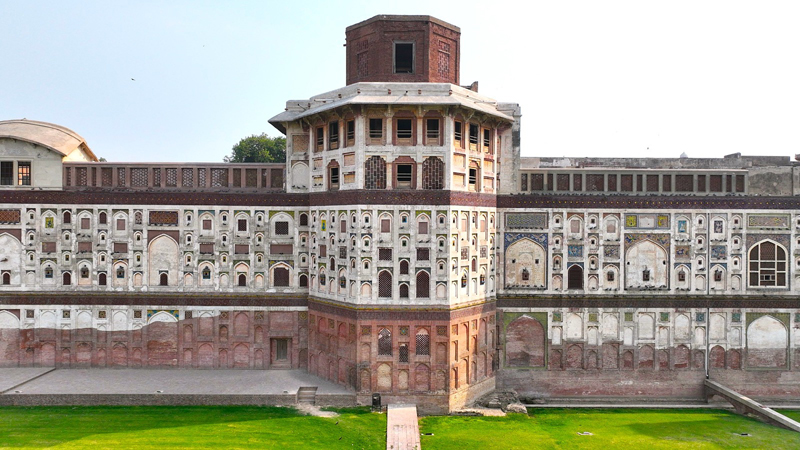
The conservation of the majestic wall constructed during the rule of the Mughal emperors Shah Jahan and Jahangir was implemented in phases. In the first phase, detailed documentation and research were carried out using scientific methods such as condition assessments, structural surveys, and historical analysis. This was followed by a workshop comprising conservators, chemists, and heritage specialists from around the globe to develop a roadmap for the full intervention based on the outcomes of work conducted on a selected section of the Western façade, which was treated as a prototype. Conservation efforts started with the Western façade in July 2018, which includes the Western Wall and Shah Burj Gate, and concluded in 2019. Work on the wall’s remaining section, the Northern façade, on the other hand, was completed in April this year, as part of the project’s final phase.
The team of heritage experts who meticulously conserved this iconic structure included conservators, architects, engineers, fine artists, and craftspeople, many of whom were trained under international consultants to deliver a conservation intervention of global standards. The project thus helped cultivate a new generation of conservation professionals, inspiring more people to pursue careers in heritage and cultural preservation.
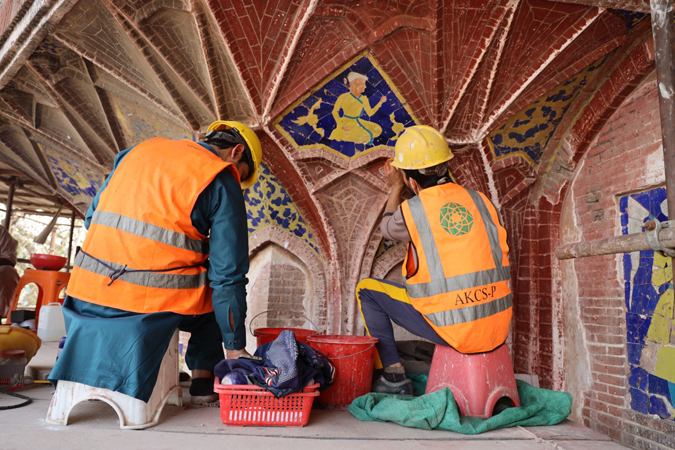
Capacity building also focused on the on-site training of unskilled and semi-skilled workers in traditional techniques through apprenticeship. At the grassroots level, the intervention contributed to the revival of traditional skills by engaging local craftspeople and incorporating techniques passed down through generations. In doing so, it safeguarded forms of indigenous knowledge that were gradually fading from practice and generated employment within the community.
Fuad Pashayev, UNESCO Representative in Pakistan, emphasized the role of partnerships in the success of the project. “The completion of the Picture Wall restoration is a testament to what can be achieved when scientific rigor, international solidarity, and local expertise work in concert,” he said. He further noted that the project’s approach could serve as a model for future conservation initiatives in the country. “We encourage Pakistan to carry this model of excellence forward,” he added.
The Picture Wall is a shining example of the inclusivity of the Mughal Empire’s cultural traditions. Its artwork reflects a range of influences encompassing Persian and Central Asian aesthetics evident in floral and geometric patterns, and South Asian craft traditions such as fresco painting, lime plaster work, and terracotta relief. European inspiration is also visible in the detailing of flora and fauna. Moreover, the wall presents a fascinating visual story of the Mughal empire, depicting scenes of processions, hunts, and courtly assemblies from the period.
While this enchanting 17th-century spectacle stood the test of time, over the years it suffered considerable damage caused by extreme weather, moisture due to outdated drainage, and fungal growth, all of which led to surface decay and structural collapse. Later interventions – such as the use of cement plaster and mortar – instead of strengthening and restoring the structure, ended up causing cracking and flaking of decorative elements. Additionally, ground fill caused the base of the wall to be buried, which, along with plaster layers, hid the original mosaic and fresco work.
Recent conservation efforts involved the removal of later interventions and biofilm, the reintegration of fresco and brick imitation work, structural stabilization, and the application of appropriate plaster to reveal the mural’s intricate patterns. The focus of the conservation strategy was to maintain the authenticity of the original form as much as possible, and therefore, the approach was geared towards preservation rather than reconstruction. Historical panel embellishments were retraced through rigorous research and analysis of historical techniques and trends.
Wajahat Ali, Director of Conservation and Design at AKCS-P, who oversaw the restoration of the Picture Wall, reflected on some of the challenges involved in implementing a project of such complexity.
“Over time, the project felt less like a structure and more like a living piece of history, carrying centuries of craftsmanship, memory, and stories. Each section of the wall presented new challenges, requiring not only technical solutions but also patience and care. Alongside conserving its decorative surfaces, we had to address structural issues, architectural complexities, and long-neglected drainage problems to ensure that the monument could continue to endure with authenticity,” he said. He also underscored the importance of a measured and thoughtful approach in executing a project that was both time-intensive and unpredictable.
“There were moments when quicker progress was expected, but we learned that heritage cannot be rushed, as haste can compromise its true character,” he shared. “We chose patience because in conservation, honesty and authenticity must always come first.”
The Picture Wall is considered a major contributor to the inclusion of Lahore Fort on the UNESCO World Heritage List. Its conservation stands as a successful partnership between local and international stakeholders and multidisciplinary experts, restoring a centuries-old work of art and, in the process, reviving complex artistic traditions rooted in the region’s cultural heritage.