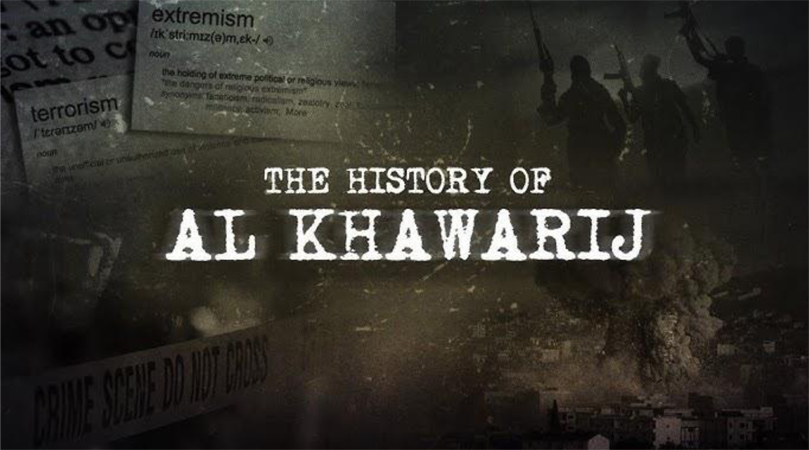
 Militancy, violent extremism & religious terrorism are often analyzed purely as political or security crises. However, treating terrorism merely as a series of physical security breaches fails to address the root of the problem. Terrorism is the ultimate physical act but it is driven by a pre-existing, coherent, and deeply flawed theological framework. In contemporary Islamic history, this psychological and ideological framework is best understood as Kharjiyat. To understand the ideological framework, one must examine the first deviant sect in Islamic history: the Khawarij. Derived from the Arabic word khuruj, meaning those who left. This group emerged during the 7th century during the first Islamic civil war.
Khawarij were originally part of the army of Hazrat Ali (RA). During the Battle of Siffin, Hazrat Ali (RA) agreed to human arbitration to stop further bloodshed among Muslims. A fanatical faction of his army revolted against this decision. They declared Hazrat Ali (RA) a disbeliever for trusting human judgment over the text of the Quran. This theological extremism culminated in 661, when a Kharji Abdul Rahman Muljim assassinated Hazrat Ali (RA).

Modern Khawarij Fitna
The historical Khawarij developed ultra-radical doctrines that completely isolated them from mainstream Muslims. Today, mainstream Islamic scholars and security analysts explicitly utilize the term Khawarij as a conceptual label for modern extremist networks, classifying groups like the Tehreek-e-Taliban Pakistan (TTP) and the Islamic State Khorasan Province (ISKP) as the modern manifestation of this fitna.

In fact, the Pakistani government officially designated the TTP as Fitna al-Khawarij to expose their theological deviation.

Core Ideological Commonalities
Despite different organizational structures, the old Khawarij and modern groups (TTP/ISKP) share five core ideological traits:

Unchecked Takfir
They pioneered the practice of takfir, declaring that committing a major sin (such as lying, adultery, or drinking alcohol) instantly turns a Muslim into a disbeliever who must be killed.
Modern Groups employ a sweeping application of takfir. ISKP routinely excommunicates mainstream Sunni & Shia Muslims. Similarly, TTP excommunicates state officials, military personnel, and civilians who support the Pakistani government.

Rebellion Against Muslim Governance
They weaponized Quranic slogans to reject legitimate authority and declare governments illegitimate over political treaties. Similarly, ISKP and TTP use the exact same logic regarding the concept of ALLAH’s sovereignty. They declare current state constitutions, democratic processes, and Muslim leaders to be Taghut.

Mass Killing of Innocent Muslims

Historically, they left non-Muslim communities largely untouched while explicitly targeting, terrorizing, and assassinating fellow Muslims who did not join their ranks. The primary victims of TTP and ISKP are other Muslims. They routinely target mosques, religious gatherings, funerals, marketplaces, and schools. Classical historian Ibn Kaseer famously wrote that if the Khawarij ever gained power, they would cause mass corruption and slaughter men, women, and children.

Rigid Textual Literalism
Khawarij were intensely hyper-literal, ripping verses out of their historical and linguistic contexts and possessing zero deep understanding. Both TTP and ISKP exploit religious texts, pulling specific verses about warfare and jihad out of context to justify suicide bombings, hostage-taking, and the killing of innocent civilians, completely bypassing established Islamic jurisprudence.
Eternal Internal Splintering
Because their ideology dictated that anyone who makes a political error or sins is an apostate, they constantly turned on each other, fracturing into dozens of warring sub-sects

The same volatility plagues modern outfits. ISKP was originally formed by disgruntled, high-level TTP defectors who broke away due to internal leadership disputes and localized versus global objectives. Today, despite sharing the same Kharijite operational blueprint, TTP and ISKP frequently engage in vicious ideological and physical clashes with one another.
Constitutional Refutation of Kharji Propaganda

The primary propaganda tool used by Kharijite groups like TTP and ISKP is takfir, falsely claiming that Pakistan’s governance is entirely secular, un-Islamic, or based on infidel British laws. 1973 Constitution of Pakistan directly neutralizes and dispels this narrative by codifying the supremacy of Sharia into the state’s legal framework.

Five Constitutional Pillars That Dismantle Extremism
1.Stripping the Narrative on Sovereignty (Article 2A)
Extremist groups claim that human legislation or democracy violates ALLAH’s sovereign Hakimiyyat.
Under Article 2A, the Constitution explicitly states that sovereignty over the entire universe belongs to Almighty ALLAH alone. It mandates that any authority exercised by the people of Pakistan is a sacred trust within the limits prescribed by HIM. This aligns perfectly with orthodox Islamic governance, entirely invalidating claims of structural apostasy.

2. Repugnancy Clause (Article 227)
Militants allege that Pakistan operates purely on secular, colonial-era laws and ignores Islamic jurisprudence.
Article 227 strictly decrees that no law shall be enacted which is repugnant to the Injunctions of Islam as laid down in the Holy Quran and Sunnah. Furthermore, it mandates that all existing laws must be brought into conformity with Islamic teachings.


State Religion and Leadership
They claim the state’s leadership is disconnected from Islam and serves non-Muslim interests.
Article 2 establishes that Islam shall be the state religion of Pakistan. The Constitution restricts the offices of both the President (Article 41) and the Prime Minister (Article 91) exclusively to Muslims. These leaders must take a rigorous oath affirming their belief in TAWHEED & KHATM-E-NABUWWAT, and their commitment to upholding the Islamic ideology of Pakistan.

Institutionalizing Islamic Law
Radical factions claim that the Pakistani judiciary ignores Sharia and functions only via Western legal norms.
Whereas Constitution establishes robust, independent institutions to legally safeguard its Islamic identity. The Federal Shariat Court holds the unique judicial power to strike down and nullify any federal or provincial law if it is found to contradict the Quran or Sunnah. Council of Islamic Ideology serves as an advisory body consisting of religious scholars representing various Islamic schools of thought, reviewing state policies to ensure complete Islamic compliance.
Paighaam-e-Pakistan
Because the state’s supreme law officially anchors itself to the Quran and Sunnah, mainstream religious authorities utilize the Constitution to systematically declare that taking up arms against the state is an act of Khuruj or Baghawat rather than Jihad.

Paighaam-e-Pakistan is a historic national decree signed by over 1,800 Pakistani Islamic scholars representing all major schools of thought. It uses the 1973 Constitution as its primary legal anchor to strip terrorist groups of their religious legitimacy. The fatwa explicitly declares terrorism, suicide bombings, and armed rebellion against Pakistan to be Haram through several legal and theological arguments.
Strategic Recommendations to Curb the Menace
While military operations are essential to dismantle the physical networks of Fitna al-Khawarij, permanently immunizing society requires a multi layered approach that addresses the ideological volatility, digital reach, and foreign proxy lifelines of these groups.
First, Khariji ideology is inherently volatile and prone to constant internal fracturing, state intelligence and counter-terrorism strategies should actively exploit these fault lines. Highlighting internal disputes over leadership and operational objectives between TTP and ISKP can systematically disrupt their organizational cohesion.
Second, Structural comparisons between Khariji propaganda and constitutional reality must be moved from specialized papers into mainstream education. Integrating the Islamic provisions of the 1973 Constitution and the Paigham-e-Pakistan into the national school and madrasah curriculums will permanently de-legitimize the extremist narrative that Pakistan operates on secular, infidel laws.
Third, Modern Khawarij pull specific verses about warfare out of context to target vulnerable populations on digital platforms. The state must establish advanced counter-theology media hubs that dismantle literalist distortions in real-time, restoring the traditional scholarly framework of fiqh and ijma.
Fourth, In alignment with the fatwa’s legal principles, policies must differentiate between the ideologically hardened leadership of these groups and the misled, low-level recruits. While the former require strict kinetic containment, the latter should be provided targeted psychological de-radicalization, theological counseling, and vocational training to reintegrate them safely into the state’s social contract.