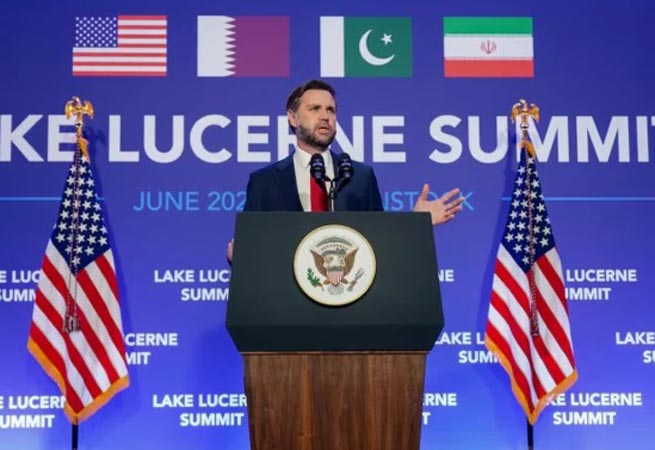
 The United States temporarily suspended sanctions on Iranian oil on Monday after Vice President JD Vance said Iran would let UN nuclear inspectors return to the country, following talks in Switzerland.
Last week, Tehran and Washington signed a memorandum of understanding laying the groundwork for the negotiations, after nearly 40 days of fighting that was followed by a shaky and often-broken ceasefire.
Officials said conditions had been set for 60 days of technical talks to begin, again in Switzerland, to secure a long-term settlement.
“We laid a very good foundation for a successful final deal,” Vance told reporters at Switzerland’s luxury Burgenstock resort, adding that “the final deal is the house… We haven’t built the house, but we’ve laid a successful foundation to get to a good place for the American people”.
“The final deal is the house. We set the foundation; we haven’t built the house, but we’ve laid a successful foundation to get to a good place for the American people.
“It’s important for all of us to appreciate how much was done, but honestly, there is still a lot to do as we continue to make progress on the nuclear talks, on the economic talks, as we continue to demine the straits and ensure that that flow of traffic continues to pick back up.
“A lot of progress but still some work to do – and we’re very committed to doing exactly that.”
He insisted that the strategic Strait of Hormuz waterway “is open”, with “millions and millions of barrels of crude and natural gas flowing through… that weren’t flowing before”.
Separately, the US Treasury said it was temporarily lifting sanctions on Iran to allow the Islamic Republic to produce, sell and deliver crude oil and related products through August 21.
US Treasury Secretary Scott Bessent cited Tehran’s commitment in ongoing negotiations to “free and open transit” in the Strait of Hormuz and permission for International Atomic Energy Agency (IAEA) inspectors to enter their country as a reason for pausing the sanctions.
The negotiators aim to tackle some of the most intractable issues that have dogged US-Iranian relations for decades, including Tehran’s nuclear programme.
Iranian foreign Ministry spokesman Esmaeil Baqaei said on Monday that “a very brief discussion took place regarding the nuclear issue, but there was no discussion of details” and that nuclear talks had not begun.
Vance, meanwhile, said Tehran had agreed to invite IAEA inspectors “back to their country”, calling it “a major milestone… and the first step in permanently denuclearising” Iran.
Tehran suspended some cooperation and blocked inspectors from the agency accessing key nuclear sites bombed by the US and Israel in 2025’s 12-day war, but inspectors continued to visit Iran, last doing so in November.
Iran was yet to comment on Vance’s statement on Monday.
As part of the deal, Tehran is set to get some form of sanctions relief from Washington, as well as the unfreezing of assets.
Vance insisted that assets had not yet been unfrozen and that, if they were, they would be used to buy US goods such as soy beans and would not fund terrorism.
He called it “a classic Trump deal, where if Iranian assets are ever unfrozen, they’re going to go to make American farmers richer and to feed the Iranian people”.
Shortly after, the US said it was lifting sanctions on Iranian oil sales until August 21.