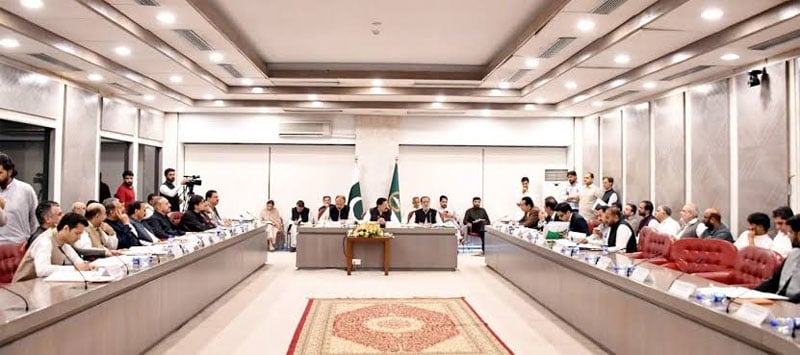
 Signaling growing parliamentary concern over the country’s security landscape, the National Assembly’s Standing Committee on Interior and Narcotics Control on Friday decided to hold a special meeting in Quetta to undertake an on-ground assessment of the law and order situation in Balochistan, marking a significant shift from the proposal to receive a briefing within Parliament House.
The decision came during the committee’s 28th meeting, chaired by Raja Khurram Shahzad Nawaz, MNA, at Parliament House, where lawmakers also reviewed key legislative proposals, infrastructure delays in Islamabad, the regularization of illegal housing schemes, and longstanding land record disputes affecting residents of the federal capital.
The committee confirmed the minutes of its previous meeting held on June 9, 2026, and expressed satisfaction over the implementation of its earlier recommendations after reviewing the compliance report submitted by the relevant authorities.
Security issues dominated the proceedings as members deliberated on the prevailing law and order situation in both Balochistan and Azad Jammu and Kashmir. While some lawmakers suggested an in-camera security briefing in Islamabad, the committee ultimately agreed that a visit to Quetta would provide members with firsthand insight into the situation and enable them to formulate informed recommendations for the government.
On the legislative front, the committee considered three government-sponsored measures: the Code of Criminal Procedure (Amendment) Bill, 2025, the West Pakistan Motor Vehicles Taxation (Amendment) Bill, 2025, and the Islamabad Capital Territory Local Government (Amendment) Bill, 2026.
Following detailed discussions, the committee deferred consideration of both the Code of Criminal Procedure (Amendment) Bill and the ICT Local Government (Amendment) Bill for further examination.
Officials from the ICT Excise and Taxation Department informed members that the Ministry of Law and Justice had advised that the objectives of the West Pakistan Motor Vehicles Taxation (Amendment) Bill had already been incorporated into the Finance Act, 2026-27, making separate legislation unnecessary. Consequently, the committee recommended that the bill be treated as withdrawn.
The committee also expressed serious concern over the prolonged delay in the construction of Sher Dhamial Road and Sigga Bintrar Road in Islamabad. Chairman of the Capital Development Authority (CDA) attributed the delay to inadequate budgetary allocations but assured lawmakers that additional funds would be provided subject to resource availability.
Directing the CDA to prioritize completion of ongoing road projects rather than launching new development schemes, the committee stressed that public convenience should take precedence over expansion plans. Minister of State for Interior and Narcotics Control Talal Chaudhry informed members that the CDA would present a detailed account of available funding for the projects at the committee’s next meeting.
Urban planning and unauthorized housing developments also came under scrutiny. Discussing the proposed engagement of consultants for preparing a feasibility study on the regularization and upgradation of illegal housing schemes and settlements in Islamabad, Committee Chairman Raja Khurram Shahzad Nawaz observed that the CDA Board already possessed the authority to engage consultants where necessary.
He emphasized that Islamabad’s zoning regulations, building by-laws and planning framework require comprehensive revision to reflect present-day realities. The chairman noted that legally feasible regularization of existing settlements would not only improve civic service delivery but also strengthen the CDA’s financial position through the collection of regularization fees and other statutory charges.
The committee urged the government to evolve a practical regulatory framework for existing settlements while simultaneously introducing effective safeguards against future illegal developments. The CDA chairman assured members that the authority remained committed to the objective but required an appropriate policy framework and formal approvals before implementation.
Another issue drawing strong criticism from lawmakers was the continuing ban on registry and mutation (Inteqal) of land in Khanna Dak, Khanna Kak and Shakrial. Members voiced frustration over the persistent delay in transferring land records from Rawalpindi to the Islamabad administration, describing the issue as a source of prolonged hardship for affected residents.
Observing that the matter had repeatedly surfaced before the committee without tangible progress, lawmakers directed the Senior Member of the Punjab Board of Revenue, the Commissioner Rawalpindi and other concerned officials to appear before the next meeting with a definitive timeline for completing the transfer of the remaining land records.
The committee maintained that the prolonged delay could no longer be justified and called for immediate administrative action to resolve the issue.
The meeting was attended by Minister of State for Law and Justice Barrister Aqeel Malik, Minister of State for Interior and Narcotics Control Talal Chaudhry, MNAs Anjum Aqeel Khan, Chaudhary Naseer Ahmed Abbas (via video link), Malik Shakir Bashir Awan, Chaudhary Muhammad Shahbaz Babar, Syed Rafiullah, Sardar Nabeel Ahmed Gabol, Abdul Qadir Patel (via video link), Nawabzada Mir Jamal Khan Raisani, Rana Ansar, Muhammad Ijaz-ul-Haq and Khushal Khan Kakar.
Senior officials from the Ministries of Interior and Narcotics Control and Law and Justice, the Capital Development Authority, the Federal Investigation Agency, as well as the Deputy Commissioner Islamabad and the Additional Deputy Commissioner (Revenue), Rawalpindi, also participated in the proceedings.