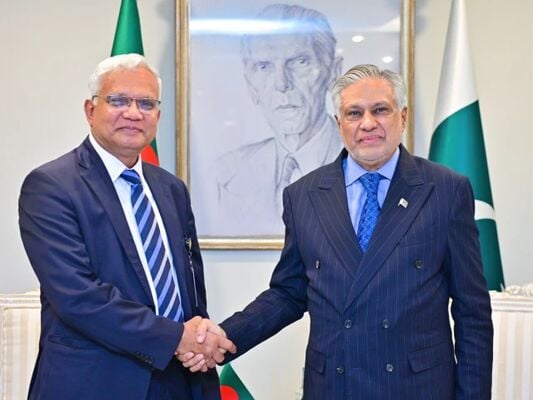
Deputy Prime Minister and Foreign Minister Ishaq Dar reaffirmed Pakistan’s commitment to stronger relations with Bangladesh during talks with Bangladesh’s Minister for Women, Children and Social Welfare, Dr AZM Zahid Hossain, in Islamabad. The meeting underscored both countries’ shared interest in expanding bilateral cooperation and enhancing engagement across multiple sectors. The discussions also reflected growing diplomatic efforts to strengthen ties between the two South Asian nations.
Dar welcomed Dr Hossain, who is visiting Pakistan to attend the Ninth Organisation of Islamic Cooperation (OIC) Ministerial Conference on Women. He appreciated Bangladesh’s participation in the conference and reaffirmed Pakistan’s commitment to advancing cooperation on women’s empowerment within the OIC framework. Dar also recalled his visit to Dhaka last August and expressed Islamabad’s readiness to broaden collaboration in areas of mutual interest.
Read more: Pakistani FM Ishaq Dar to visit Bangladesh as relations improve
Both leaders exchanged views on expanding cooperation in trade, education, social welfare, and people-to-people contacts. They agreed that stronger bilateral engagement would benefit both countries and contribute to regional understanding. The meeting highlighted the importance of maintaining regular dialogue and promoting practical partnerships across key sectors.
Dr. A. Z. M. Zahid Hossain, Minister for Women, Children and Social Welfare of Bangladesh, called on the Deputy Prime Minister/Foreign Minister Senator Mohammad Ishaq Dar @MIshaqDar50 last evening.
Welcoming Dr. Hossain to Pakistan for the 9th OIC Ministerial Conference on Women… pic.twitter.com/6Y8dLZKOe2
— Ministry of Foreign Affairs – Pakistan (@ForeignOfficePk) July 14, 2026
The discussions came as the Ninth OIC Ministerial Conference on Women adopted the Islamabad Declaration, reaffirming member states’ commitment to empowering women and girls. The declaration also launched a new initiative to promote digital inclusion for women across the Muslim world. It called for stronger policies to improve women’s participation in political, economic, and public life.
Read more: Ishaq Dar to visit Bangladesh for key talks
The declaration further urged member states to remove barriers to women’s education and employment while expanding access to vocational training, entrepreneurship, and financial services. It also emphasized greater opportunities for women in science, technology, engineering, mathematics, artificial intelligence, and other emerging technologies, describing these sectors as essential for inclusive development.