America, Russia and China, the three major military powers today, have not fought one another directly before or after the two World Wars. They have, however, been involved in dozens of conflicts in which other countries have fought on their behalf.
In recent past, all three have launched vigorous efforts to improve security in areas of particular interest to them. America has been expanding and consolidating her sphere of influence in Asia-Pacific by implementing the Pivot to Asia or Asia-Pacific Rebalancing Policy. It has also sought to control and manage Europe, Middle East, the CASA region, Africa, South America and Latin Americas through Bretonwoods financial institutions and the NATO military alliance. Russia has invaded Crimea and parts of Ukraine and has been accused of secretly trying to destabilize European democracies. China has built artificial island fortresses in international waters, claimed vast swathes of the western Pacific, and moved to organize Eurasia, Central Asia and South Asia in ways favourable to her through the biggest infrastructure development programme ever under its Belt and Road Initiative.
Iran has expanded its influence over much of Iraq, Lebanon, Syria, and Yemen and is allegedly pursuing nuclear weapons. Pakistan, despite having won the war against terror at an extremely heavy cost, remains under tight US scrutiny through the IMF, the World Bank and the FATF. It faces multi-front wars through 5th generation warfare for two reasons 1) its nuclear deterrence capability and 2) its pivotal role in the Chinese BRI through development of Gwadar deep sea port and completion of China-Pakistan Economic Corridor.
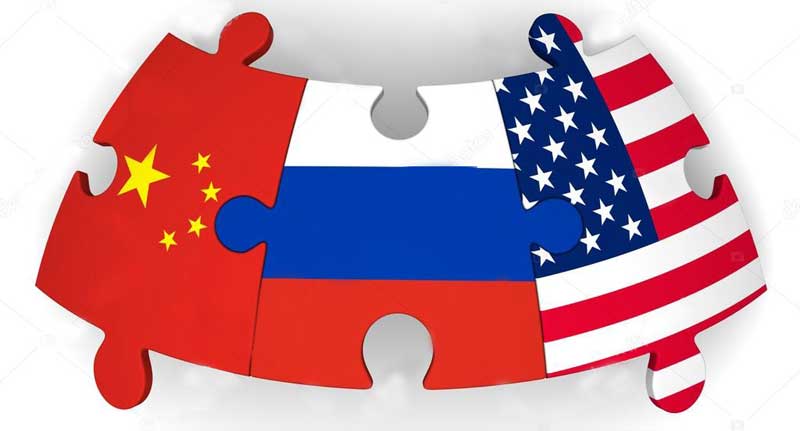 Some Western foreign policy experts are of the view that following the Cold War example, the US should move to contain Russia, China and Iran.
Cold War divided the world into rival camps, splitting regions and even countries. Similar cleavages are developing today with each revisionist power seeking its own sphere of influence. Russia is reasserting control over parts of former Soviet Union, China is gaining control over maritime commerce in the western Pacific and dominating lines of communications connecting Asia with Europe. Iran continues to control vast oil reserves in the Persian Gulf. Pakistan is proving a formidable hurdle to the Indian bid for regional hegemony and super power status.
So far the USA has been successful in capitalizing on the competing interests of her competitors. Contemporary containment will involve three initiatives i.e. ideology, economy and military. As for ideology, Russia has completely abandoned communism and China partially. Iran’s ideological appeal is limited primarily to Shiite minorities in the neighbourhood. Pakistan represents a relatively moderate Islamic ideology the presence of small ultra-orthodox minorities notwithstanding. Conflicts in Middle East have helped America effectively divide Muslim World into two distinct blocks on sectarian basis i.e. Saudi-led Sunni and Iran-led Shiite blocks.
So far, none of the perceived rivals possesses the military might of the former Soviet Union. Russia is a shrunken version of its older self militarily and Iran lacks formidable modern military forces. China’s economic growth may ultimately allow it to match the United States, but to date, Beijing is concentrating on developing forces to exclude the United States from the Western Pacific, not to project power globally. Lastly, unlike Soviet Union which was largely detached from the US-centred global economy during the Cold War; China is fully engaged. Russia and Iran have relatively small economies and export mostly energy, but China has the world’s second-largest economy, with deep, wide, and growing connections everywhere.
America, Russia and China, the three major military powers today, have not fought one another directly before or after the two World Wars. They have, however, been involved in dozens of conflicts in which other countries have fought on their behalf
Pakistan has yet to recover from conflicts on its western borders. It also has unresolved disputes with India. It will also have to focus on ideology, economy and military capability. On the ideological front, the government will have to suppress the extremists groups with an iron hand. It will also need to rehabilitate the survivors and integrate them in the national mainstream. This is one area where international actors are likely to lend a helping hand.
Protection of minorities’ rights, investment in tourism and interfaith harmony will go a long way in restoring normalcy.
A fragile economy has been Pakistan’s Achilles heel since its inception. The government should recover the looted public money and rid the country of the corrupt Mafia. Austerity should be adopted. A careful purge of the politicized bureaucracy is imperative. Pledges of investment by some friendly countries are encouraging. China should be asked for BOT loans.
Finally, the military capability. Pakistan has attained multi-tiered nuclear deterrence with second strike capability. Its conventional capability to thwart any misadventure against Pakistan is formidable. Pakistan should be part of a defence alliance including China and Russia. The armed forces must remain vigilant.
Last but not least, winning the wars of narratives is as important as winning other battles. The ISPR has played its roles with diligence and maturity. However, the battle of narratives is a continuous effort. There should be no complacency.
The writer is a retired army officer with rich experience in military and intelligence diplomacy