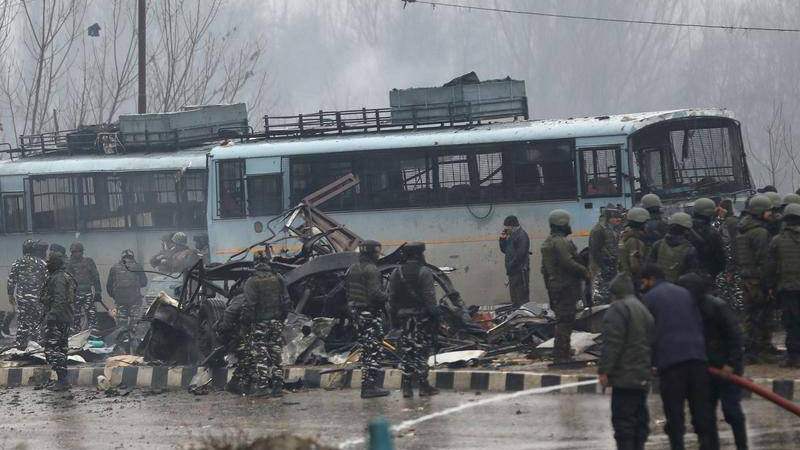
 Calling upon the United Nations Security Council (UNSC) to take steps for maintaining peace and stability in the region, speakers at a roundtable titled ‘Pulwama: A Strategic Understanding’ stated that the Pulwama incident has changed the dynamics of war in South Asia as no war can remain limited in terms of time, space and effects.
At the event organized by Centre for Aerospace and Security Studies (CASS) and the South Asian Strategic Stability Institute (SASSI) University here, the speakers maintained that unilateral use of force cannot yield results for India either on the domestic front or the regional security calculus as it only increases the threat of a large-scale war between India and Pakistan. This is particularly true if the human rights violations in the Indian-held Kashmir remain unchecked and India continues to pursue a policy of aggression under the rubric of pre-emptive defense, they added.
Former chief of air staff and CASS President Air Chief Marshal (r) Kaleem Saadat, Chairperson of SASSI University Dr Maria Sultan, Air Marshal (r) Javaid Ahmed, Director Economic Policy and BRI at SASSI University Dr Shazia Ghani and Director CASS Dr Usman Chohan were prominent among those spoke on the occasion.
In his address, Deputy Chief of Air Staff Air Marshal Shahid Akhter Alvi said after the Pulwama incident, Indian Air Force has ended up in an unviable state while the Pakistan Air Force has acted responsibly and with restraint. Any breach of sovereignty will be dealt with stern and fierce actions, he added.
In his remarks, Air Chief Marshal (r) Kaleem Saadat said there are two problems with the Indian narrative. He said the freedom struggle by the Kashmiri people cannot be categorised as terrorism but a struggle for freedom allowed under Article 1 of the UN Charter. Secondly, he said, the aggression against Pakistan cannot be condoned as counter-terrorism operations.
He said India showed that every terrorist action will give New Delhi a license to launch its air force or army. He said captured Indian pilot Abhinandan who should have been embarrassed while returning to India was fictionally made a hero for allegedly having shot down a PAF F-16. A perpetrator of terrorism, genocide, subversion and xenophobia is being painted as a victim of terrorism, he added.
SASSI University Chairperson Dr Maria Sultan made a detailed presentation about act of war and the doctrinal debate after the Pulwama incident in which impacts on policy making after the Indian aggression and counter-strike by Pakistan were discussed. She highlighted that by attacking Pakistan, India has internationalised the Kashmir issue. “Consequently, a resolution of the long-outstanding issue is in order. It is therefore urgent that Pakistan takes up the issue of Indian act of war, its linkage with Kashmir and the Indian hybrid war imposed on Pakistan at the United Nations. Doing so will make Pakistan less vulnerable to coercion and any planned aggression in future,” she said.
Dr Sultan said the Indian attempt to achieve high-end political and military objectives under a nuclear overhang in a region prone to crises escalation is fraught with frightening consequences. She said Pakistan must consolidate its narrative, including a proactive approach towards India and its hybrid endeavours to destabilize Pakistan, and emphasize on resumption of dialogue and international mediation.
In his address, Air Marshal (r) Javaid Ahmed said the use of Indian Air Force for a failed strike inside Pakistan, the highly effective defensive counterstrike by Pakistan, and raising the nuclear ante by India are serious developments, exacerbated by an almost absence of the international players. He said after suffering aerial losses, significant force transformation steps will be a compulsion for India, which will increase instability in the region.
Director Economic Policy and BRI at SASSI Dr Shazia Ghani spoke on India’s choice of geo-economics tools to inflict unsustainable economic cost on Pakistan. “India’s choice of geo-economic tools is a reflection of changing global geo-strategic scenario where economic tools are being used to settle geo-political scores,” she said, and further explained how Pakistan is facing fundamental geo-economic challenges post-Pulwama.
CASS Director Dr Usman Chohan made a detailed presentation about FATF and argued that the formalisation and implementation of better oversight over economy is in Pakistan’s best long-term interests. “But our stakeholders must realize that international economic institution can and do serve as a tool for structural violence, and FATF is playing such a role against Pakistan,” he maintained.