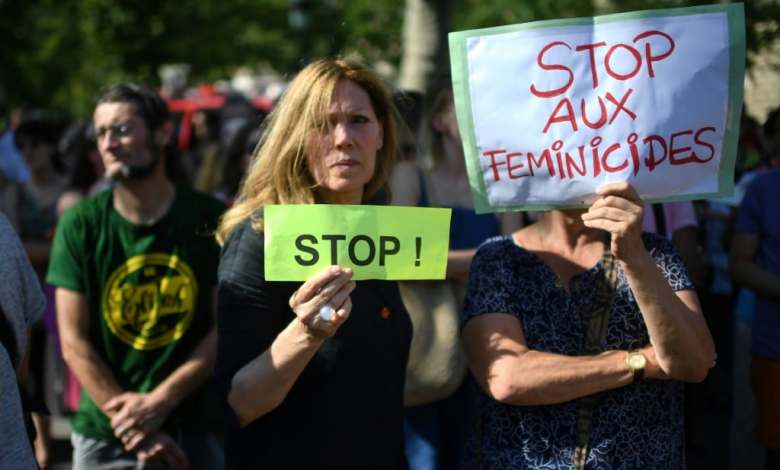
As life gradually returns to normal in Europe, there has been a resurgence of deadly violence against women as abusers experience a “loss of the control” they enjoyed throughout the coronavirus lockdowns.
And their faces are making the headlines. Like Chahinez, a French woman who was burnt alive by her estranged husband, or the five women killed in three weeks in spring in Sweden, whose images haunt TV bulletins there.
In the few European countries where official statistics for 2021 are available, the figures are indisputable: in Spain, for example, since the state of emergency ended in May, one woman has been killed every three days, compared with an average of one a week before. In Belgium, 13 women have died from violence since the end of April compared with 24 in the whole of 2020, while in France, 56 have been killed so far this year compared with 46 for the same period a year earlier, NGO figures show. “With women gaining more freedom, the aggressors feel as if they’re losing control and react with more extreme violence,” explained Victoria Rosell, head of the Spanish government’s taskforce against gender violence. “In the case of the increasing numbers we’ve seen in recent months, we’ve seen how easing the restrictions has exposed another underlying pandemic, that of male violence.”
In 2004, Spain approved Europe’s first law that specifically cracked down on domestic violence, making the victim’s gender an aggravating factor in cases of assault. And with the recent rise in deadly violence, Prime Minister Pedro Sanchez has reiterated his desire to put an end to this “misogynist scourge” once and for all.
– Difficulty calling for help –
Throughout Europe, the lockdowns have made it harder to pick up on cases of domestic violence. Forced to stay at home with their abusers, victims could only reach out for help with extreme discretion.
During Spain’s three-month lockdown at the start of the pandemic, appeals for help rose by 58 percent compared to the same period in 2019 with online — or “silent” — appeals soaring by 458 percent, equality ministry figures show. “This shows how women were not even able to make a phone call from home,” said Rosell. The same was true in Italy and Germany, with calls to domestic violence hotlines peaking in April and May 2020, while in the UK, the NGO Refuge said calls almost doubled between spring 2020 and February 2021. To provide a lifeline to women at risk, different counties came up with innovative ways to call for help, such as Italy where women could call a police emergency number and say: “I’d like to order a margarita pizza” which would alert the operator to send round a patrol. In Spain, women could alert the authorities by going into a chemist, one of the few shops open during the lockdown, and requesting “a purple mask”. Although the number of calls for help rose, both the number of complaints and murders fell during the lockdowns, explained Angeles Carmona, head of Spain’s Observatory for Domestic and Gender-based Violence.
– ‘Ideal conditions for control’ –
In France, Italy and Spain, the number of women killed by their partner or ex-partner fell last year to 90, 67 and 45 respectively, while in Belgium it remained unchanged at 24. But the numbers don’t surprise Angeles Jaime de Pablo, head of Themis, a Spanish organisation of women jurists, who says the combination of working from home and the lack of social contact created the “ideal conditions for exercising the violence of control”. And in that light, the recent increase in deadly violence was “foreseeable”, she told AFP.
Under normal circumstances, such violence is often triggered by a divorce or separation, or when an ex-partner starts a new relationship — situations which have been largely put on hold during the lockdown. “Once the state of emergency and the lockdowns ended, many victims took things into their own hands and decided to leave,” explained Carmen Ruiz Repullo, a sociologist who specialises in gender violence. “And that’s where the risk is much higher and you start seeing these murders.”