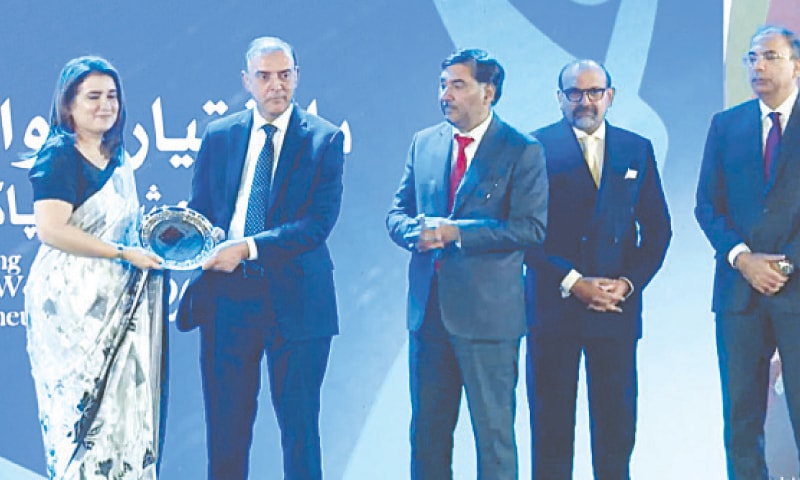
KARACHI: Women’s participation in the economy is not just a matter of equity but a catalyst for national growth, State Bank of Pakistan (SBP) Governor Jameel Ahmad said at the Pakistan Women Entrepreneurship Day 2025 event.
Read More: Women’s empowerment key to tackling Pakistan’s population crisis
He revealed that women’s financial inclusion has climbed to 52 per cent, with the gender gap narrowing significantly from 47pc in 2018 to 30pc in 2025. More than 17.6 million new women-owned bank accounts have been opened since 2021.
Between November 2024 and October 2025, over 974,000 loans amounting to Rs230.3 billion were issued under the government-led push to expand women’s access to finance. However, 93pc of these loans fall under microfinance, highlighting that most women remain restricted to entry-level economic activity. This disconnect between access and advancement reflects in entrepreneurship as well, where only 1pc of enterprises are led by women.
“When women earn, their families flourish, their children attend school regularly and their communities benefit,” Ms Munir highlighted.https://t.co/o2rE1T6GSA
— Dawn Business (@dawn_business) December 4, 2025
Zeelaf Munir, chairperson of the Pakistan Business Council, noted that 92pc of women-owned enterprises operate informally, making them “unseen and under-recognised” despite their contribution. She stressed that access to finance alone is insufficient without integration into formal value chains. Citing Artistic Milliners’ work with women cotton farmers, she said the company’s strategic support — from training to sustainable inputs — improved yields, reduced pesticide and fertiliser use, and cut farming costs by 33pc.
Ms Munir argued that such structural models are critical for long-term competitiveness, drawing parallels with Bangladesh’s garment sector, which scaled globally by integrating women at every stage of the value chain. “When women earn, their families flourish and communities progress,” she said.
Read More: Women empowerment is a myth in Pakistan
TCS President Saira Awan Malik added that cultural expectations and mobility constraints remain significant barriers for women, especially in conservative societies. She urged that women’s participation be viewed as a force for social and economic progress, not a cultural threat. Looking ahead, the SBP governor said the National Financial Inclusion Strategy 2024–28 aims to raise overall financial inclusion to 75pc and reduce the gender gap to 25pc by 2028.