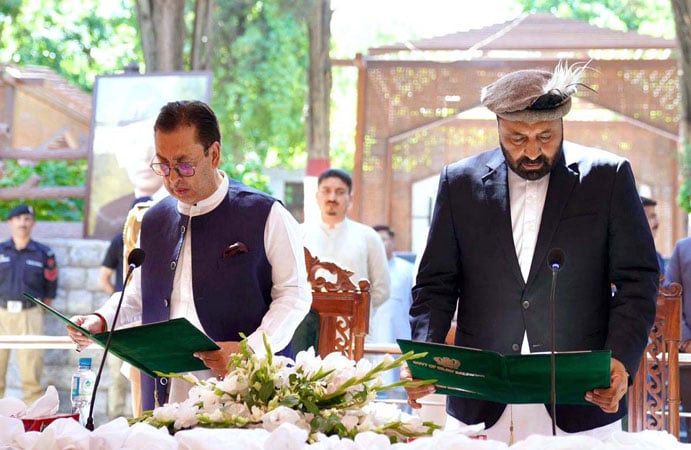
 PPP’s Amjad Hussain on Monday was sworn in as the chief minister of Gilgit-Baltistan in a ceremony attended by his party chairman Bilawal Bhutto-Zardari.
Advocate Hussain was elected for the role on June 22 following the June 7 elections, in which the PPP emerged as the largest party, with 12 seats in the 24-member GB assembly.
Addressing the ceremony in Gilgit after taking the oath, Hussain said the PPP emerged as the “largest party” in the elections.
He noted that the region’s youth and women “had a huge role” in the polls, in which his party candidates secured several seats.
Hussain particularly thanked the people of Nagar who “gave the PPP 100 per cent results and two seats”, adding that the “heavy mandate” given to his party was an expression of the public confidence in the PPP.
He highlighted that the Gilgit and Baltistan divisions were traditionally considered areas with a mandate for the PPP, thanking the residents there for maintaining that support.
“This mandate is not a new thing,” the newly sworn-in CM said, stressing that the relationship between his party and the people of GB had existed for three generations.
He further pointed out, “The people of GB broke many records. Never had it happened that one party is in [power in] the Centre and another party given the trust in GB.”
Hussain prayed that God may help him fulfil the “most difficult responsibility” given to him as the chief minister, as decided by the PPP leadership.
The PPP had announced that it would form a government in GB with the support of the PML-N. However, they agreed that the PML-N would sit in the opposition.
‘GB can be a prime example of good governance’
In his maiden speech as the GB CM, Hussain shed light on the key attributes of the region.
He highlighted GB’s population and land area, noting that the region was somewhat smaller than Khyber Pakhtunkhwa but housed 1.7 million people.
“GB can be a prime example of good governance for the rest of the country,” he remarked. “We consider transparency our prime subject. We consider it our foundation stone.”
The chief minister also addressed issues in the region, noting that GB had a budgetary right to Rs258 billion whereas it had only received Rs142bn from the federation – a deficiency of over Rs100bn, without which he noted the region’s issues could not be solved.
He also pointed out that GB had received a development budget of Rs23bn rather than the required Rs33bn, and only Rs15bn rather than the Rs29bn required in subsidies, calling this “abuse”.
“We want the federation to fulfil its responsibilities,” he asserted.
Hussain noted that the region’s potential “does not match” its 22 hours of loadshedding.
The chief minister also promised that loadshedding in GB would be nearly eliminated by the end of five years, but stressed that this would not happen without the payment of electricity bills and declared there would be no compromise on these.