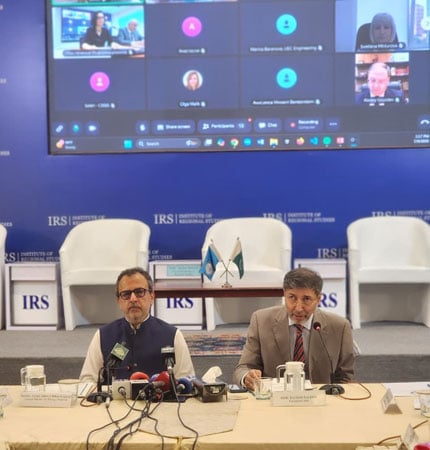
 Federal Minister for Energy (Power Division) Sardar Awais Ahmed Khan Leghari on Thursday said Pakistan and Russia possess immense untapped potential in trade, energy, education and connectivity, stressing that stronger economic cooperation and improved transport links could help bilateral trade surpass the billion-dollar mark in the coming years.
Addressing a webinar titled “Pakistan-Russia: Strengthening Trade, Education and Energy Collaboration,” jointly organized by the University of World Civilizations Moscow (UWCM) and the Institute of Regional Studies (IRS), the minister said Pakistan-Russia relations had gained positive momentum over the past two decades, driven by mutual trust, respect and a shared commitment to regional stability.
He said the bilateral relationship had evolved independently and was no longer shaped by geopolitical considerations, adding that both countries attached great importance to the United Nations and international law in promoting peace, security and cooperation.
Leghari said Eurasian connectivity offered significant opportunities for economic growth and common prosperity. He termed the revival of historic land routes through Central Asia and the International North-South Transport Corridor (INSTC) vital for enhancing trade between Pakistan and Russia.
The minister noted that bilateral trade stood at $243.412 million during FY2025, significantly below its potential. He said trade had exceeded $1 billion in FY2024 but later declined due to challenges related to payment mechanisms, banking channels, financing arrangements and shipping logistics.
He expressed confidence that the Programme of Economic Cooperation between Pakistan and Russia until 2030 would help strengthen economic ties and create new opportunities for businesses in both countries.
Referring to regional connectivity initiatives, Leghari said Pakistan had signed a memorandum of understanding on the Belarus-Russia-Kazakhstan-Uzbekistan-Afghanistan-Pakistan multimodal transport corridor and another agreement on railway cooperation with Russia in June 2024.
The establishment of a rail link would be instrumental in expanding bilateral trade and could help realize the upgradation of the Quetta-Taftan railroad, he added.
The minister said there were presently no direct flights between the two countries, both sides are considering the possibilities of early resumption, and our airlines could explore code-sharing and transit route arrangements, particularly for cargo flights.
Discussing energy cooperation, Leghari said Russia, as a major global energy producer, offered significant opportunities for collaboration with Pakistan.
He noted that Russian energy company Zarubezhneft had signed memoranda of understanding with Pakistan Petroleum Limited (PPL) and Oil and Gas Development Company Limited (OGDCL) in February 2025, while its operational presence in Pakistan since August 2025 marked a major step toward deeper cooperation in the oil and gas sector.
He also welcomed NOVATEK’s interest in developing cooperation with Pakistani partners in the gas sector, LNG supplies, and integrated gas projects, as well as the RusHydro Group’s interest in serving as an engineering partner for the modernization of existing hydraulic facilities and the design of new ones in Pakistan.
The minister described the revival of Pakistan Steel Mills as a flagship project reflecting the historic partnership between Pakistan and Russia, saying its successful implementation would symbolize enduring friendship and economic cooperation between the two countries.
On educational cooperation, Leghari said approximately 1,087 Pakistani students were currently studying at Russian universities and educational institutions.
He appreciated Russia’s scholarship programmes for Pakistani students and called for expanding educational opportunities, particularly in science and technology disciplines.
The minister also welcomed the signing of the Readmission Agreement between Pakistan and Russia, describing it as an important step toward strengthening people-to-people contacts. He urged both countries to work toward a more facilitative visa regime, especially for businesspersons, students and tourists.
Concluding his remarks, Leghari said the discussions had reaffirmed the growing scope of Pakistan-Russia cooperation and expressed confidence that continued dialogue would translate into tangible outcomes in trade, energy, education and connectivity.