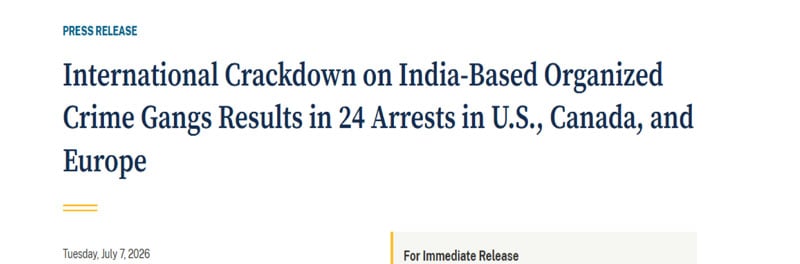
 On July 7, 2026, the United States Department of Justice (DOJ), in coordination with international law enforcement partners in Canada and Europe, unsealed three sweeping federal indictments under the banner of Operation Hard Ball. This highly synchronized, multi-jurisdictional operation dismantled three major India-based transnational organized crime groups: the Bishnoi Enterprise, the Bhagwanpuria Enterprise, and the Dhanda Network.
The indictments charge 37 defendants with a litany of offenses, including racketeering, political assassinations, targeted killings, multi-million-dollar extortion schemes, weapons smuggling, and large scale narcotics trafficking.

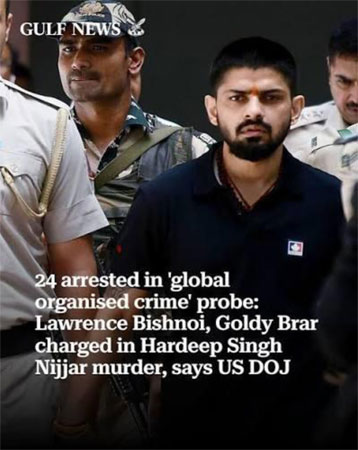
With 24 suspects already arrested across the United States, Canada, and Spain, including 11 in California alone, and a $50,000 FBI bounty placed on fugitive operatives, Operation Hard Ball represents the most significant Western law enforcement exposure of an integrated, externalized Indian criminal ecosystem in modern history.
Anatomy of Operation Hard Ball
Operation Hard Ball is the culmination of a years long, intelligence-led investigation spearheaded by the FBI and the US Attorney’s Office for the Central District of California, working alongside the Royal Canadian Mounted Police (RCMP), the Los Angeles Police Department (LAPD), Homeland Security Investigations, the Drug Enforcement Administration (DEA), and Spain’s Guardia Civil.

The scale of the criminal enterprises exposed is unprecedented, as reflected in the volume of illicit contraband seized during coordinated raids:
Drugs
Approximately 1000 kilograms of cocaine and 1 kilogram of heroin were seized. Dhanda Network, led by Ravinder Singh Dhanda, routinely utilized commercial long-haul semi-trucks to transport bulk cocaine and methamphetamine from Southern California hubs (including Los Angeles, Ontario, Fontana, and Perris) across the border into Canada.

Arsenal & Cash
A dozen high-caliber firearms and substantial bulk cash were confiscated across 23 search warrants executed in the Sacramento area and 11 in Los Angeles.
The operational theater spanned India, the United States, Canada, Mexico, Spain, the United Kingdom, Australia, and New Zealand, indicating a highly mature logistical network capable of exploiting Western financial pathways and immigration systems (such as student and work visas) to embed enforcement assets abroad.
The Indian Hand
The most politically devastating and legally damning revelation within the US federal indictments is that the primary architects of this global violence orchestrated their networks from inside high-security Indian prisons.
Bishnoi Jail Platform
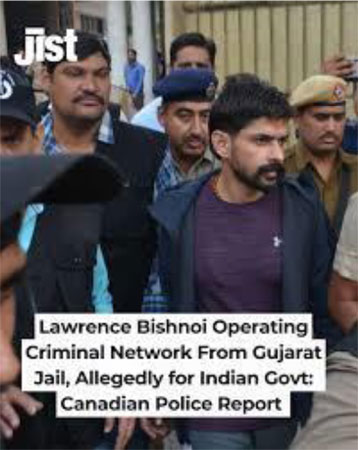
Lawrence Bishnoi, the 33-year-old leader of the Bishnoi Organized Crime Group (OCG), has been continuously incarcerated by Indian authorities since 2015 and is currently lodged in the high-security Sabarmati Central Jail in Ahmedabad, Gujarat.

Despite his confinement, the DOJ unsealed evidence showing that Bishnoi used contraband cellphones, encrypted applications and Voice-over-IP devices to directly manage his multi-continent operations. Between December 2025 and January 2026, Bishnoi personally directed extortion plots demanding $5 million from victims in Los Angeles and Thousand Oaks, California, threatening the immediate slaughter of their families in India if they failed to comply.

Bhagwanpuria Institutional Corruption
Operating in parallel, Jaggu Bhagwanpuria directed a global syndicate of over 1000 members worldwide from his cell in Silchar Central Jail in Assam. US indictment explicitly highlights that the Bhagwanpuria enterprise systematically corrupted law enforcement officers and government officials in India to facilitate its transnational extortion schemes.
Instances of Institutional Weaponization
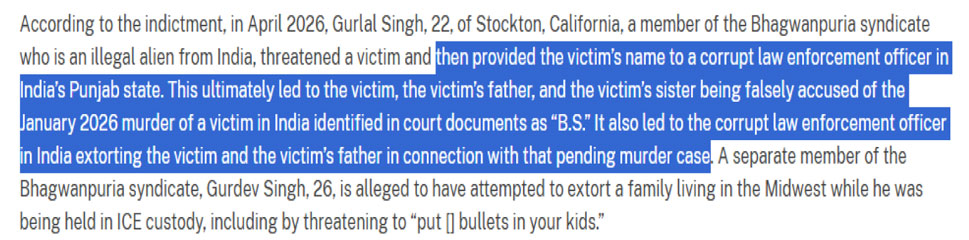
In April 2026, Gurlal Singh, a Bhagwanpuria operative residing in Stockton, California threatened a diaspora victim in the US and fed the victim’s identity to a corrupt law enforcement inspector within India’s Punjab Police. The corrupt Indian officer subsequently fabricated criminal charges, falsely accusing the US victim, his father, and his sister of a January 2026 murder in India. This fraudulent state machinery was then leveraged to extort massive sums from the family.

This jail-run command system exposes an acute structural vulnerability or active facilitation within the Indian state apparatus. It raises serious questions regarding how top-tier prisoners can maintain unhindered access to telecommunications infrastructure and coordinate international assassinations without the knowledge, negligence, or complicity of state administrative bodies.

Transnational Repression
To sustain its recruitment and retain operational control over diaspora communities, the Bishnoi Enterprise cultivated a weaponized social media presence. DOJ notes that Bishnoi projected a public image as a “patriot,” “nationalist,” and deeply religious figure via Facebook and encrypted channels. This carefully manufactured persona allowed the gang to recruit vulnerable youth within India and the diaspora, framing violent transnational criminal operations as acts of national security or ideological alignment. Behind this facade lay a brutal campaign of transnational repression designed to silence dissent, extort wealthy diaspora businesses, and control the cultural narrative of the South Asian immigrant community in the West. The syndicates targeted individuals across multiple distinct categories.

Culturally & Socially Significant Targets
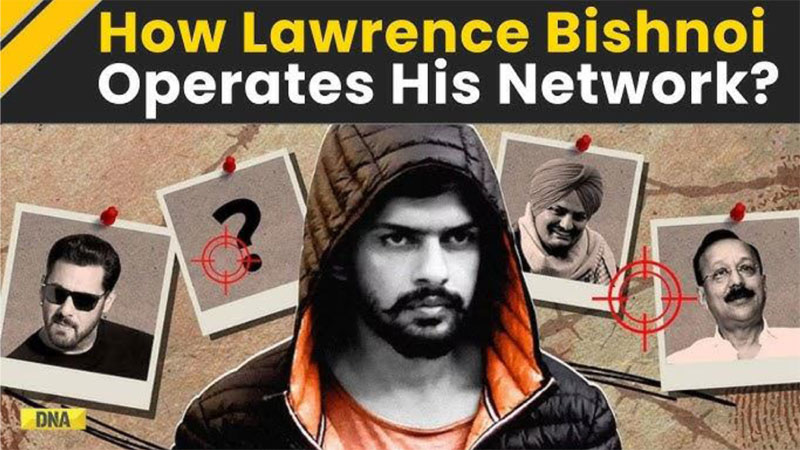
Political Dissidents: The most geopolitically volatile charge in the US indictment formally links Lawrence Bishnoi and his North American lieutenant, Satinderjeet Singh aka Goldy Brar, to the June 18, 2023, assassination of Sikh activist Hardeep Singh Nijjar in Surrey. Bishnoi provided co-conspirators with Nijjar’s photographs and multiple residential addresses to execute the targeted killing.

Cultural Icons & Media Personalities: The network systematically targeted high-profile artists to extract extortion revenues. This includes the May 2022 murder of Punjabi singer Sidhu Moose Wala, a September 2024 shooting targeted at the British Columbia residence of singer AP Dhillon, and repeated violent extortions targeted at comedian Kapil Sharma’s cafe in Surrey throughout 2025.

Athletes: In Stockton, California, the Bhagwanpuria and Bishnoi syndicates utilized physical intimidation and extortion against traditional Kabaddi sports tournaments and players, forcing multiple athletes to withdraw from competitions out of fear for their safety.
Geopolitical & Diplomatic Fallout
Unsealing of Operation Hard Ball shatters New Delhi’s long-standing external narrative, which consistently frames India solely as a victim of cross-border extremism.

The empirical evidence compiled by Western judiciaries demonstrates that India has been a primary exporter of highly organized, transnational criminal violence.
While the proofs of Indian involvement in the assassination of Khalistani leader, Hardeep Singh Nijjar are evident. The high-profile US prosecution of Nikhil Gupta who was conspiring with an unnamed Indian government intelligence official to assassinate US-Canadian citizen Gurpatwant Singh Pannun on American soil.

Structural crossover between intelligence agencies, corrupt local police forces, and jail-bound criminal proxies establishes a highly dangerous crime-terror nexus. Consequently, Canada took the extraordinary step in September, 2025, of formally listing the Bishnoi Gang as a terrorist entity under its Criminal Code, stripping away any diplomatic pretense that these networks are merely ordinary domestic gangsters.
Strategic Analytical Takeaways

The findings of Operation Hard Ball demand a fundamental re-evaluation of international security cooperation with India:
* The documentation of a multi-million-dollar global command center operating out of Sabarmati and Silchar central jails invalidates India’s claims of robust domestic administrative controls.
* The use of criminal proxies allows a state to maintain plausible deniability while aggressively violating the state sovereignty of Western nations and terrorizing immigrant diaspora populations.

* With Canada leading the path via formal terrorist designations, there is mounting judicial pressure on the United States, the United Kingdom, Australia, and European partners to apply matching counter-terrorism frameworks, asset freezes, and travel bans against the institutional facilitators enabling these India-origin syndicates.
Operation Hard Ball has permanently altered the geopolitical landscape. It establishes a binding legal record showing that India’s internal criminal ecosystem has gone global, posing a direct, documented threat to Western rule of law, state sovereignty, and international diaspora safety.