• Skip to primary navigation
  • Skip to main content
  • Skip to primary sidebar
  • Skip to footer
Trending:
  • Kashmir
  • Elections
Monday, June 8, 2026

Daily Times

Your right to know

  • HOME
  • Latest
  • Iran-Israel war
  • Gilgit Baltistan Election
  • Pakistan
    • Balochistan
    • Gilgit Baltistan
    • Khyber Pakhtunkhwa
    • Punjab
    • Sindh
  • World
  • Editorials & Opinions
    • Editorials
    • Op-Eds
    • Commentary / Insight
    • Perspectives
    • Cartoons
    • Letters to the Editor
    • Featured
    • Blogs
      • Pakistan
      • World
      • Lifestyle
      • Culture
      • Sports
  • Business
  • Sports
  • E-PAPER
    • Lahore
    • Islamabad
    • Karachi

World spends far more on harming nature than protecting it, UNEP warns

Published on: January 24, 2026 10:40 AM

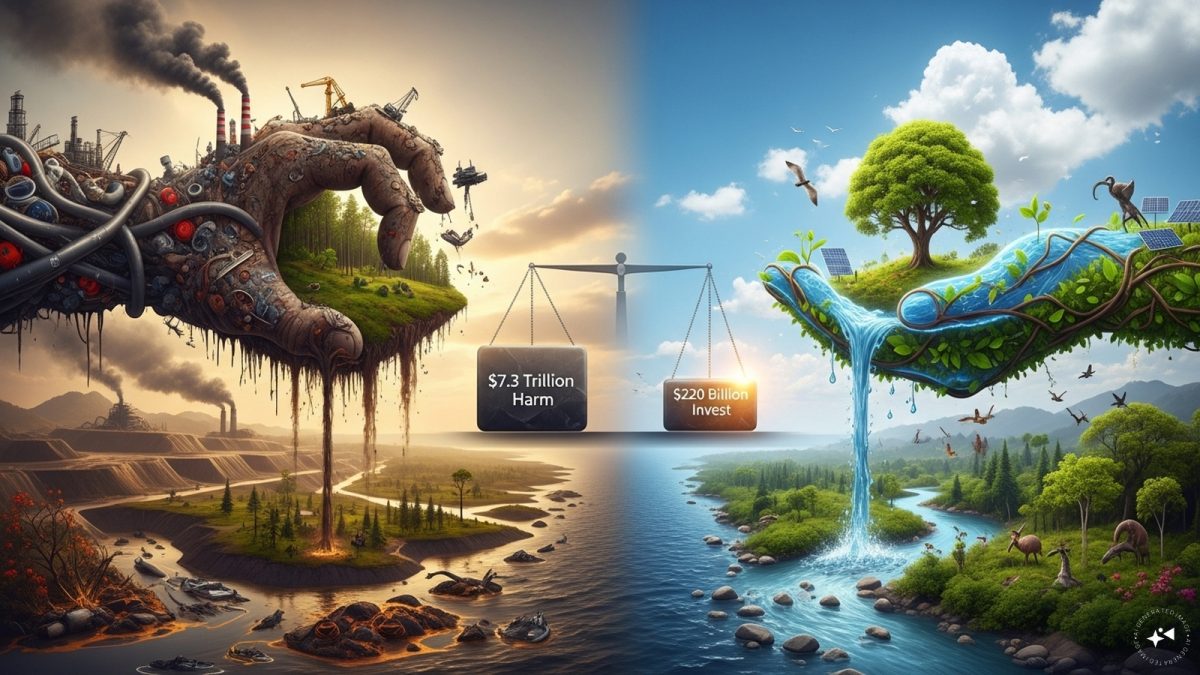
The nature of money: UN says world spends $220 bn protecting nature — and $7.3 tn harming it

The world spends nearly $30 destroying nature for every $1 invested in its protection, according to a new report by the United Nations Environment Programme (UNEP), highlighting a deep imbalance in global financial flows that threatens ecosystems and economic stability.

Read More: Pakistan sends dossier to UN on ‘eco-terrorism’ by India

The State of Finance for Nature 2026 report estimates that total nature-negative finance reached $7.3 trillion in 2023. Of this amount, $4.9 trillion came from private sources, largely concentrated in sectors such as energy, utilities, industrials and basic materials. Public environmentally harmful subsidies, mainly supporting fossil fuels, agriculture, water, transport and construction, accounted for the remaining $2.4 trillion.

While funding to protect nature is growing, much more is invested in destroying it.

UNEP’s latest report calls on governments and the private sector to increase investment in protection and restoration: https://t.co/UtcPYjGtxA pic.twitter.com/6xt8wchfkV

— UN Environment Programme (@UNEP) January 22, 2026

In contrast, global investment in nature-based solutions (NbS) totalled just $220 billion in 2023. Nearly 90 per cent of this funding came from public sources, reflecting growing government support but limited engagement from private investors.

UNEP warned that continued dominance of nature-negative finance is eroding ecosystems, increasing economic risks and undermining human well-being. The report noted that almost half of global economic activity is significantly dependent on nature, yet financial systems continue to prioritise investments that degrade natural capital.

The report called for a fundamental shift in global finance, urging governments and financial institutions to phase out environmentally harmful subsidies and redirect capital toward nature-positive investments. According to UNEP, scaling up NbS financing could deliver strong economic returns, reduce exposure to climate and environmental risks, and improve long-term resilience.

To meet international commitments under the Rio Conventions on biodiversity, climate change and land restoration, investment in NbS must rise to $571 billion annually by 2030 — more than two and a half times current levels. At the same time, harmful financial flows must be gradually repurposed or eliminated.

Read More: Urban canopy trees: Nature’s defense against polluted skies

While funding for nature-based solutions has increased in recent years, the report stressed that current levels remain far below what is required to halt environmental degradation and meet global sustainability goals.

Filed Under: Top Stories, World Tagged With: biodiversity, climate finance, environment, Latest, nature-based solutions, sustainability, UNEP

Submit a Comment


Primary Sidebar


Latest News

PFF president hails national men’s team for ending 64-year wait

Maryam Nawaz unveils major Lahore urban renewal project

UoR earns NTC thumbs-up, sets new benchmarks in technology education

US weighs Iranian assets plan as Gulf tensions rise

Punjab shifts to digital land ownership system from July

Pakistan

Maryam Nawaz unveils major Lahore urban renewal project

UoR earns NTC thumbs-up, sets new benchmarks in technology education

Punjab shifts to digital land ownership system from July

Bilawal calls urgent PPP meeting over AJK tensions

Punjab launches QR panic button system for transport safety upgrade

More Posts from this Category

Business

Pakistan savings rate hits 30-year low raising economic concerns

PSX new IPOs deliver 47% average return, boosting investor confidence

Pakistan signs MoU with Saudi, local firms to develop Karachi maritime business district

Gold prices witness sharp decline

Gul Ahmed venture QGDC announces $230m investment to set up Pakistan’s largest data centre

More Posts from this Category

World

US weighs Iranian assets plan as Gulf tensions rise

King Charles signals unity as royals gather at wedding

Pakistan tells un Kashmir dispute remains unresolved integral issue

More Posts from this Category


Footer

Home
Lead Stories
Latest News
Editor’s Picks

Culture
Life & Style
Featured
Videos

Editorials
OP-EDS
Commentary
Advertise

Cartoons
Letters
Blogs
Privacy Policy

Contact
Company’s Financials
Investor Information
Terms & Conditions

Facebook
Twitter
Instagram
Youtube

© 2026 Daily Times. All rights reserved.

We use cookies to ensure that we give you the best experience on our website. If you continue to use this site we will assume that you are happy with it.