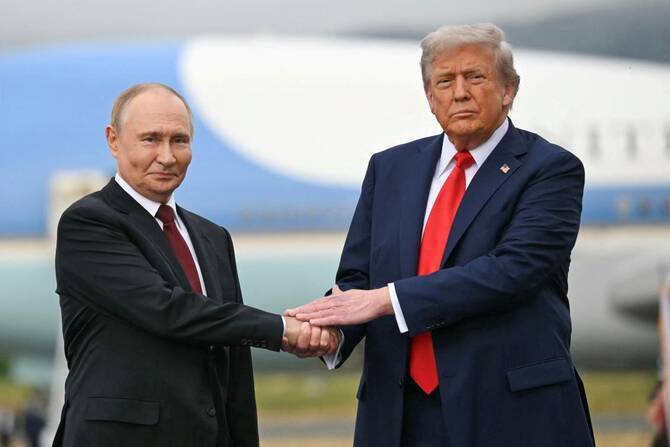
US President Donald Trump on Thursday declined an offer from Russia President Vladimir Putin to voluntarily extend the caps on strategic nuclear weapons under the now-expired New START treaty.
Read More: Last US-Russia nuclear pact expires, prompting fears of new arms
In a post on his Truth Social platform, Trump wrote, “Rather than extend ‘New START … we should have our Nuclear Experts work on a new, improved and modernised Treaty that can last long into the future.” He called New START “a badly negotiated deal” and criticized Russia for allegedly violating aspects of the treaty, referencing Putin’s 2023 suspension of on-site inspections.
BREAKING:
President Trump calls for a new, modernized nuclear arms treaty between the U.S. and Russia instead of extending New START, which has now expired.
He says a “new and improved” agreement should replace it. pic.twitter.com/wX5YIcNgiy
— DC_Global_News (@DC_Global_News) February 6, 2026
The New START treaty, signed in 2010 and extended once in 2021 by Biden and Putin, limited each side to 1,550 warheads on 700 delivery systems — including missiles, aircraft, and submarines. The treaty also provided inspections that helped build trust and stability between the US and Russia.
Following the rejection, the Kremlin said it remained open to dialogue if Washington responded constructively. The UN has urged both sides to restore the agreement, warning that its absence could trigger an accelerated nuclear arms race. Security analysts caution that without limits, the US and Russia might increase arsenals, relying on worst-case assumptions about the other’s intentions, while China continues its nuclear expansion.
Trump has previously expressed a desire to negotiate a new deal including China, but Beijing has declined. China reiterated on Thursday that the treaty’s expiry was regrettable and urged the US and Russia to resume talks on strategic stability.
Read More: Trump warns of ‘new terrifying world’ over treaty
Experts emphasize that strategic nuclear weapons, designed for long-range strikes on military and industrial targets, pose significant risks if unconstrained. Karim Haggag of the Stockholm International Peace Research Institute noted that “transparency and predictability are among the more intangible benefits of arms control and underpin deterrence and strategic stability.”
The treaty’s expiration underscores rising global uncertainty, with both Washington and Moscow signaling potential military-technical adjustments while leaving a narrow window for diplomacy.