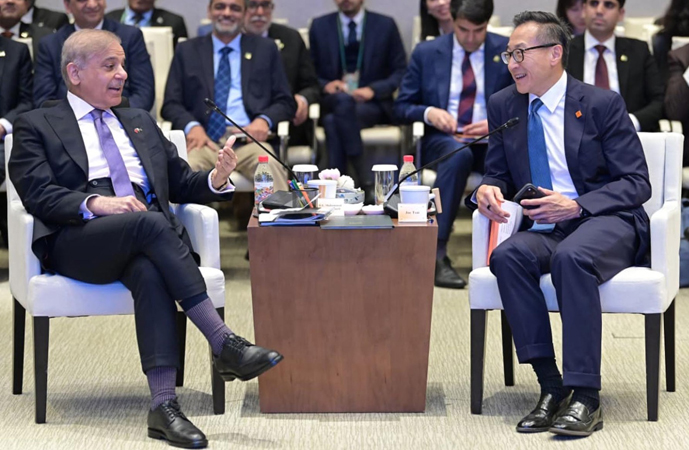
 Prime Minister Muhammad Shehbaz Sharif, on Sunday, invited the Chinese companies and entrepreneurs to relocate their industries and businesses to Pakistan, enter into joint ventures with the local firms, and benefit from the country’s investor-friendly policies, describing the initiative as a “win-win model” for both nations.
Addressing the Pakistan-China B2B Investment Conference on IT & Telecom, battery energy storage systems (BESS) and agriculture in Hangzhou, China, the prime minister said that labour in China today had become pretty expensive and that China was obviously moving towards a very high level of industrialisation.
He observed that the industry where China was no longer competitive because of expensive labour could come to Pakistan, bring in plant and machinery, enter into joint ventures with Pakistani entrepreneurs, manufacture goods, and export to third countries. “This model will be a win-win model for Chinese and Pakistani entrepreneurs, and this will be something of a roaring success in times to come, whether it is textile or leather or other areas,” the prime minister maintained in his speech broadcast on national TV channels.
He also invited Chinese businessmen to come and see the export zone in Karachi, where they would have great opportunities to understand business propositions.
Referring to the potential in mines and minerals, he said that it was also a very important area where Pakistan had large deposits of minerals and gemstones.
About the agriculture sector, he said Pakistan was basically an agrarian economy. Last year, they sent 1,000 boys and girls to China for advanced training, who returned and are doing a great job, but this was just the first step.
He said China imports about 100 billion dollars worth of agricultural products from abroad. Pakistan’s share was just a fraction, adding that they needed their cooperation in this regard.
The prime minister hoped that in this manner, they would be able to produce agri products as per their requirement in terms of quality and other controls and if they worked together as iron brothers in this sector, they would be able to not only provide massive job opportunities in the rural areas of Pakistan but also be able to raise hundreds of thousands of small, medium entrepreneurs in the rural areas and have value addition and export those items to China.
In the next five to seven years, he said they expected an increase in their agri product trade to China by about 10 $billion dollars which was not a big task.
Separately, Shehbaz Sharif Sunday attended ceremony of signing and exchange of agreements and memorandums of understanding with Alibaba Group in diverse sectors of the economy.
ADuring his visit to Alibaba headquarters in Hangzhou, he was briefed about the company by Alibaba Chairman Joe Tsai.
A long-term cooperation agreement between Pakistan and Alibaba was signed in the presence of the prime minister.
In his remarks on the occasion, the Prime Minister said Pakistan and China had built a unique relationship which had strengthened by every generation.
He said Pakistan had diligently played the role of a peacemaker in the region and this would not have been possible without support of China and friendly countries.
Pakistan fully supports agenda of China’s President Xi Jinping for lasting peace in the region and beyond he said adding the bilateral relations of Pakistan and China had expanded to bring progress and prosperity to the people.
Later, Shehbaz Sharif arrived in Beijing after concluding his official programme in Hangzhou, Zhejiang Province. Huang Runqiu, Minister of Environment & Ecology of China, received the Prime Minister at the Beijing Capital International Airport.
During his stay in Beijing, the prime minister will hold high-level engagements, including meetings with Chinese President Xi Jinping and Prime Minister Li Qiang to further strengthen Pakistan-China All-Weather Strategic Cooperative Partnership and advance cooperation under CPEC Phase-II, particularly in trade, investment, industry, agriculture, science and technology, and people-to-people exchanges.