 The view at 2,000 metres (6,500 feet) is idyllic, but it comes with an invisible, mortal threat.
“Everything around the factory is controlled by armed groups,” warns Joseph Kitsa.
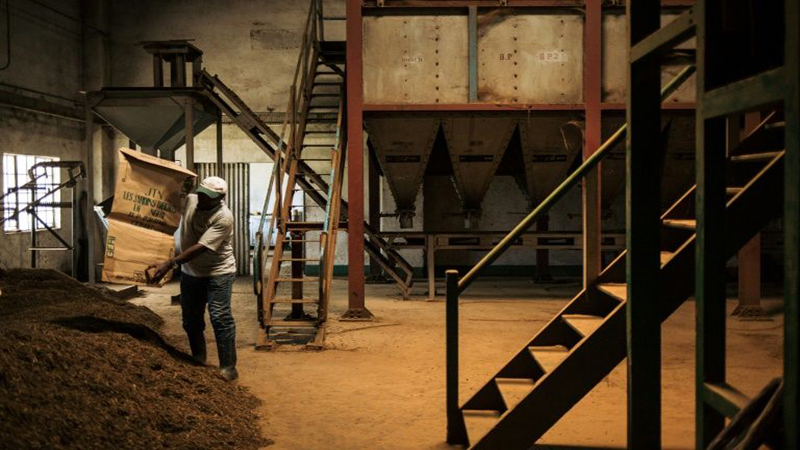
He watches over a tea processing plant which, with venerable equipment and heroic commitment, survives in the highlands of one of Africa’s most troubled locations — war-scarred eastern Democratic Republic of Congo. To get to this outpost near Mweso, in Masisi territory, the trek starts in Goma, the capital of North Kivu province, a bumpy four-hour drive away.
A dirt track winds upwards into a paradisal landscape — the “Switzerland of Africa”, famed for its milk, cheese and lush alpine vistas. The verdant pastures and cattle are tended by peasant farmers from the Masisi and Rutshuru territories.
Orderly rows of tea shrubs, looking rather like a vineyard, appear between houses for employees and a large factory, its roof partly wrecked.
In its halcyon days, before 1994, the JTN plantation — French acronym for the “Tea Gardens of Ngeri” — had 1,200 paid workers and lodged them in hundreds of homes on site.
The workforce cared for 450 hectares (1,100 acres) of shrubs and a huge processing plant on behalf of a subsidiary of Unilever in the then Zaire, according to Kitsa, JTN’s deputy manager.
The factory is today owned by four shareholders who rarely visit because of the insecurity.
’10 percent of capacity’
The plant is ageing, needing repairs and investment, yet its machines still handle tea, covering all of the processing steps — withering, rolling, oxidation, drying, sorting and packing. But times got tough in the past quarter-century, and remain so today.
“The factory is now operating at 10 percent of capacity,” Kitsa told AFP. “We produce 10 to 12 tonnes a month, with 450 employees.”
The tea heads towards Goma, serving the regional market.
Lamenting a chronic lack of funds, Kitsa pointed to a broken-down mechanical treadmill and antique processing machinery.
Production has been badly hit by the multiple conflicts that have ravaged North and neighbouring South Kivu since 1994 — the year that about a million Hutus swept across the border from neighbouring Rwanda in the wake of genocide.
Some of these people were in an armed movement opposed to the new regime in Kigali and consisting of extremist militias and former soldiers behind the systematic slaughter of 800,000 people, mainly minority Tutsis.
The influx began a proxy conflict and the start of clashes among militia groups themselves as they jostled over resources. And it heightened tensions among ethnic communities in eastern DRC, including Congolese Hutus and Tutsis and the Hunde and Nande tribes.
Minimal security
In January 1999, JTN was attacked by the FDLR, the Democratic Forces for the Liberation of Rwanda.
Then, from 2007 until 2011, the regular army and a Congolese Tutsi force “battled around the concession” in a bid for control, Kitsa said.
Today, the area around the plantation is infested by armed groups fighting over the valuable land.
AFP was only able to visit JTN under a military escort provided by the UN peacekeeping mission in the DRC.
Troops of the Indian contingent provided protection during the ascent and descent to the plantation, their weapons at hand and eyes on the alert.
But at normal times, the protection is minimal. “We have five police officers and five Congolese soldiers,” Kitsa said.
Tribalism and unemployment
The half-dozen main armed groups active locally each claim to be defending a community. The militia forces also lure unemployed youths in villages near the plantation.
Congolese authorities backed by the United Nations hope to dry up militia recruitment by bringing the JTN factory to full capacity and promoting other regional opportunities.
“The problems of tribalism come from unemployment,” said Gilles Kabatami, the traditional chief of the main town in the region, Mweso.
“Just after I got my state diploma, I didn’t have the means to pursue my studies. We lived with the assailants, in the bush,” said Ghislain, a former fighter who works as a typist at a public service office in Mweso.
MONUSCO is backing a $6-million (5.3-million-euro) plan to help stabilise the region.
But its ills can only be cured by a solution that breaks the vicious circle — if there is no security, there is no work, and if there is no work, this breeds insecurity.
“The solution can’t be just a military one,” said an official with the programme, Rebecca Camp, an American from a family of missionaries who have been in the mountains of North Kivu for four generations.