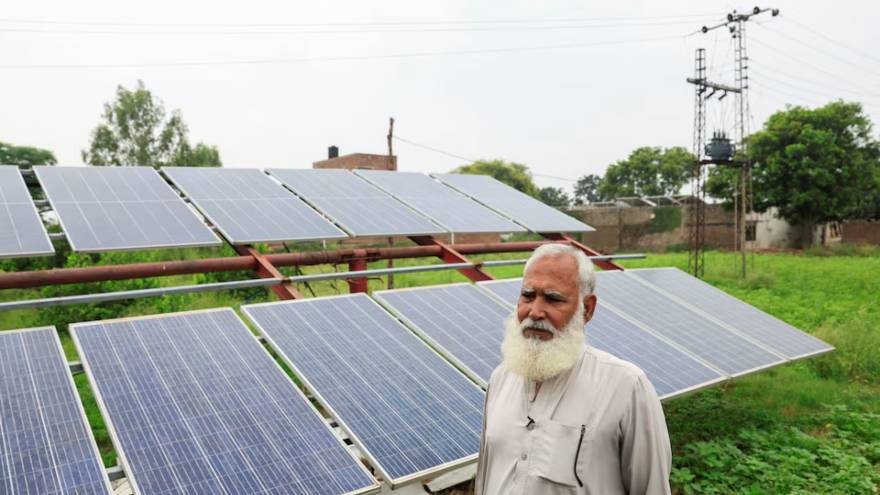
MURIDKE, Punjab — Under the blinding sun of central Punjab, rice farmer Karamat Ali stands beside a gleaming row of solar panels that have replaced the dozen cows he once relied on for milk and livelihood.
“I sold my animals for this,” he says, pointing toward the panels that now power his tube well. “Water supply to my paddy field is smoother than before.”
Ali is one of thousands of farmers across Pakistan turning to solar-powered tube wells to escape erratic electricity and costly diesel. But as the solar boom spreads, so too does a silent crisis beneath the soil: Punjab’s groundwater is vanishing at alarming rates.
A Bright Revolution with a Dark Underside
The shift toward solar irrigation marks one of the most dramatic transformations in Pakistan’s agriculture in decades. Encouraged by rising power tariffs and falling solar prices, farmers have rapidly adopted photovoltaic systems to fuel their water pumps.
According to estimates by energy economist Ammar Habib, roughly 650,000 solar tube wells are now operating across Pakistan — 400,000 converted from grid electricity and another 250,000 newly installed since 2023.
Yet, as farmers gain the freedom to pump water anytime, groundwater levels are plummeting. Confidential Punjab water authority documents viewed by Reuters show that the water table has sunk below 60 feet in 6.6% of the province’s area — a 25% increase since 2020. In some regions, wells now run deeper than 80 feet.
Water Without Limits
For many growers, solar energy means liberation from dependency on unreliable grid supply. But it also means pumping without restraint.
Farmers interviewed across Punjab say they now irrigate their rice paddies several times a day through a method called pulse irrigation — a luxury they couldn’t afford under diesel costs. U.S. Department of Agriculture data show that rice cultivation expanded 30% between 2023 and 2025, while less water-intensive maize acreage fell by 10%.
“Solar panels should be installed at all costs,” says 38-year-old farmer Rai Abdul Ghafoor, who is saving up for his own system. “They save time, money, and worry.”
The affordability of solar power has even led rural communities to pool resources. “Farmers share, rent, and move panels like tractors,” says solar merchant Shahab Qureshi. “Within months, the panels pay for themselves.”
Officials Divided Over the Water Fallout
Federal power minister Awais Leghari rejects the notion that solar irrigation is draining Punjab’s aquifers, arguing that farmers are “replacing expensive diesel with solar” and not expanding farmland.
But Punjab’s irrigation minister Muhammad Kazim Pirzada admits the tradeoff is real: “Solarization is good for the environment because it’s clean energy,” he says. “But at the same time, it is also impacting our water table.”
The province has launched aquifer-recharge projects at 40 sites to slow depletion and revive traditional water infrastructure, including the colonial-era Ravi Siphon. Still, experts warn that these efforts are piecemeal compared to the pace of extraction.
An Unregulated Rush
Pakistan’s solar transition mirrors a global trend driven by the 80% drop in solar panel prices since 2017, largely due to Chinese production. Yet the country lacks regulation for groundwater use or real-time monitoring of tube wells.
Independent environmental scientist Imran Saqib Khalid cautions that “the solar push lacks any method to the madness.” Without governance reforms, he says, Pakistan risks an agricultural imbalance: “In the long run, this will affect the kinds of crops we can grow — and our food security.”
The Rising Cost of Free Energy
Back in Muridke, farmer Mohammad Naseem proudly guards his solar panels, dismantling them each night to prevent theft. The panels have saved him 2 million rupees in energy costs since 2021 and improved his rice yields.
Yet, as Punjab’s aquifers retreat deeper underground, the benefits of solarization may prove temporary. The sun may be free — but the water it draws is not infinite.