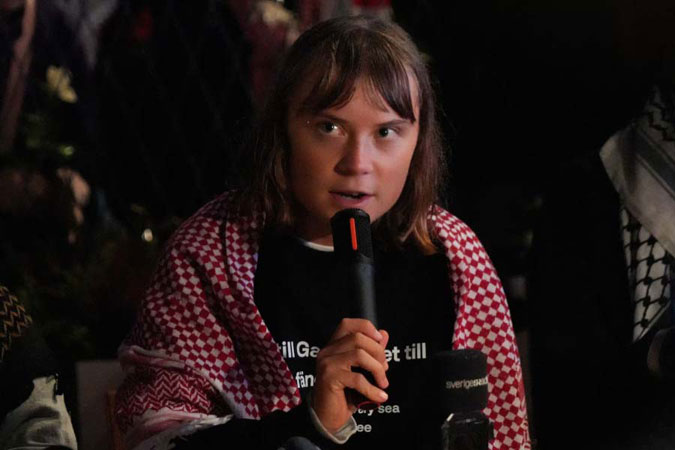
 Swedish activist Greta Thunberg alleged on Tuesday that she and other detainees of the Gaza flotilla were subjected to torture in the Israeli prison they were held.
Thunberg told a news conference in Stockholm that she and others were “kidnapped and tortured” by the Israeli military.
She declined to elaborate, adding when pressed that she didn’t get clean water and that other detainees were deprived of critical medication.
“Personally, I don’t want to share what I was subjected to because I don’t want it to make headlines and ‘Greta has been tortured’, because that’s not the story here,” she said, adding that what they were subjected to paled in comparison to what people in Gaza experienced daily.
Israel’s foreign ministry did not immediately respond to a Reuters request for comment but has repeatedly denied mistreating the detainees.
“All detainees … were given access to water, food, and restrooms; they were not denied access to legal counsel, and all their legal rights were fully upheld,” a foreign ministry spokesperson told Reuters last week.
Thunberg, was part of the Global Sumud Flotilla, a group of vessels that tried to reach Gaza to bring aid supplies and draw attention to the plight of the enclave, where most of the 2.2 million residents have been driven from their homes and the United Nations says hunger is rampant.
Thunberg was detained along with 478 people in the flotilla and expelled from Israel on Monday.
Israel, which says reports of hunger in Gaza are exaggerated, has dismissed the flotilla as a publicity stunt benefiting Palestinian militant group Hamas.
It had previously detained Thunberg at sea in a similar attempt to breach Israel’s blockade of Gaza in June.
Swedish activists said on Saturday that Thunberg was shoved and forced to wear an Israeli flag during her detention, but Thunberg made no mention of it during Tuesday’s press conference.
Thunberg and other participants also complained that the Swedish government had not given them sufficient help while detained.
The government said in a statement on Tuesday that it had repeatedly advised against all travel to Gaza but that it had nevertheless provided consular support to the activists and stressed to Israel the importance of treating Swedish citizens well.
The most promising effort yet to end the war in Gaza was bolstered as senior figures from Israel and the United States joined the negotiations on Wednesday after Hamas handed over its lists of hostages and Palestinian prisoners to be freed in a swap.
With President Donald Trump’s 20-point plan appearing closer than any previous bid to halt the war, delegations were upgrading their presence at the indirect talks, launched on Monday in the Egyptian resort town of Sharm el-Sheikh.
Trump’s son-in-law Jared Kushner and special envoy Steve Witkoff and Israeli Strategic Affairs Minister Ron Dermer, a close confidant of Prime Minister Benjamin Netanyahu, arrived and began participation in the talks, Israeli and Palestinian sources said.
Also joining the discussions was the prime minister of longstanding mediator Qatar, Sheikh Mohammed bin Abdulrahman al-Thani, according to Egyptian sources.
Turkish Foreign Minister Hakan Fidan said the mediated negotiations between Israel and the Palestinian militant group Hamas had made “a lot of headway” and that a ceasefire would be declared if they reached a positive outcome.
Trump also expressed optimism about progress towards a deal on Tuesday, and European, Arab and other states will meet in Paris on Thursday to discuss Gaza’s post-war transition, with Washington likely to be represented, diplomatic sources said.
But crucial details are yet to be spelled out, including the timing, a post-war administration for the Gaza Strip and the fate of Hamas.
Gaza authorities say more than 67,000 people have been killed and much of the enclave has been flattened since Israel began its military response to the Hamas attack two years ago. Around 1,200 people were killed and 251 were taken hostage back to Gaza, according to Israeli officials, with 20 of the 48 hostages still held believed to be alive.
Hamas said it had handed over its lists of hostages and Palestinian prisoners to be exchanged in a swap, and was optimistic about the talks so far.
The list of Palestinians Hamas wants freed is expected to include some of the most prominent prisoners ever jailed by Israel, whose release had been off limits in previous ceasefires.
According to a Palestinian source close to the talks, the list includes Marwan al-Barghouti, a leader of the Fatah movement, and Ahmed Saadat, head of the Popular Front for the Liberation of Palestine. Both are serving multiple life sentences for involvement in attacks that killed Israelis.