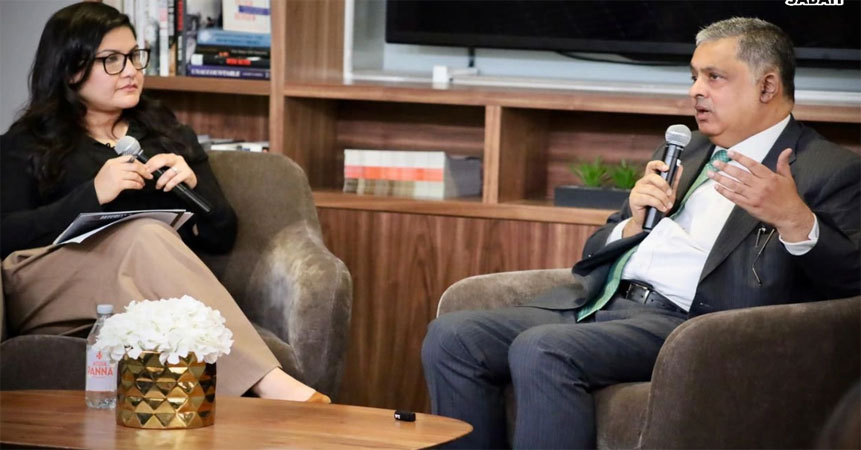
 Ambassador of Pakistan to the United States Rizwan Saeed Sheikh underscored the significance of an indispensable Pakistan-U.S. relations during a panel discussion on “The Future of the U.S.-Pakistan Relationship” at the Future Security Forum 2025 in Washington, D.C.
“Between the two mega countries of today and tomorrow – from both a present and a futuristic perspective – good relations are not a matter of choice or preference; they are indispensable,” stated Ambassador Sheikh.
Highlighting the depth and continuity of the bilateral partnership, Ambassador Sheikh noted that Pakistan and the United States shared a longstanding and consequential relationship, marked by collaboration on critical global challenges including counterterrorism and climate change.
The 11th Annual Future Security Forum was organized by Arizona State University and New America in collaboration with Security & Defence PLuS. The event brought together senior policymakers, defense experts, and thought leaders for discussions on emerging global security dynamics.
The Ambassador thanked the U.S. leadership, particularly President Trump, for facilitating the ceasefire that ended the 88-hour standoff, calling it “a vital act that prevented escalation in a nuclear neighborhood of 1.7 billion people.”
Addressing a wide range of issues including climate change, India-Pakistan relations, the situation in Indian Illegally Occupied Jammu and Kashmir (IIOJK), China-Pakistan relations, the Ukraine conflict, and regional tensions with Afghanistan, Ambassador Sheikh reaffirmed Pakistan’s commitment to diplomacy, stability, and pragmatic policymaking.
He spoke at length about Pakistan’s climate resilience and self-reliance. He said that climate change was not an abstract concept for Pakistan but an existential crisis. He recounted the country’s repeated cycles of devastating floods, describing new phenomena such as cloudbursts and compounding, sequential climate disasters that have destroyed infrastructure, reversed economic gains, and disrupted development programs.
The Ambassador emphasized that Pakistan’s diplomacy today was deeply intertwined with climate policy and economic security, noting that “what we build every few years is washed away by floods, but we still must pay back what we borrowed to rebuild.”
Reiterating Pakistan’s principled stance on IIOJK, the Ambassador called for international mediation to help the Kashmiri people realize their right to self-determination in line with UN Security Council (UNSC) resolutions, emphasizing that peace in South Asia remains contingent upon resolution of this longstanding dispute. Rejecting “camp politics,” he said Pakistan’s foreign policy seeks balanced relations. He asserted that Pakistan’s ties with Beijing were rooted in historical continuity and economic cooperation.