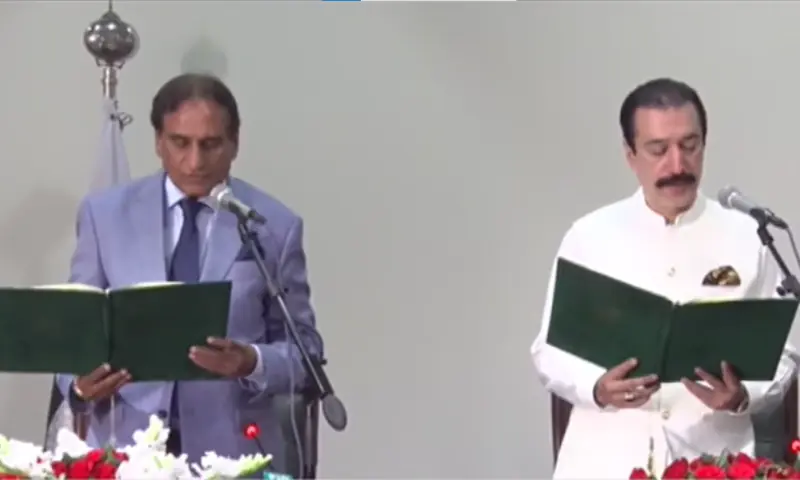
Raja Faisal Mumtaz Rathore took oath on Tuesday as the 16th prime minister of Azad Jammu and Kashmir (AJK), a day after he was elected through a vote of no-confidence against former premier Chaudhry Anwarul Haq. The oath-taking ceremony was held at the President’s House in Muzaffarabad, with AJK Legislative Assembly Speaker Chaudhry Latif Akbar administering the oath on behalf of AJK President Barrister Sultan Mahmood, who could not attend due to health issues.
Read More: Raja Faisal Mumtaz elected new Azad Kashmir PM
In his address after being sworn in, Rathore expressed gratitude for the responsibility placed upon him, acknowledging the challenges ahead. He credited the Pakistan Peoples Party (PPP) leadership — President Asif Ali Zardari and Faryal Talpur — for re-establishing the party as a major force in the region and enabling the formation of a new government. Rathore also reflected on his family’s political legacy, noting that both Zulfikar Ali Bhutto and Benazir Bhutto had chosen his father for key roles in AJK’s political setup.

Earlier in the day, Prime Minister Shehbaz Sharif congratulated Rathore in a phone call, assuring him that the federal government prioritises the development and prosperity of AJK. Shehbaz pledged full cooperation in areas of economic progress, welfare, and security, extending best wishes for Rathore’s term in office.
Rathore becomes the fourth AJK premier in four years, underscoring the political instability in the region. The no-confidence motion against Chaudhry succeeded with 36 votes from PPP and PML-N lawmakers, along with support from two PTI opposition members. Under the AJK Constitution, such a vote also counts as support for the prime ministerial candidate nominated in the resolution.
Read More: No-confidence ousts Haq in AJK; Rathore takes over premiership
Following his election, the 47-year-old leader announced several administrative reforms, including a downsizing drive, a new transport policy for officials, and limiting the number of secretaries to 20. He vowed to prioritise public issues and address the needs of low-paid government employees.