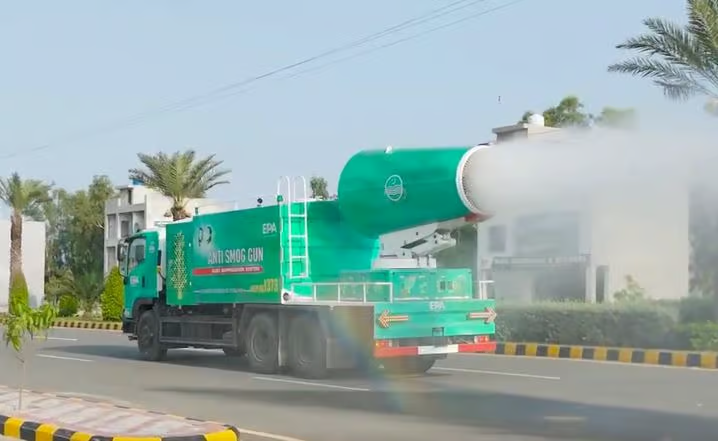
The Punjab government has unveiled a Rs3 billion initiative to deploy 30 state-of-the-art fog cannons mounted on electric trucks, targeting smog and rising air pollution in major cities and industrial zones. This ambitious project is a key part of the province’s broader clean air and climate resilience strategy, designed to lower pollution levels while reinforcing environmental protections for urban populations.
Officials explained that the electric vehicles equipped with fog cannons will operate in pollution-prone areas to suppress dust and reduce harmful particulate matter, ensuring cleaner air for residents and improving overall urban health standards across the province. The initiative also emphasizes sustainable technology by using electric trucks, which further reduces emissions during smog control operations.
Read more : Discos implement forced loadshedding as shortfall hits 4,000MW
In addition to the fog cannon project, the government has allocated Rs2.25 billion under the Lahore Air Improvement Framework to implement a coordinated clean air program in the provincial capital. A new super station system will enable real-time detection of pollution sources, strengthening regulatory oversight and allowing immediate response to environmental hazards.
The province has already installed over 50 modern air quality monitoring stations and launched an automated quality assurance system to enhance data accuracy and transparency. Authorities are also activating a digital environmental monitoring mechanism to track industrial emissions and enforce compliance more efficiently.
Read more : Government cites weather, fuel issues for recent power outages
Furthermore, environmental laboratories are being upgraded, advanced analytical equipment is being installed, and dedicated forensic facilities for emission testing are being established. These measures aim to provide comprehensive scientific support for cleaner air initiatives and effective pollution control strategies across Punjab.
To oversee the entire implementation, an Environment and Climate Delivery Unit will monitor progress through a digital dashboard, ensuring that environmental targets are met and policies under the “One City, One Policy” model are effectively executed for better urban air quality management.