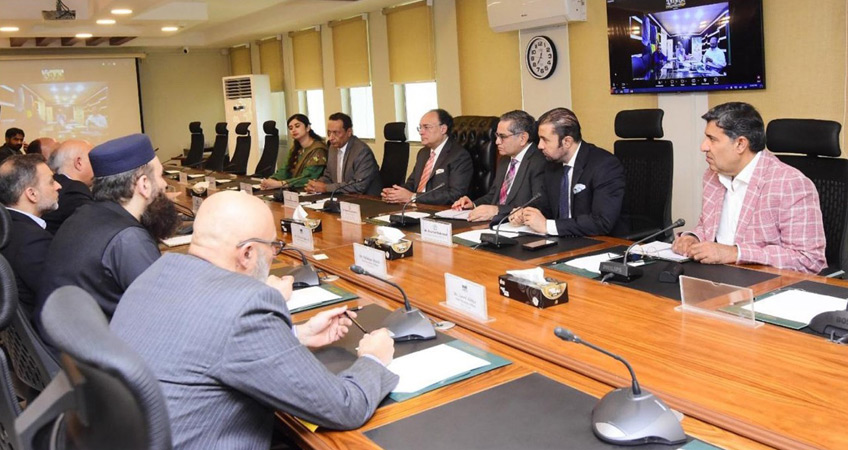
 Federal Minister for Finance and Revenue, Senator Muhammad Aurangzeb, held a virtual meeting on Wednesday with the Pakistan Banks’ Association (PBA), led by its Chairman Zafar Masud, along with presidents and senior leadership of leading banks across the country.
The discussion focused on the evolving economic and financial situation in light of prevailing regional developments and the importance of close coordination between the government, the State Bank of Pakistan, and the banking sector to ensure financial stability and uninterrupted financial services, said a press release. During the meeting, the Finance Minister briefed participants on the government’s ongoing monitoring of the situation and the steps being taken to assess its potential economic implications. He shared that the government has established a high-level coordination mechanism comprising key economic ministries and relevant institutions to review developments on a continuous basis.
The forum is closely examining developments in global markets, particularly in relation to supply chains and energy markets, while assessing their potential impact on key macroeconomic indicators.
Senator Aurangzeb informed the participants that the government is undertaking regular scenario analysis to evaluate possible implications for inflation, external accounts, and broader economic stability.
He emphasized that the authorities remain focused on ensuring continuity of essential supplies and maintaining macroeconomic stability while responding to developments in a timely and prudent manner. He further noted that the government remains engaged with relevant stakeholders and international partners as part of its efforts to safeguard the country’s economic interests.
The Finance Minister highlighted the importance of coordinated decision-making and close engagement with key sectors of the economy during periods of uncertainty. In this regard, he appreciated the role of the financial sector in maintaining confidence and ensuring the smooth functioning of financial markets. He encouraged the banking industry to continue supporting businesses and customers while maintaining responsible risk management practices. He also underscored the importance of operational resilience and effective communication within the financial sector to ensure uninterrupted financial services.
Senator Aurangzeb reaffirmed the government’s commitment to maintaining open channels of communication with the banking industry and other stakeholders. He assured participants that the government will continue to work closely with the State Bank of Pakistan and the financial sector to respond to developments in a coordinated and timely manner. Separately, Aurangzeb met with a delegation of leading textile and apparel exporters and industry stakeholders led by Haroon Sharif, Chairman of the Pakistan Regional Economic Forum, to discuss measures aimed at strengthening export competitiveness, facilitating investment, and supporting industrial growth.
During the meeting, the Finance Minister emphasized that strengthening export-led sectors remains central to Pakistan’s economic revival strategy. He noted that enhancing productivity, encouraging innovation, and improving global competitiveness of Pakistan’s key industries are critical to expanding exports, creating employment opportunities, and sustaining long-term economic growth, said a release issued here. The Minister reaffirmed the Government’s commitment to maintaining close engagement with industry stakeholders to ensure that economic policies remain responsive to the needs of the business community while supporting sustainable and inclusive growth.
He observed that policy frameworks are being continuously refined to promote investment, facilitate reinvestment by established exporters, and remove procedural bottlenecks that hinder industrial expansion, while maintaining fiscal discipline and macroeconomic stability. Highlighting the importance of strengthening Pakistan’s competitive sectors, the Finance Minister stated that the Government recognizes the strategic role of export-oriented industries in driving economic activity and expanding the country’s presence in international markets. He emphasized that creating an enabling environment for exporters through improved policy coordination, regulatory facilitation, and investment promotion remains a key priority.