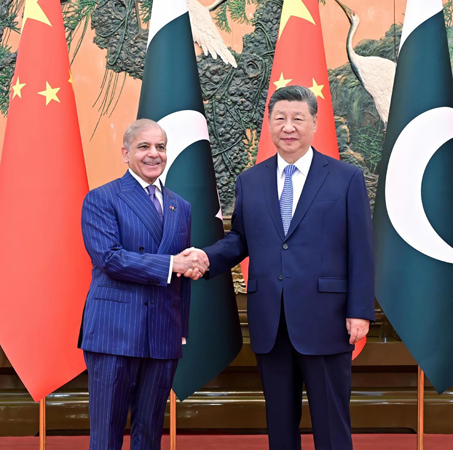
 Pakistan and China on Tuesday reiterating opposition to any unilateral actions, reaffirmed the significance of maintaining peace and stability in South Asia, and resolution of all outstanding disputes through dialogue and diplomacy including Jammu and Kashmir dispute, besides expressing readiness to conduct trans-boundary water resources cooperation.
The bilateral and regional ties were discussed during the four-day official visit of Prime Minister Shehbaz Sharif, at the invitation of Li Qiang, Premier of the State Council of the People’s Republic of China.
According to a joint statement issued on the conclusion of the prime minister’s visit, both sides agreed to tap into the potential for cooperation in such areas as economy and trade, energy, digital economy, finance, scientific and technological innovation, artificial intelligence, information and communication, water conservancy, marine affairs, among others, scale up personnel training, consult on advancing trade liberalization, and jointly safeguard the stability and security of industrial and supply chains.
The Pakistani side briefed the Chinese side on the latest developments in the situation in Jammu and Kashmir. “The Chinese side reiterated that the Jammu and Kashmir dispute is left over from history, and should be properly and peacefully resolved in accordance with the U.N. Charter, relevant U.N. Security Council resolutions and bilateral agreements.”
According to the statement, the two sides expressed readiness to conduct trans-boundary water resources cooperation under the principle of equality and mutual benefit. The significance of the maintenance of international and regional security and stability was reiterated.
Mentioning the successful holding of the informal talks among China, Afghanistan and Pakistan in Urumqi on the issue of Afghanistan, both sides stressed on the need of not allowing any individual, group or party, including the Tehreek-e-Taliban Pakistan (TTP), the Eastern Turkistan Islamic Movement (ETIM) etc., to use the territories to harm and threaten regional security and interests, or conduct terrorist actions and activities.
During the visit, Prime Minister Shehbaz met with Chinese President Xi Jinping and Premier Li Qiang, and reached a new broad consensus on further deepening the China-Pakistan All-Weather Strategic Cooperative Partnership and on international and regional issues of mutual interest.
Both sides reiterated the commitment to unswervingly safeguard and develop their bilateral relations, maintain high-level exchanges, deepen mutual trust, practical cooperation, defense and security cooperation, and keep close coordination on international and regional issues, to better harness this relationship to the benefit of the two peoples and contribute to peace, stability and prosperity in the region and the world.
Both sides agreed to further strengthen strategic dialogue and enhance exchanges at various levels to continue deepening political mutual trust and jointly keep China-Pakistan relations in the right direction.
The two sides reaffirmed their unyielding support for each other on issues concerning their respective core interests. They stressed that the authority of the U.N. General Assembly Resolution 2758 brooks no question or challenge.
Pakistan reaffirmed its strong commitment to the one-China principle, and holds the view that Taiwan is an inalienable part of the territory of the People’s Republic of China and the Taiwan question is at the core of China’s core interests.
“Pakistan firmly supports all efforts by China to achieve national reunification and resolutely opposes any form of “Taiwan independence.” Pakistan firmly supports China’s just stance on issues concerning Xinjiang, Xizang, Hong Kong and the South China Sea. China reiterated its unwavering support for Pakistan in defending its national sovereignty, independence, and territorial integrity, and firmly supports Pakistan’s efforts to safeguard its national security, stability, development and prosperity,” the statement added.
China congratulated Pakistani leaders on leading the country to achieve macroeconomic stability centered on Pakistan’s National Economic Transformation Plan (2024-2029) (URAAN Pakistan).
Both sides agreed to advance high-quality Belt and Road cooperation, hold the meeting of the China-Pakistan Economic Corridor Joint Cooperation Committee (JCC) , and promote the high-quality development of the upgraded version of CPEC 2.0.
Both sides welcomed third parties to participate in the development of CPEC under the model agreed upon by China and Pakistan.
The Chinese side stands ready to work with the Pakistani side to fully implement the GSI, establish the China-Pakistan Security Partnership, conduct continued bilateral and multilateral counter-terrorism cooperation, and strengthen military-to-military cooperation, so as to further play a positive role in promoting regional peace and stability.
The Pakistani side will take targeted steps to strengthen security measures and cooperation to ensure the safety of Chinese personnel, projects and institutions in Pakistan.
“China supports Pakistan in its continued and firm fight against terrorism. Both sides called on the international community to enhance counter-terrorism cooperation, and reaffirmed their firm opposition to applying double standards on counter-terrorism or to politicizing and instrumentalize counter-terrorism.”
The Chinese side also commended Pakistan’s various initiatives for strengthening multilateralism, peaceful resolution of disputes, and regional cooperation under its U.N. Security Council Presidency in July 2025.
Both sides reiterated early implementation of the five-point initiative for restoring peace and stability in the Gulf and Middle East region and expressed their readiness to jointly make positive contributions for the early restoration of peace and stability in the region.