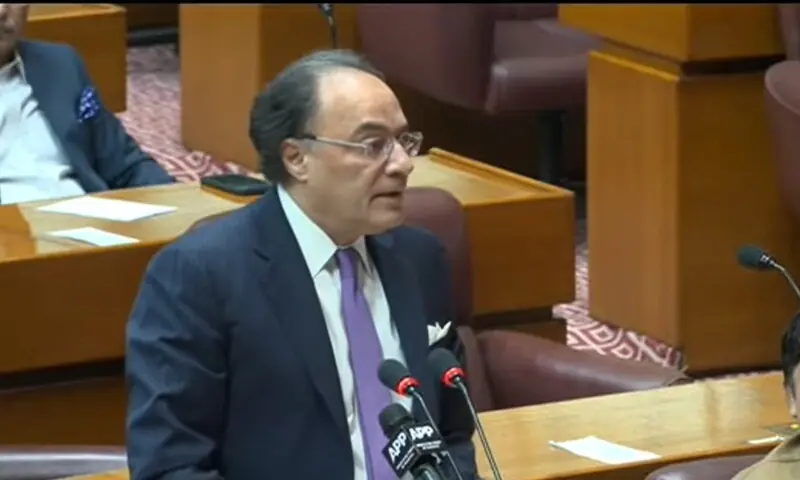
Finance Minister Muhammad Aurangzeb on Saturday said the proposed federal budget for fiscal year 2026-27 (FY27) would provide the foundation for accelerating the sustainable economic growth achieved over the past two years.
Wrapping up the budget debate in the National Assembly, Aurangzeb described the budget as a positive and pro-growth document that had received encouraging feedback from both lawmakers and stakeholders outside parliament.
He said the government’s primary objective was to achieve sustainable, inclusive and export-led growth by increasing productivity and expanding economic activity. According to the minister, the budget seeks to broaden the tax base rather than impose additional burdens on existing taxpayers.
Aurangzeb maintained that relief measures had been introduced for the salaried class, small businesses, exporters and industrialists, while efforts were being made to ensure greater fairness in the taxation system. He highlighted the introduction of the Fixed Asaan Tax Scheme as part of the government’s strategy to bring more individuals and businesses into the formal tax net.
وفاقی وزیر برائے خزانہ و محصولات، سینیٹر محمد اورنگزیب نے بجٹ پر عمومی بحث کو سمیٹتے ہوئے مالی سال 2025-26 کے لیے قومی اسمبلی کیلئے مختص بجٹ میں سے وزیراعظم پاکستان کی کفایت شعاری مہم کے تحت 5 ارب روپے کی خطیر بچت کو قابلِ تحسین اقدام قرار دیتے ہوئے اسپیکر قومی اسمبلی سردار ایاز… pic.twitter.com/OrPCb1Sz2y
— National Assembly 🇵🇰 (@NAofPakistan) June 20, 2026
The finance minister also outlined ongoing reforms in tax administration, noting that tax policy had been separated from tax collection functions. He said a new operating model would rely heavily on automation and digitisation, reducing direct interaction between taxpayers and tax officials to improve transparency and minimise discretionary powers.
Defending the Federal Board of Revenue’s performance, Aurangzeb said the government had generated an additional $14 billion in revenues during the past two years, a figure he compared favourably with revenue growth achieved over previous decades.
On agriculture, which he described as the backbone of Pakistan’s economy, the minister highlighted several initiatives aimed at supporting farmers. These include interest-free loans for small farmers under the Zarkhez scheme, subsidies under the Prime Minister’s Youth Business and Agriculture Loan Scheme, and financial support to stabilise fertiliser prices.
He said the budget also allocates funds for agricultural development programmes, modernisation of farming equipment and the establishment of cold-storage infrastructure in partnership with the private sector. Aurangzeb added that agricultural cooperation with China was being expanded through training programmes and knowledge-sharing initiatives.
قومی اسمبلی کے بجٹ اجلاس 2026-27 کے دوران وفاقی وزیر برائے خزانہ و محصولات سینیٹر محمد اورنگزیب کا بجٹ 2026-27 پر عمومی بحث کو سمیٹتے ہوئے اظہار خیال #BudgetSession@Financegovpk pic.twitter.com/m9PGUbX75A
— National Assembly 🇵🇰 (@NAofPakistan) June 20, 2026
The minister further noted that the budget includes tax relief for salaried individuals, pay and pension increases for government employees, reduced taxes on life-saving medicines and the abolition of taxes on sanitary pads and contraceptives.
Addressing concerns raised by some lawmakers regarding economic indicators, Aurangzeb insisted that no changes had been made to the methodology used to calculate GDP growth, per capita income and other key statistics. He said Pakistan’s nominal GDP had increased from $408.2 billion in FY25 to $452.1 billion in FY26.
Concluding his speech, Aurangzeb stressed that national consensus remained essential for sustaining economic recovery and long-term development.