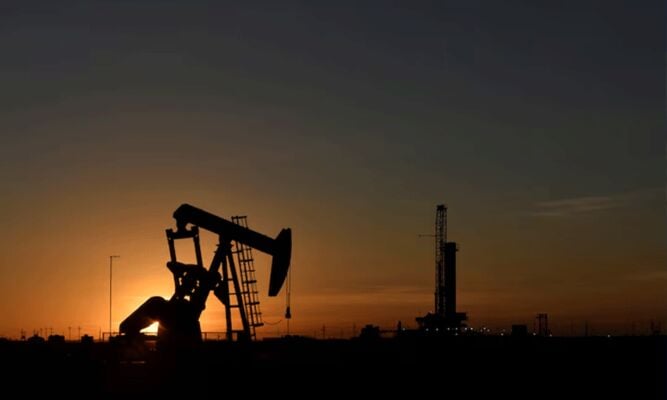
Escalating tensions between the United States and Iran have pushed global oil prices to their highest levels in several months, while stock markets around the world faced selling pressure amid growing concerns over energy supply disruptions.
Read More: Petroleum prices likely to rise in next review
Oil prices surged by nearly 4 per cent on Friday, with investors reacting to renewed military exchanges between Washington and Tehran and fears that the conflict could further expand across the Middle East.
The international benchmark Brent crude rose by $3.10, or 3.68 per cent, reaching $87.33 per barrel, marking its highest level in recent months. Meanwhile, US benchmark West Texas Intermediate (WTI) increased by $3.14, or 3.98 per cent, to $82.09 per barrel.
Other energy benchmarks also recorded gains, with Murban crude rising nearly 3.91 per cent to $80.77 per barrel and WTI Midland increasing to $81.81 per barrel.
Market analysts said traders were adding a geopolitical risk premium to oil prices due to concerns that further escalation could threaten supplies passing through the Strait of Hormuz, a key global oil route that handles a significant share of international crude shipments.
The rise in oil prices also spread across the wider energy market. US gasoline futures increased by 3.86 per cent, while European natural gas prices and Asian LNG benchmarks also recorded gains.
Global equity markets reacted negatively as investors moved away from riskier assets and turned towards safer investments. Wall Street opened lower, with major indices including the S&P 500, Nasdaq Composite and Dow Jones Industrial Average trading in negative territory.
European markets also declined, with Germany’s DAX and France’s CAC 40 falling amid concerns that higher energy costs could weaken economic recovery. However, energy companies benefited from rising crude prices, with major oil firms seeing gains.
Asian markets, including Japan’s Nikkei 225, South Korea’s Kospi and Chinese indices, also faced pressure as investors assessed the economic impact of higher energy costs.
Read More: Oil prices climb as Middle East tensions intensify
For Pakistan, the increase in global oil prices poses additional economic challenges due to heavy reliance on imported petroleum. Analysts warned that sustained prices near $90 per barrel could increase the import bill, widen the current account deficit, accelerate inflation and put pressure on the rupee and public finances.